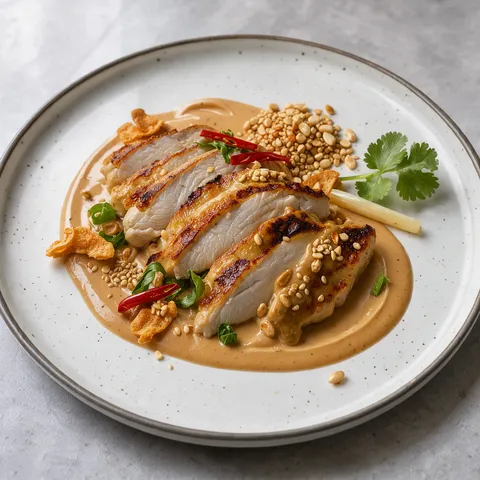
Nkatenkwan 2.0
A Ghanaian soup. Takes 1 hr 10 min, Serves 4. Difficulty: challenging.
At a glance
- Total time
- 1 hr 10 min
- Serves
- Serves 4
- Difficulty
- Challenging
- Cuisine
- Ghanaian cuisine
- Dish type
- Soup
- Diet
- Gluten-free
- Allergens
- Peanuts, Tree nuts, Celery
Ingredients
Chicken
- 4 skin-on boneless chicken thighs (about 640 g in total)
- 7 g salt
- 1 cm piece of ginger (finely grated)
Peanut velouté
- 150 g raw shelled peanuts
- 1 onion (finely chopped)
- 2 ripe tomatoes (roughly chopped)
- 1/2 scotch bonnet chilli (deseeded)
- 2 cm piece of ginger
- 2 garlic cloves
- 700 ml Chicken Stock (Basics)
- 1 tsp tomato paste
- 1 tbsp sunflower oil
- 1 tsp lemon juice
- salt
Omo tuo crisps
- 150 g short-grain rice
- 400 ml water
- 1/2 tsp salt
- 40 g rice flour
- oil for frying (about 700 ml)
Red palm oil
- 50 ml red palm oil
- 1/4 scotch bonnet chilli (finely chopped)
- 1 cm piece of ginger (thinly sliced)
Pickle
- 1 red onion
- 80 ml cider vinegar
- 80 ml water
- 1 tbsp sugar
- 1/2 tsp salt
To finish
- 30 g roasted peanuts (roughly crushed, from the peanuts above)
- African basil or fresh basil leaves
- flaky salt
Equipment
- Chef's knife
- Chopping board
- Heavy-based saucepan
- Frying pan
- Wooden spoon / spatula
- Fine sieve / chinois
- Blender
- Mandoline
- Probe thermometer
- Baking tray
- Oven
- Fine grater
- Baking paper
- Cast-iron frying pan
Method
- Roast the peanuts: Preheat the oven to 170°C. Spread the peanuts on a baking tray and roast for 12 min until golden brown inside. Rub with a cloth to remove the skins and roughly crush 30 g for the finish. Roasting gives the velouté the depth of the freshly ground peanuts of classic nkatenkwan
- Make the pickle: While the peanuts are in the oven, slice the red onion into 2 mm rings on a mandoline. Bring the vinegar, water, sugar and salt to the boil, pour over the onion and leave for at least 30 min. These pink rings will be the acid that cuts the heavy oil of the peanuts. Takes 5 min
- Cook the velouté base: In a heavy-based pan heat the oil, soften the onion over medium heat for 5 min, fry the ginger, garlic and chilli for 1 min and the tomato paste for 1 min, add the tomatoes and cook for 3 min. Add the chicken stock and the rest of the roasted peanuts and simmer over low heat for 15 min. Blend for 2 min, until completely smooth, and pass through a fine sieve back into the pan. The consistency should coat the back of a spoon thinly, and if thick loosen with chicken stock. Takes 27 min in total
- Cook and shape the omo tuo: At the same time as the velouté, cook the rice with 400 ml water and the salt, covered, over the lowest heat for 18 min, until all the water is absorbed and the rice is very soft. Mash with a wooden spoon for 2 min into a sticky dough. With damp hands, shape 12 balls of 3 cm, arrange on a tray and chill in the fridge for 10 min to firm up. The rice balls of the classic dish are fried here, to become crisp-shelled, soft-centred morsels
- Salt the chicken: Dry the skin of the chicken thighs thoroughly with kitchen paper. Rub the salt and ginger on the flesh side and sprinkle only a pinch of salt on the skin side. Dry skin crisps, while wet skin steams in the pan and stays rubbery
- Cook the chicken: Arrange the thighs skin side down in a cold cast-iron pan and turn the heat to medium. Press with baking paper and a heavy saucepan on top so the skin touches the pan completely. Cook for 10-12 min until the skin is deep golden and glassy-crisp, then turn and cook for 4-5 min more. A thermometer should read an internal temperature of 74°C. Transfer to a board skin side up and rest for 5 min
- Infuse the palm oil: While the chicken cooks, warm the palm oil, chilli and ginger in a small pan to 60°C, take off the heat and steep for 10 min. Do not strain: pieces of chilli will fall onto the plate with the drops. If the oil gets too hot it loses its orange colour
- Fry the omo tuo: Heat the frying oil in a deep pan to 180°C. Roll the rice balls in the rice flour and fry for 3 min, until the outside is golden and crisp, then drain on kitchen paper and sprinkle with flaky salt. The rice flour coating is lighter and crunchier than a floury crust. Takes 6 min
- Finish the velouté: Bring the velouté up to the boil, adjust with the lemon juice and salt. Lemon is not in the classic soup, but it brightens the sweetness of the peanuts. Transfer to a jug for serving
- Slice the chicken: With a sharp knife, cut the thighs skin side up into 3 thick slices, drawing the knife in one movement so the skin does not crack
- Plate: Fan the chicken slices skin side up on one side of a warm, wide-rimmed deep plate. Place three omo tuo crisps opposite like a triangle. Put the pickled rings over the slices of chicken, scatter the crushed peanuts into the empty parts of the plate and add a few basil leaves. Pour the velouté at the table from the jug between the chicken and the omo tuo, around them so the crisps do not get soaked. Let orange drops of palm oil fall over the velouté and serve straight away
Chef's note
All the elements of the classic can be recognised: peanut, chicken, hot pepper and rice ball. What changes is the textures: the soup is now a silky velouté, the chicken a crisp-skinned thigh, the omo tuo a crunchy-shelled morsel, and the palm oil a glossy final touch on the surface. Pouring the velouté at the table keeps the omo tuo crisp. Inspired by the goat version of the classic, it can also be made with lamb chops.
Frequently asked questions
- How does the chicken skin get glass-crisp?
- Arrange the thighs skin-side down in a cold cast-iron pan and press them down with baking paper and a heavy pot. Cook for 10 to 12 minutes.
- How are the omo tuo crisps made?
- Cook the rice with the lid on and mash it for 2 minutes into a sticky dough. Shape 3 cm balls with damp hands, chill for 10 minutes, coat in rice flour and fry in 180°C oil for 3 minutes.
- Why is lemon added to the veloute?
- Lemon juice is added as a touch to brighten the sweetness of the peanuts. It is an innovation that isn't in the classic soup.
 Nkatenkwan and Omo Tuo1 hr 25 min · Soup
 Ghanaian Rice and Black-Eyed Beans1 hr 15 min · Main course
 Ghanaian Tomato and Chicken Soup1 hr 10 min · Soup
 Ghanaian Spiced Fried Plantain35 min · Starter
 Kelewele 2.055 min · Starter
 Taro Leaves with Melon Seed1 hr 15 min · Main course
 Okro Stew and Banku1 hr 5 min · Main course