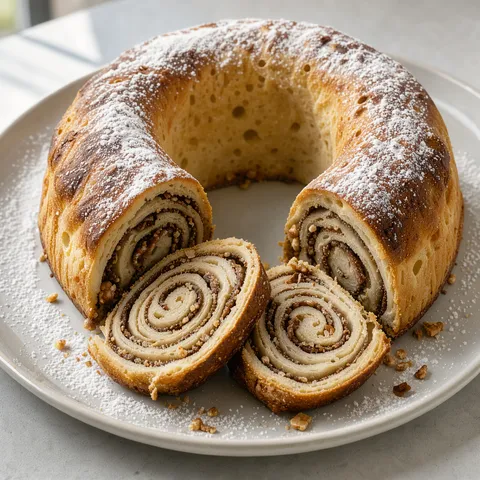
Slovenian Walnut Roll Yeast Cake Orehova Potica
A Slovenian patisserie. Takes 3 hr 45 min · +1 hr cooling, Serves 4. Difficulty: challenging.
At a glance
- Total time
- 3 hr 45 min · +1 hr cooling
- Serves
- Serves 4
- Difficulty
- Challenging
- Cuisine
- Slovenian cuisine
- Dish type
- Patisserie
- Allergens
- Gluten, Milk, Eggs, Tree nuts
Ingredients
Dough
- 500 g plain flour
- 7 g fast-action dried yeast
- 60 g sugar
- 1/2 tsp salt
- 250 ml lukewarm milk
- 2 egg yolks
- 1 egg
- 80 g butter (melted and cooled slightly)
- grated zest of 1 lemon
Filling
- 400 g walnuts (shelled)
- 200 ml milk
- 150 g sugar
- 60 g honey
- 50 g butter
- 1 tsp ground cinnamon
- grated zest of 1 orange
- 2 tbsp rum
- 2 egg whites
For the tin and top
- 15 g butter (for the tin)
- 1 egg yolk
- 1 tbsp milk
To serve
- 1 tbsp icing sugar
Equipment
- Mixing bowls
- Food processor
- Saucepan
- Balloon whisk
- Silicone spatula
- Cake tin
- Pastry brush
- Rolling pin / oklava
- Oven
- Baking paper
- Bread knife
- Fine grater
- Stand mixer (optional)
Method
- Knead the dough: Mix the flour, yeast, sugar, salt and lemon zest in a large bowl. Add the lukewarm milk, egg yolks, egg and melted butter. Knead with the dough hook of a stand mixer on medium speed, or by hand, for 10 min, until the dough is smooth, glossy and comes away from the sides of the bowl. It should be soft but easy to handle
- First prove: Cover the bowl and leave in a warm place for 1 hr, until the dough has doubled in size
- Cook the filling: While the dough proves, process the walnuts in a food processor for 1 min to a fine, sandy flour, stopping before they release oil and turn into a paste. Bring the milk, sugar, honey and butter to the boil in a pan, add the walnuts and cinnamon and stir for 2 min. Take off the heat, fold in the orange zest and rum and leave for 20 min, until lukewarm. A hot filling would melt the dough
- Whisk the egg whites: Whisk the egg whites in a clean bowl for 2-3 min to soft peaks and fold into the lukewarm walnut filling in two additions with a spatula. The whites lighten the filling and help it rise as it bakes. It should be a spreadable cream consistency
- Prepare the tin: Grease a 26 cm (about 3 litre) kugelhopf tin thoroughly with butter, brushing it into the grooves too
- Roll out the dough: Knock back the risen dough, put it on a large floured work surface and roll out with a rolling pin to a 50×60 cm rectangle about 3 mm thick. Thinly rolled dough gives many fine spirals in each slice, and the beauty of a potica is in this spiral
- Fill and roll: Spread the filling over the dough with a spatula in an even, thin layer, leaving a 1 cm gap at the edges. Starting from a long edge, roll up tightly, pulling slightly as you roll to avoid air pockets. Form the roll into a ring with the ends meeting, place it in the tin with the seam on top and press the ends together
- Second prove and preheat: Cover the tin and leave to prove for 45 min, until the roll comes within 1-2 cm of the top of the tin. Preheat the oven to 175°C (conventional) for the last 20 min. Whisk the egg yolk with the milk, brush over the surface and prick the surface in 6-8 places with a cocktail stick, so air bubbles do not leave a gap between filling and dough
- Bake: Bake on the bottom shelf of the oven for 60 min. When the surface is deep golden at 30 min, cover with baking paper so it does not burn. The sign it is done: a skewer pushed into the centre should come out dry and the tin should sound hollow when tapped
- Cool and slice: Rest in the tin for 15 min, then turn out onto a wire rack or board and cool for at least 1 hr. If cut while hot, the filling will squash. Dust with icing sugar and cut into 2 cm slices with a bread knife
Chef's note
Potica is a yeast cake identified with Slovenian holiday tables, especially Easter and Christmas, and counted among the symbols of the country. The walnut version is the most common, though tarragon, poppy seed, honey and fresh curd cheese fillings are also common in Slovenia. It is traditionally baked in an earthenware mould called a "potičnik", with fluted sides and a hole in the middle, and a kugelhopf tin gives the same shape. If you prefer to leave out the rum, add the same amount of milk. Baked potica stays fresh for 4-5 days in a lidded container.
Frequently asked questions
- Why is the walnut filling cooled slightly?
- A hot filling melts the dough. So take the filling off the heat and wait 20 minutes until lukewarm.
- Why is the dough rolled out thin?
- Dough rolled thin gives many fine spirals in each slice, and that spiral is the beauty of potica.
- Can potica be sliced while hot?
- If cut while hot, the filling squashes. Rest it in the tin, turn it out, cool for at least 1 hour and then slice with a bread knife.
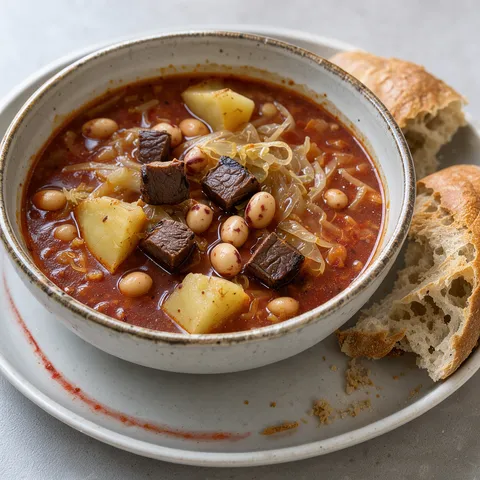 Karst Sauerkraut and Bean Soup2 hr 5 min · Soup
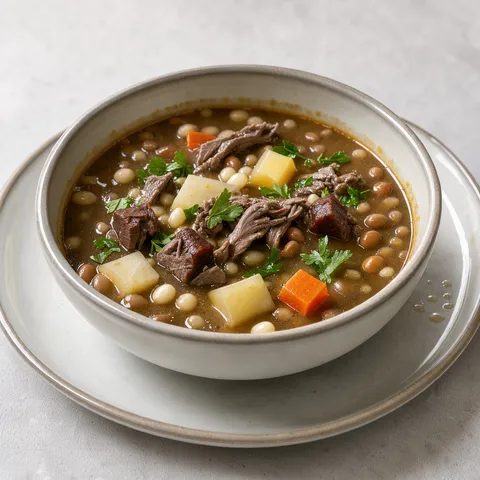 Slovenian Barley and Bean Stew2 hr 5 min · Main course
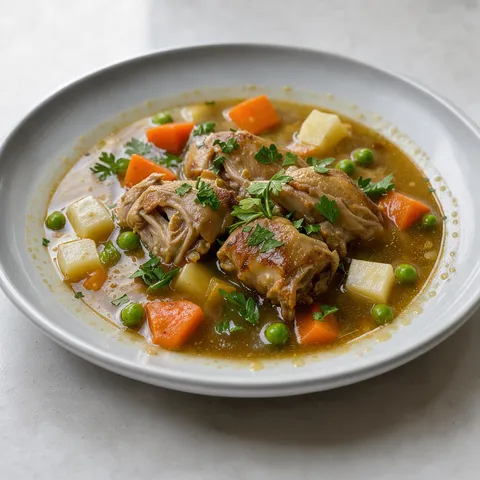 Slovenian Thick Chicken Stew1 hr 25 min · Main course
 Slovenian Buckwheat Flour Clumps1 hr · Side dish
 Potato Dumplings2 hr · Main course
 Bela Krajina Caraway Yeast Bread1 hr 10 min · Bread & pastry