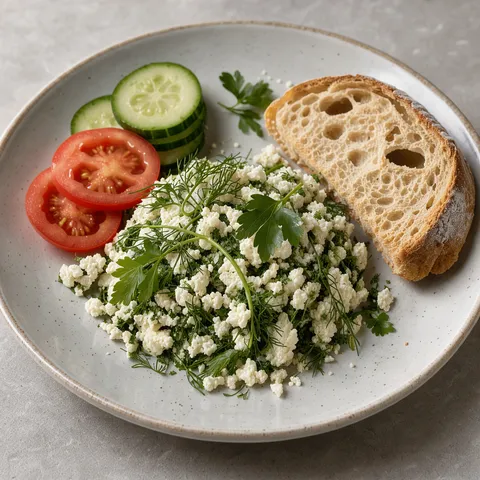
Whey Curd with Fresh Herbs and Village Bread Otlu Lor
A Turkish breakfast. Takes 1 hr 1 min · +2 days 10 min resting, 4 servings (about 200 g lor). Difficulty: medium.
At a glance
- Total time
- 1 hr 1 min · +2 days 10 min resting
- Serves
- 4 servings (about 200 g lor)
- Difficulty
- Medium
- Cuisine
- Turkish cuisine
- Dish type
- Breakfast
- Diet
- Vegetarian
- Allergens
- Gluten, Milk
Ingredients
Whey
- about 10 litres fresh
- rennet-set whey from Turkish white cheese (from a cheesemaker or left over from white cheese made at home with 10 litres of milk, as whey from milk curdled with vinegar or lemon is not suitable)
Herb mix
- 15 g mixed fresh herbs (dill, parsley, fresh thyme or wild garlic)
- 1 tsp fine salt (about 6 g)
To serve
- 4 slices of village bread
- 2 tomatoes
- 1 cucumber
Equipment
- Saucepan
- Colander
- Muslin
- Ladle
- Chef's knife
- Chopping board
- Mixing bowls
- Probe thermometer (optional)
- Precision scales (optional)
Method
- Heat the whey: Bring about 10 litres of fresh whey left over from cheesemaking to 90°C in a wide pan of at least 15 litres over medium heat, stirring occasionally so it does not catch. Whey proteins coagulate with heat, so use the whey straight after the cheese has been drained, as whey that is left to stand turns sour and the yield drops. If you have no thermometer, stop just before boiling, when white threadlike pieces appear on the surface and steam rises (~35 min)
- Let the curd float: Turn off the heat and leave for 10 min without stirring. The white proteins rise to the surface in a thin layer and the whey underneath clears. If you stir, the grains break up and escape through the muslin (waiting, 10 min)
- Collect the curd: Lift the white layer from the surface with a fine slotted spoon into a colander lined with a double layer of muslin and leave for 5 min to drain. The greenish liquid left underneath is the whey that has done its job and is thrown away. About 200 g of curd from 10 litres of whey is normal, a yield of about 2% (~8 min)
- Rest for 24 hr: Transfer the curd in the muslin to a clean lidded container and keep it in the fridge (at 4°C or below) for 24 hr. The entry asks for the coagulated protein to be kept in a cool place for 24 hr, and in a home kitchen the cool place is the fridge, and cold storage is also essential for food safety. In this time the fresh curd cheese firms up and takes on its slightly sour character (waiting, 24 hr)
- Drain in muslin: The next day, put the curd in clean double muslin, tie the ends tightly and hang it over a colander with a bowl underneath, or put a small plate and a light weight on top, and drain in the fridge for 24 hr. The entry gives draining as 1-4 days, and the shortest time, 1 day, was chosen for this recipe, so extend it to 2-3 days for a more crumbly, drier fresh curd cheese. Draining joins the grains of the fresh curd cheese, removes the excess liquid and gives a firm, spreadable texture (~5 min, then waiting, 24 hr)
- Prepare the herbs: When the draining is done, chop 15 g of the herbs (about 7% of the weight of the fresh curd cheese) very finely. If wild garlic (sirmo) or sov cannot be found, dill, parsley and fresh thyme are enough. Fresh herbs speckle the fresh curd cheese green and freshen the sourness (~5 min)
- Salt and mix: Weigh the drained fresh curd cheese (it should come to about 200 g), put it in a bowl, mash with a fork, add 1 tsp (6 g) of fine salt and the chopped herbs and mix for 2 min. The entry gives a salt ratio of 2-8% and a herb ratio of 2-10%, which here works out at 3% salt and about 7% herbs. Add half the salt first and taste, then add the rest (~4 min)
- Plate: Slice the tomatoes and cucumber. Put the fresh curd cheese on 4 plates in mounds of about 50 g, make a slight hollow in the middle and arrange the vegetables and a slice of village bread alongside. Serve cold or at room temperature (~4 min)
Chef's note
Van fresh curd cheese, or lorik (Turkish whey cheese), according to the entry in the Culture Portal's Van Traditional Foods Inventory, is made by boiling whey, keeping the coagulated protein in a cool place for 24 hr, draining it in muslin and flavouring it with salt and herbs (sirmo, sov, thyme, parsley, dill), and it is eaten at breakfast (https://www.kulturportali.gov.tr/turkiye/van/neyenir/fresh curd cheese-lork). The order in the entry was followed here and no milk was added. There are two home adaptations: the fridge in place of a cool place and 1 day of draining in place of 1-4 days. About 200 g of fresh curd cheese comes from 10 litres of whey, and you can get the whey from a cheesemaker or make rennet-set white cheese from 10 litres of milk and use the whey left over. Lorik does not form in the whey of milk curdled with vinegar or lemon. The product is a crumbly, slightly sour, dense fresh curd cheese. Waiting and draining must be done at 4°C or below, and the fresh curd cheese keeps for 3 days in the fridge.
Frequently asked questions
- What kind of whey is needed for Whey Curd?
- Use fresh whey from white cheese set with rennet. Whey from milk curdled with vinegar or lemon is not suitable.
- Why is the whey used straight away?
- Whey that stands turns sour and the yield drops.
- How can I make the whey curd drier and more crumbly?
- In this recipe it drains for 1 day, the shortest time. For a drier, more crumbly curd, extend the draining to 2-3 days.
 Chilled Wheat Yoghurt Soup1 hr · Soup
 Noodle and Yoghurt Soup1 hr 10 min · Soup
 Lamb, Chickpea and Potato Stew1 hr 15 min · Soup
 Marinated Sea Bass30 min · Meze
 Crispy Fried Liver Slices25 min · Meze
 Courgette Crisps30 min · Meze