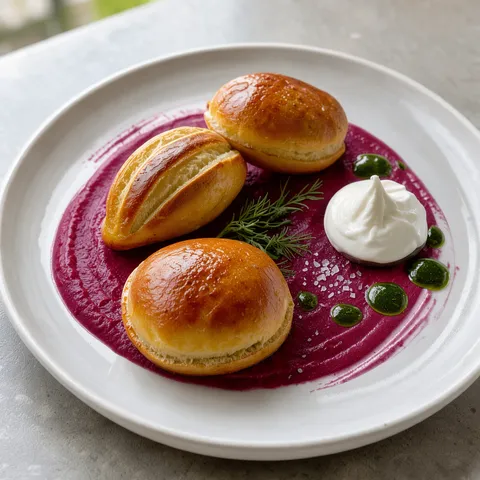
Pampushky 2.0
An Ukrainian bread & pastry. Takes 1 hr 20 min, 12 pieces (4 servings). Difficulty: challenging.
At a glance
- Total time
- 1 hr 20 min
- Serves
- 12 pieces (4 servings)
- Difficulty
- Challenging
- Cuisine
- Ukrainian cuisine
- Dish type
- Bread & pastry
- Allergens
- Gluten, Milk, Eggs
Ingredients
Dough
- 300 g plain flour
- 8 g fast-action dried yeast
- 1 tsp sugar
- 1 tsp salt
- 150 ml lukewarm milk (37-40°C)
- 1 egg
- 30 ml sunflower oil
- 1 tsp sunflower oil (for the bowl)
Filling
- 120 g fresh curd cheese
- 2 tbsp dill (finely chopped)
- 1 garlic clove (grated)
- 1/4 tsp salt
- 1/4 tsp black pepper
- 1 tbsp plain flour
Garlic oil
- 5 garlic cloves (thinly sliced)
- 70 ml sunflower oil
- 1/4 tsp salt
Beetroot cream
- 250 g beetroot (peeled, cut into 2 cm cubes)
- 150 ml water
- 1/2 tsp salt (for cooking)
- 80 g soured cream
- 1 tbsp cider vinegar
- 1/2 tsp salt
- a pinch of black pepper
Dill oil
- 25 g dill (8 tips reserved for garnish)
- 70 ml sunflower oil
For the top
- 1 egg yolk
- 1 tbsp milk
To serve
- 60 g soured cream
- a pinch of flaky salt
Equipment
- Mixing bowls
- Dough scraper
- Pressure cooker
- Colander
- Frying pan
- Muslin
- Blender
- Baking tray
- Baking paper
- Pastry brush
- Oven
- Chef's knife
- Chopping board
- Probe thermometer (optional)
- Stand mixer (optional)
- Squeezy bottle (optional)
Method
- Knead the dough: Mix the flour, yeast, sugar and salt in a large bowl. Make a well in the centre and add 150 ml lukewarm milk, checked with a thermometer at 37-40°C, the egg and 30 ml oil: hotter milk kills the yeast. Bring together by hand first, then knead with the dough hook of a stand mixer on medium speed for 6 min, or by hand on the work surface for 8-10 min, until the dough is smooth, elastic and slightly sticky. If a small piece stretched out becomes thin enough to let light through, the gluten has developed
- First prove: Put the dough in a bowl greased with 1 tsp oil, cover and leave in a warm place for 25 min, until it has risen by 1.5 times. With this much yeast, that is long enough. Meanwhile, do the preparation below in parallel: no more than 2 hob rings will be on at once
- Pressure-cook the beetroot: Peel the beetroot, cut into 2 cm cubes and put in the pressure cooker with 150 ml water and 1/2 tsp salt. Close the lid and, once steam starts to escape, cook over low heat for 8 min. Then take the cooker off the heat and release the pressure over 2 min by letting the steam out gradually through the valve. The tip of a knife should slide into the beetroot easily. Beetroot stains hands and boards, so wear gloves if needed
- Fry the garlic oil: Put 70 ml oil and the sliced garlic into a small cold frying pan and heat over low heat for 6-8 min, until the slices turn light golden. Garlic turns bitter if it darkens, so take it off the heat while still light golden and tip it straight into a bowl with its oil: hot oil left in the pan keeps on frying it. Add the salt and set aside
- Make the filling: Put the curd cheese in fine muslin, leave to drain for 5 min and squeeze gently: excess liquid makes the filling watery. In a bowl, mix the curd cheese, dill, grated garlic, salt, pepper and 1 tbsp flour with a fork. It should be a paste that holds on a spoon and keeps its shape. Divide into 12 equal pieces (about 10 g, the size of a walnut), roll into balls with wet hands and put on a plate
- Blend the beetroot cream: Drain the cooked beetroot in a colander, reserving 50 ml of the cooking liquid. Put the beetroot in a blender and add the soured cream, vinegar, 1/2 tsp salt, pepper and 40 ml of the cooking liquid. Blend on the highest speed for 1.5 min until completely smooth and a vivid fuchsia. It should coat the back of a spoon: if it's too thick, add 1 tbsp of the remaining cooking liquid. Leave in a bowl at room temperature
- Make the dill oil: Set aside 8 fine dill tips for garnish. Blend the rest with 70 ml sunflower oil on the highest speed for 2 min, until the oil turns dark green and warms slightly. Let it drip through muslin into a bowl for 10 min without pressing, or it turns cloudy. Transfer to a squeeze bottle
- Shape and fill: Gently knock back the risen dough and divide into 12 equal pieces (about 45 g) with a dough scraper. Flatten each piece in your palm, put a ball of filling in the centre, bring the edges together in the middle and pinch the seam tightly shut. Turn seam side down and roll under your cupped palm on the work surface in a circular motion into a taut ball. If the seam is open, the filling leaks during baking. Arrange on a tray lined with baking paper, with 2 cm gaps between them
- Second prove and oven: Cover the rolls and prove for 15 min until puffy. At the same time, preheat the oven to 210°C (conventional). Beat the egg yolk with the milk and brush gently over the rolls with a pastry brush, taking care not to deflate them
- Bake: Put the tray on the middle shelf and bake for 14-16 min until the rolls are deep golden. The internal temperature should be 94-96°C on a thermometer, or they should sound hollow when tapped underneath. Small rolls burn quickly, so keep an eye on them for the last 3 min
- Brush and plate: As soon as the rolls come out of the oven, brush them with the garlic oil using a pastry brush: the hot dough soaks up the oil and the garlic mellows. Spread 3 tbsp beetroot cream in a wide circle in the centre of each warmed plate with the back of a spoon. Place 3 hot pampushky on top and 15 g soured cream alongside. Dot 6-8 drops of dill oil on and around the cream, add the dill tips and sprinkle with a pinch of flaky salt. Serve immediately
Chef's note
The elements of pampushky served alongside borscht have been taken apart and rebuilt here: the garlic has gone from a raw paste on the surface of the roll to a golden garlic oil mellowed in fat, the dill has become a bright green oil and the beetroot of the borscht a vivid cream, while a garlicky curd cheese filling has gone inside the roll. Thanks to plenty of yeast and small rolls, the dish is ready in under 1.5 hr. If you can't find curd cheese, use fresh strained cheese or ricotta. The rolls are best hot, but can be refreshed the next day by warming in the oven for 3-4 min.
Frequently asked questions
- How do I stop the cheese filling leaking from the rolls?
- Bring the edges together in the middle and pinch the seam tightly shut, then turn seam side down and shape into a ball. If the seam is open, the filling leaks out while baking.
- How do I stop the garlic oil turning bitter?
- Heat the garlic in cold oil over a low heat and take it off the heat when light golden. It turns bitter if it darkens. Pour it into a bowl straight away, since hot oil left in the pan keeps frying.
- Why is the curd cheese drained for the filling?
- Drain it in muslin for 5 minutes and squeeze lightly, since excess water thins the filling. It should be a paste that holds its shape on a spoon.
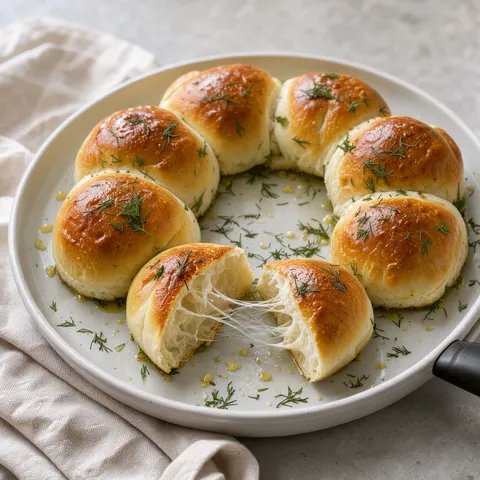 Ukrainian Garlic and Dill Bread Rolls2 hr 30 min · Bread & pastry
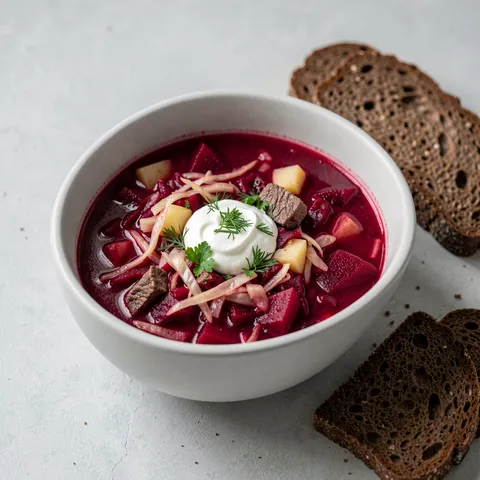 Borscht2 hr 15 min · Soup
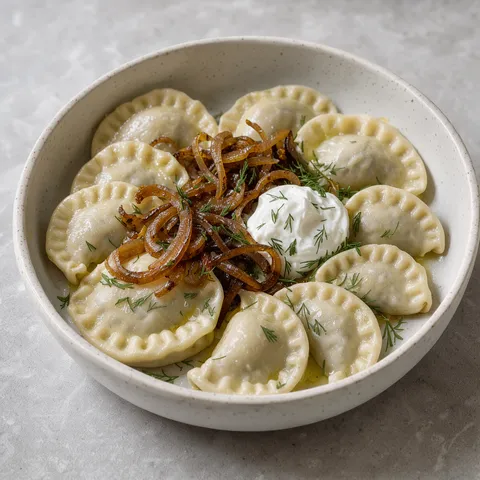 Varenyky1 hr 45 min · Bread & pastry
 Chicken Kyiv1 hr 15 min · Main course
 Syrnyky40 min · Dessert
 Borscht 2.01 hr 25 min · Soup
 Ukrainian Christmas Eve Wheat Berry Pudding1 hr 10 min · Dessert