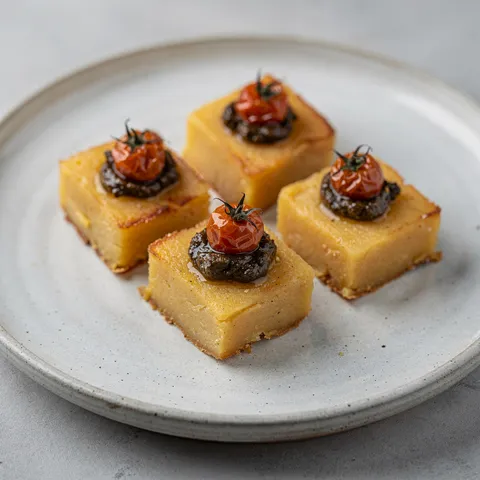
Panisse Fried Chickpea Flour Cubes
A French meze. Takes 57 min · +45 min cooling and setting, Makes 36. Difficulty: medium.
At a glance
- Total time
- 57 min · +45 min cooling and setting
- Serves
- Makes 36
- Difficulty
- Medium
- Cuisine
- French cuisine
- Dish type
- Meze
- Diet
- Gluten-free
- Allergens
- Fish
Ingredients
- Panisse (36 pieces, about 18 g each, 3×3×2 cm): 140 g chickpea flour
- 560 ml water
- 30 ml olive oil
- 1 tsp fine salt
- 1 litre neutral oil (for frying)
Tomato confit (36 halves)
- 18 cherry tomatoes
- 2 tbsp olive oil
- 1 tsp sugar
- 1/2 tsp salt
- 3 thyme sprigs. Tapenade (about 150 g, 4 g per piece): 100 g pitted black olives
- 20 g capers
- 2 salted anchovy fillets
- 1 garlic clove
- 40 ml olive oil
- 1 tsp finely grated lemon zest
To finish
- 36 basil leaves
- flaky salt
Equipment
- Saucepan
- Heavy-based saucepan
- Probe thermometer
- Balloon whisk
- Wooden spoon / spatula
- Silicone spatula
- Cake tin
- Baking paper
- Baking tray
- Oven
- Food processor
- Colander
- Chef's knife
Method
- Roast the tomatoes: Preheat the oven to 120°C. Halve the cherry tomatoes and arrange cut side up on a tray lined with baking paper. Add the olive oil, sugar, salt and thyme. Roast for 40 min, until curled and slightly dry but still holding their shape. Low heat evaporates the juice slowly and concentrates the sweetness. This time runs in parallel with the other work
- Whisk the chickpea flour: Put the cold water in a saucepan, sift in the chickpea flour and whisk until lump-free. Cold water stops the flour clumping, whereas hot water makes lumps. Add the olive oil and salt
- Cook the panisse batter: Heat the pan over medium heat, stirring. For the first 4 min it stays liquid and then suddenly thickens. Over low heat, keep stirring from the bottom with a wooden spoon instead of a whisk for 6 min. It is ready when the mixture comes away from the sides of the pan, a spoon stands upright and it no longer tastes of raw flour. An undercooked batter falls apart when fried
- Pour into the tin: Line an 18×18 cm square tin with baking paper. Pour in the hot batter, level with a spatula to 2 cm thick and press baking paper onto the surface. The paper stops a skin forming. Rest at room temperature for 15 min, then in the fridge for 30 min. Once completely cool, it is firm and can be cut
- Blend the tapenade: While it rests, pulse the olives, capers, anchovies, garlic and lemon zest in a food processor for 15 sec, and add the olive oil with the motor running. The consistency should be a coarse, rough, oily paste, as a smooth paste would drown the taste of the anchovy
- Cut into cubes: Turn the cooled panisse block out of the tin and cut into 3×3 cm squares, 36 pieces in total. Wipe the knife after each cut. Each cube is about 18 g and 2 cm high
- Fry: Heat the oil in a pan to 180°C (use a thermometer). Fry the cubes in four batches of 9 for 3 min, until the crust is golden and crisp and the inside soft and creamy. If the heat drops the cubes absorb oil, and if it rises the outside burns while the inside stays raw. Lift out with a slotted spoon, blot the oil with kitchen paper and sprinkle with flaky salt at once
- Assemble the canapés: Put 4 g of tapenade on each hot cube, place half a confit tomato on top and finish with a basil leaf. The cubes begin to lose their crispness within 5 min, so assemble at the last moment
Chef's note
Serve hot. Allow 4 per person, ×11 for 100 people (396 pieces). The panisse block is made 2 days ahead and kept in the fridge, and fried on the day of serving. The tapenade and tomato confit are prepared 2 days ahead. Panisse is a street snack in Marseille, and here it takes the place of toasted bread.
Frequently asked questions
- Why is the chickpea flour whisked into cold water?
- Cold water stops the flour clumping, while hot water makes lumps. Sift the flour in and whisk until smooth.
- How can I tell the panisse mixture is cooked?
- It is ready when it comes away from the sides of the pan, a spoon stands upright in it and it no longer tastes of raw flour. Undercooked mixture falls apart when fried.
- Why is panisse chilled before cutting?
- Once fully cold, the mixture is firm enough to cut. Let the poured mixture set at room temperature first, then chill it in the fridge.
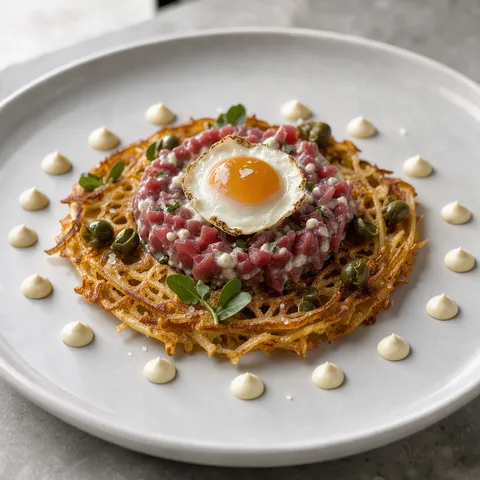 Tuna Tartare, Potato Rösti Disc, Quail's Egg55 min · Starter
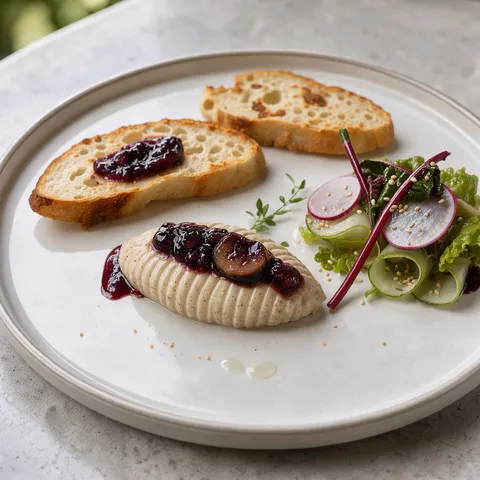 Duck Rillettes, Fig Jam, Crunchy Crostini, Pickle Salad1 hr 30 min · Starter
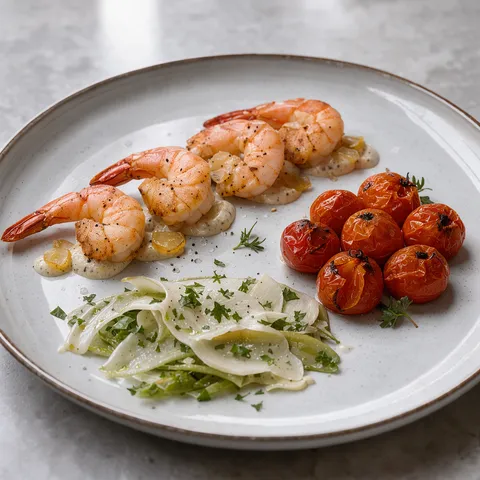 Prawns, Garlic Confit Aioli, Charred Tomatoes, Fennel Salad35 min · Starter
 Beetroot Carpaccio, Goat's Cheese Mousse, Walnuts1 hr · Starter
 Honey Mustard Chicken, Potato Gratin, Asparagus1 hr 30 min · Main course
 Beef Fillet, Red Wine Sauce, Pommes Purée1 hr 10 min · Main course