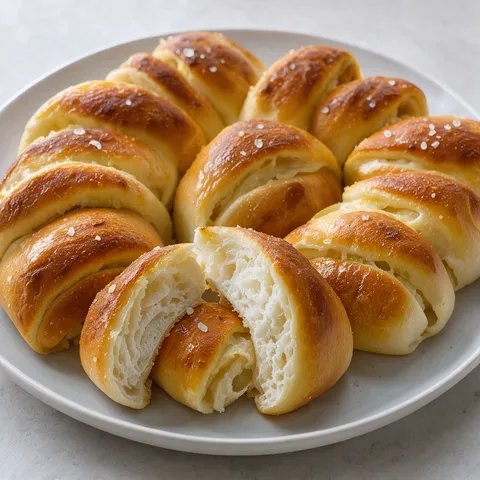
Boston Buttered Folded Rolls Parker House Rolls
An American bread & pastry. Takes 1 hr 10 min · +1 hr 30 min rising, Serves 4. Difficulty: challenging.
At a glance
- Total time
- 1 hr 10 min · +1 hr 30 min rising
- Serves
- Serves 4
- Difficulty
- Challenging
- Cuisine
- American cuisine
- Dish type
- Bread & pastry
- Allergens
- Gluten, Milk, Eggs
Ingredients
Dough
- 400 g plain flour
- 7 g fast-action dried yeast
- 30 g sugar (1 tsp of it for the yeast)
- 1 tsp salt
- 220 ml lukewarm milk
- 1 egg
- 50 g soft butter (+ 1 tsp for the bowl)
For brushing
- 60 g butter (melted, 30 g for folding, 30 g after baking)
Topping
- 1/2 tsp flaky sea salt
Equipment
- Stand mixer
- Mixing bowls
- Cling film
- Precision scales
- Rolling pin / oklava
- Wooden spoon / spatula
- Pastry brush
- Baking tray
- Baking paper
- Oven
- Probe thermometer (optional)
Method
- Activate the yeast: Heat the milk to 37°C, mix in 1 tsp of the sugar and the yeast and leave for 5 min. Foam should form on the surface
- Knead the dough: Put the flour, remaining sugar and salt in the bowl of a stand mixer and add the yeasted milk and the egg. Mix with the dough hook on low speed for 2 min, add the soft butter and knead on medium speed for 6-7 min. The dough should be soft, slightly damp but leaving the bowl, and glossy. A soft dough gives these rolls their cloud-like crumb, so do not firm it up by adding flour
- First prove: Put the dough in an oiled bowl, cover with cling film and prove in a warm place for 1 hr, until doubled in size
- Divide and roll: Knock back the dough on the worktop and weigh it. It comes to about 760 g. Divide into 16 pieces of about 47 g each. Rub each piece against the worktop under the palm of your hand into a tight ball, cover with cling film and rest for 10 min so it does not spring back when rolled out
- Shape: Roll each ball with a rolling pin into an oval of 10×7 cm. Press the handle of a wooden spoon along the middle of the oval, parallel to the long edge, to make a deep crease. Brush some of the melted butter over the surface with a pastry brush and fold the oval along the crease, leaving the top half 1 cm shorter than the bottom. Press the edge down lightly. The layer of butter in between keeps the two halves apart as it bakes, and the roll becomes like a pocket that opens by hand
- Arrange and prove: Line a 23×33 cm tin with baking paper. Arrange the rolls in 4 rows with the folded edges facing the same way, each overlapping the one before by half. Cover with cling film and prove for 30 min, until clearly puffed. Preheat the oven to 190°C for the last 15 min
- Bake: Bake on the middle shelf for 16-18 min, until the tops are deep golden and the internal temperature reaches 90°C
- Finish with butter and salt: As soon as they come out of the oven, brush the remaining melted butter generously over the hot rolls and sprinkle with the flaky salt. Let cool in the tin for 5 min and serve hot
Chef's note
Parker House rolls are said to have been born in the bakery of the Parker House hotel in Boston in the 1870s, and to have taken their name from the hotel. The folded shape also gave them the American name pocketbook roll. The rolls are served at festive tables, especially at Thanksgiving, with turkey and gravy. The next day they refresh when heated in a 160°C oven wrapped in foil for 8 min. Makes 16.
Frequently asked questions
- Why should the dough stay soft, and should I add flour to firm it up?
- No. A soft, slightly moist dough that is glossy and pulls away from the bowl gives the cloud-like crumb. Adding flour spoils that texture.
- What does creasing the middle with a wooden spoon handle and brushing with butter do?
- The layer of melted butter between the folded oval keeps the two halves apart while baking. That way the roll opens like a pocket by hand.
- How do I know the yeast is alive?
- After warming the milk to 37°C, mixing the yeast with a teaspoon of sugar and waiting 5 minutes, the surface should foam. If there's no foam, check before continuing with the yeasted milk.
 New England Clam Chowder1 hr 15 min · Soup
 Louisiana Prawn and Okra Gumbo2 hr 15 min · Soup
 Southern Fried Chicken1 hr 35 min · Main course
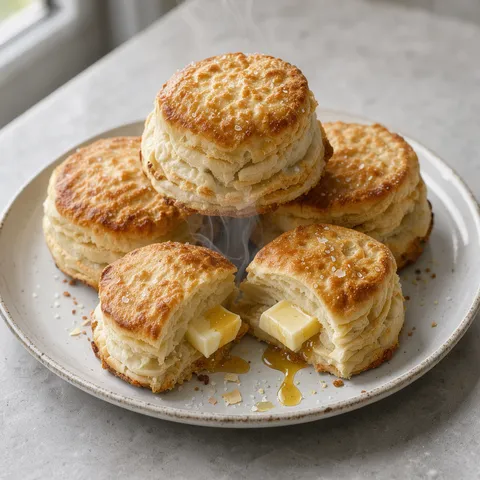 Flaky Southern Scones50 min · Bread & pastry
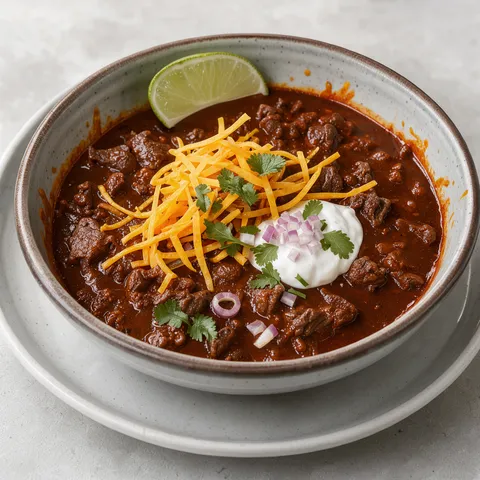 Bean-Free Chili con Carne3 hr · Main course
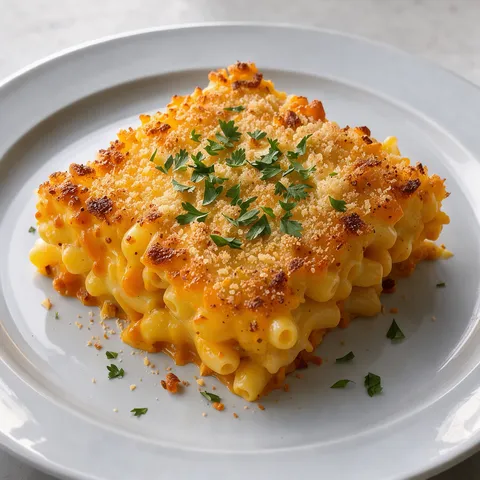 Baked Cheddar Macaroni55 min · Main course