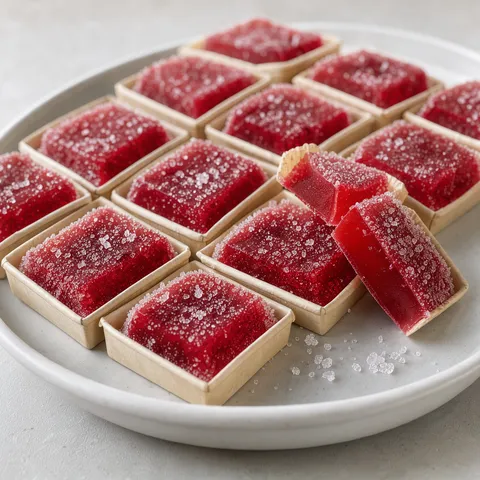
Sugar-Coated Raspberry Fruit Jellies Pâte de Fruits
A French meze. Takes 39 min · +13 hr standing, Makes 24. Difficulty: medium.
At a glance
- Total time
- 39 min · +13 hr standing
- Serves
- Makes 24
- Difficulty
- Medium
- Cuisine
- French cuisine
- Dish type
- Meze
- Diet
- Vegetarian, Vegan, Gluten-free
- Allergens
- Contains none of the 14 listed allergens
Ingredients
- Jelly (24 pieces, 4×2.5×0.9 cm, about 12.5 g each, about 300 g in total, 16×15 cm tin): 200 g raspberry purée (300 g thawed frozen raspberries, pushed through a fine sieve and the seeds discarded)
- 180 g caster sugar (20 g mixed with the pectin, 160 g added later)
- 20 g glucose syrup or invert sugar syrup
- 5 g yellow pectin (pectine jaune, HM, not NH, from specialist pastry suppliers)
- 2 tsp (10 g) lemon juice
Coating
- 60 g caster sugar
- 24 small paper cases
Tin
- 16×15 cm
- small tin lined with baking paper
Equipment
- Heavy-based saucepan
- Sugar thermometer
- Fine sieve / chinois
- Mixing bowls
- Silicone spatula
- Baking paper
- Chef's knife
- Chopping board
- Precision scales
- Baking tray
Method
- Prepare the purée: Push the thawed raspberries through a fine sieve with pressure to separate the seeds, and you need 200 g purée. The purée must be smooth, without the hardness of the seeds, because the jelly should be translucent and glossy. Line the tin with baking paper and grease it (~6 min)
- Separate the pectin: Mix the yellow pectin thoroughly with 20 g sugar in a bowl. Pectin added to liquid without sugar clumps, but mixed with sugar it disperses evenly. This mixture is sprinkled into the pan later (~3 min)
- Cook: In a small heavy-based pan of 16-18 cm (so that the thermometer tip can be immersed in the mixture), heat the purée and glucose to 40°C, then sprinkle in the pectin and sugar mixture, whisking, and bring to the boil. Add the remaining 160 g sugar and, stirring constantly, bring to 106°C on a sugar thermometer, which takes about 12 min. Skim off the foam with a spoon. Test for doneness: a spoonful of the mixture cooled on a plate drips heavily off the spoon and its surface wrinkles when pushed with a finger. Underboiled jelly is runny and overboiled jelly is hard. Take off the heat and whisk in the lemon juice. The mixture is very hot (106°C), so avoid splashes (~12 min)
- Pour into the tin: Pour the mixture into the tin straight away, level it with a spatula and spread it to an even thickness of about 0.9 cm. Meanwhile the cooked mixture starts to set, so work quickly and pop the bubbles with a cocktail stick (~4 min)
- Rest: Rest the jelly uncovered at room temperature for 1 hr so that it sets (the wait is listed separately in the time field). Test for doneness: the surface is firm and does not hold a mark when pressed with a finger. The fridge wets the surface of the jelly, so leave it at room temperature
- Cut and dry: Lift the jelly out with the paper onto a board and wet the knife. Cut into 24 rectangles of 4×2.5 cm using a 4×6 grid, wiping the knife after each cut. Each piece weighs about 12.5 g. If the knife sticks, dip it in water and cut again. Dry the pieces on a paper-lined tray, uncovered, for 6-12 hr (overnight), because the sugar coating melts unless the surface is dry (the wait is listed separately in the time field) (~6 min)
- Coat in sugar: Roll the pieces in caster sugar no more than 2-3 hr before serving and shake off the excess. The sugar bonds with the dried surface of the jelly and forms a glossy, lightly crisp coating. If coated too early, the sugar draws moisture and melts (~5 min)
- Serve: Arrange the pieces on a flat ceramic plate and place them in small paper cases. Serve at room temperature, and the pieces can stay on the plate for 2 hr (~3 min)
Chef's note
Serve at room temperature. Allow 2 per person, 96 people × 2 = 192 pieces. Because the recipe makes 24, the multiplier is 192/24 = 8, or 8.5 with 5% waste (1.7 kg raspberry purée, 2.05 kg caster sugar, 170 g glucose syrup or invert sugar syrup, 40 g yellow pectin (pectine jaune), 17 tsp lemon juice). It is entirely plant-based and gluten-free (pectin is plant-derived, so no gelatine is needed). Pâte de fruits is the classic fruit confection of French petit four and chocolate tables. This recipe uses classic yellow pectin (pectine jaune, HM): it is thermo-irreversible, so a jelly that has set does not melt when heated, which suits cutting and transporting. NH pectin, by contrast, melts when heated and suits nappage, and is not used here. Look for the product under the name pectine jaune at pastry suppliers. Before sugar coating, the dried jelly keeps for 2 weeks in a lidded container at room temperature, while a coated piece keeps in its case for up to 1 day, as the coating melts in a humid environment. 8.5 batches make 192 pieces (a single 40×60 cm tray or about 9 tins), and 1.7 kg of purée cannot be cooked at once, so split it into 5 batches of 15-18 min each. Dry the pieces overnight and coat on the morning of service.
Frequently asked questions
- Why is the pectin mixed with sugar first?
- Pectin clumps if added without sugar, but spreads evenly when mixed with it. Sprinkle this mix into the pan afterwards.
- Why is the jelly left at room temperature and not in the fridge?
- The fridge makes the surface of the jelly wet. Leave the jelly uncovered at room temperature and dry the pieces overnight afterwards.
- When is the sugar coating done?
- No more than 2 to 3 hours before serving. If coated too early the sugar draws in moisture and melts.
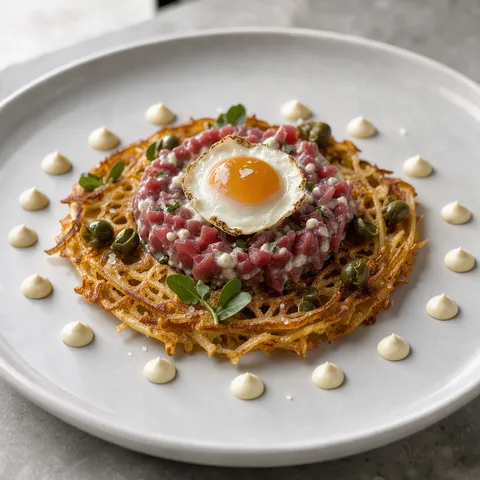 Tuna Tartare, Potato Rösti Disc, Quail's Egg55 min · Starter
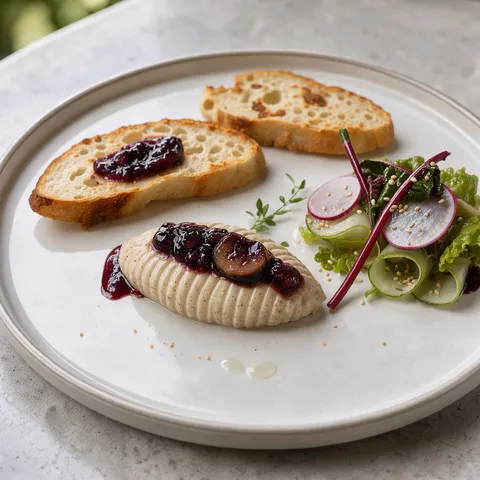 Duck Rillettes, Fig Jam, Crunchy Crostini, Pickle Salad1 hr 30 min · Starter
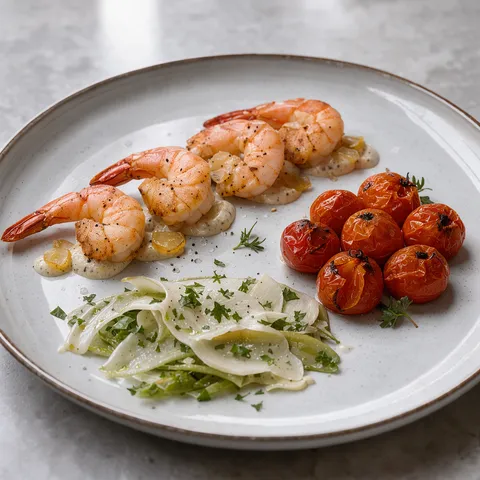 Prawns, Garlic Confit Aioli, Charred Tomatoes, Fennel Salad35 min · Starter
 Beetroot Carpaccio, Goat's Cheese Mousse, Walnuts1 hr · Starter
 Honey Mustard Chicken, Potato Gratin, Asparagus1 hr 30 min · Main course
 Beef Fillet, Red Wine Sauce, Pommes Purée1 hr 10 min · Main course