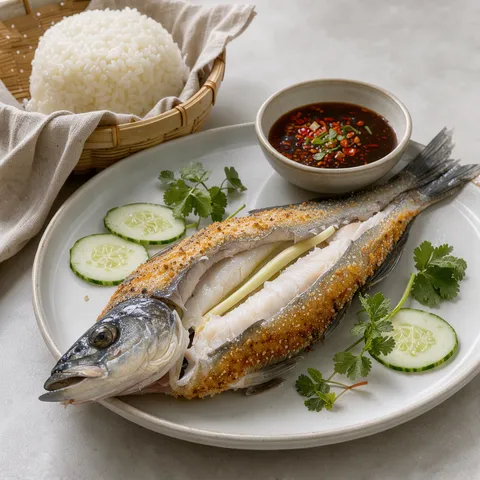
Salt-Crusted Sea Bass with Lemongrass Pla Pao
A Thai main course. Takes 1 hr 3 min, Serves 4. Difficulty: medium.
At a glance
- Total time
- 1 hr 3 min
- Serves
- Serves 4
- Difficulty
- Medium
- Cuisine
- Thai cuisine
- Dish type
- Main course
- Diet
- Gluten-free
- Allergens
- Eggs, Fish
Ingredients
Fish
- 2 whole sea bass (about 500 g each, cleaned)
- 3 lemongrass stalks (crushed)
- 4 garlic cloves (crushed)
- 1 handful coriander stalks
- 3 makrut lime leaves
Salt crust
- 1.2 kg coarse sea salt
- 3 egg whites
- 4 tbsp water
Nam jim jaew
- 2 tbsp fish sauce
- 3 tbsp lemon juice
- 1 tbsp palm sugar
- 1 tbsp toasted rice powder
- 1 tsp chilli flakes
- 2 tbsp chopped coriander
- 2 tbsp finely chopped shallot
To serve
- glutinous rice
- cucumber slices
- fresh herbs
Equipment
- Probe thermometer
- Oven
- Baking tray
- Baking paper
- Mixing bowls
Method
- Make the sauce: Put the fish sauce, lemon juice, sugar and chilli flakes in a small bowl and stir until the sugar dissolves. Add the toasted rice powder, shallot and coriander. The sauce rests while the fish bakes and the flavour settles (~4 min)
- Stuff the fish: Wash the fish and pat dry with kitchen paper. Stuff the belly cavities evenly with the crushed lemongrass, garlic, coriander stalks and lime leaves. The stuffing flavours the fish from the inside and the salt crust from the outside (~6 min)
- Prepare the salt crust: Preheat the oven to 220°C. Mix the salt, egg whites and water in a bowl until it sticks together like damp sand. The egg white binds the salt and the crust turns hard (~3 min)
- Build the crust: Line a tray with baking paper and spread a 1 cm layer of salt on it. Lay the fish on the salt and cover completely with the remaining salt except the tail and head, pressing down with your hands to pack it. If any air gap is left, the fish cooks dry (~6 min)
- Bake: Put the tray in the oven and bake for 30 min. The crust should harden and take a little colour. Push the tip of a probe thermometer through the crust into the thickest part of the fish. The internal temperature should reach 62°C. The salt crust steams the fish tender and keeps it moist (~30 min)
- Rest: Take the tray out of the oven and rest the fish for 5 min. During resting the heat spreads evenly through the fish and the flesh near the bone cooks through (~5 min)
- Crack the crust: Tap the salt crust with the handle of a spoon to crack it and lift off the pieces. Peel the skin off the fish and wipe off salt residue with kitchen paper. Salt left on the flesh makes the dish too salty (~3 min)
- Fillet: Separate the fish from the bone and take clean fillets from each side. Discard the lemongrass stuffing, because its fibre is not edible (~3 min)
- Plate: Put the fillets on a serving plate and arrange the bowl of sauce, cucumber slices and herbs alongside. Serve hot with glutinous rice. The pieces of fish are dipped in the sauce to eat (~3 min)
Chef's note
Pla pao is the Isan dish in which fish is stuffed with lemongrass, coated in salt and cooked over embers. Here a salt crust method suited to a home oven is used. Sea bream also works in place of sea bass. Fish sauce is a traditional ready-made product. When cracking the salt crust, do not let salt fall onto the fish.
Frequently asked questions
- What is pla pao?
- In Isan cooking it is fish stuffed with lemongrass, coated in salt and cooked over embers. It is eaten with a sour-hot sauce called nam jim jaew.
- How long does fish in a salt crust take to cook?
- A sea bass of about 500 g takes 30 minutes in a 220°C oven. It is ready when the internal temperature reaches 62°C.
- Does a salt crust make the fish too salty?
- No, the skin stops the salt getting in. After cracking the crust, just peel the skin from the fish and brush off any salt.
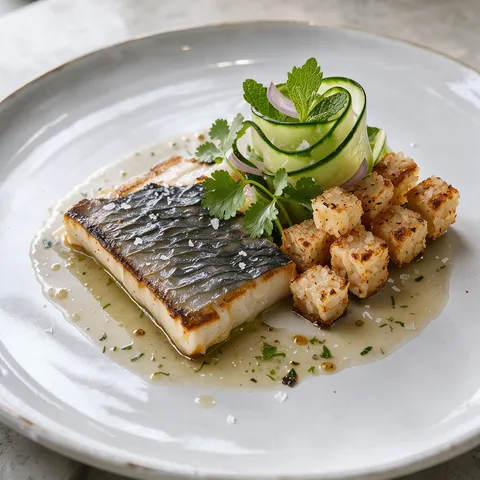 Salt-Crusted Sea Bass with Lemongrass 2.01 hr 4 min · Main course
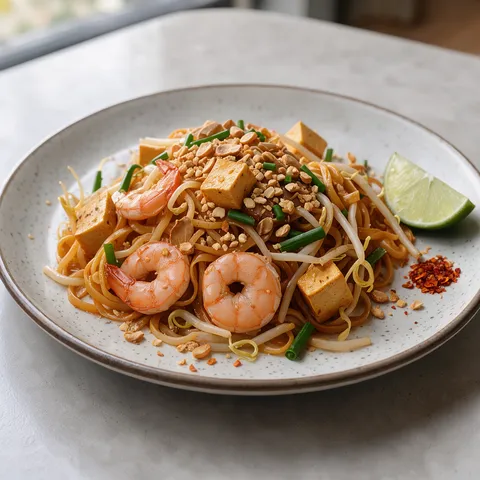 Pad Thai40 min · Main course
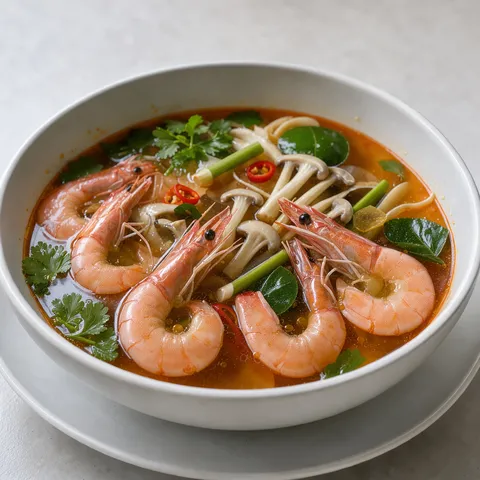 Hot and Sour Prawn Soup35 min · Soup
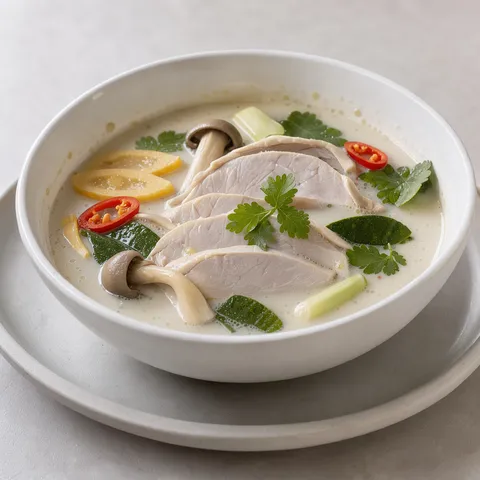 Thai Coconut Chicken Soup35 min · Soup
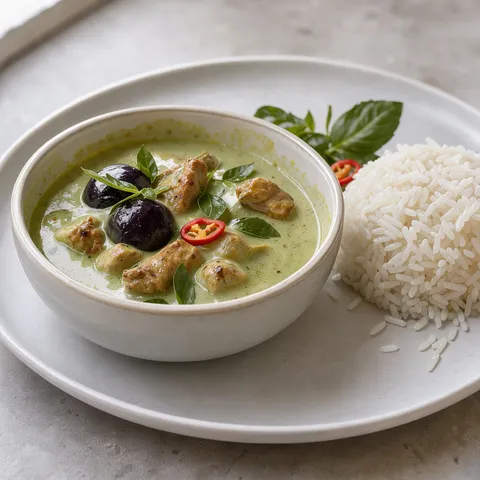 Green Curry40 min · Main course
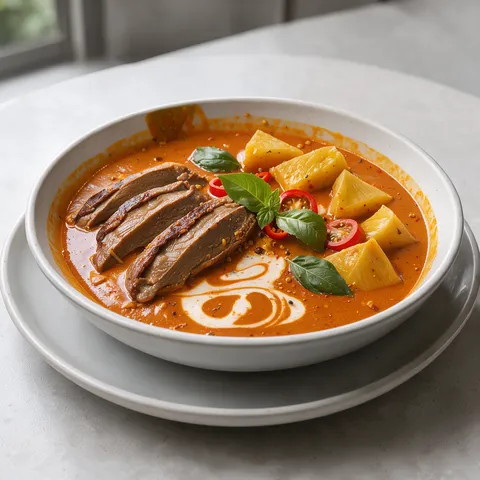 Red Curry with Duck and Pineapple40 min · Main course
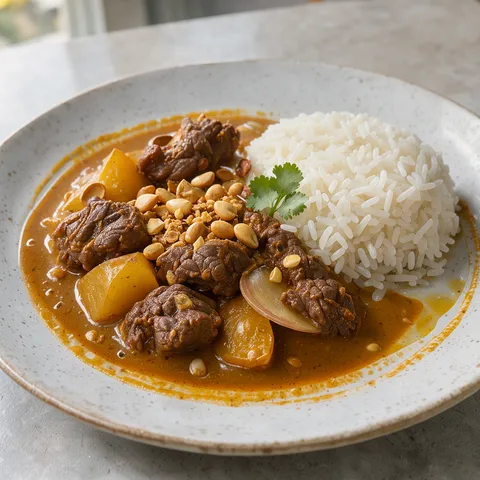 Massaman Curry1 hr 15 min · Main course