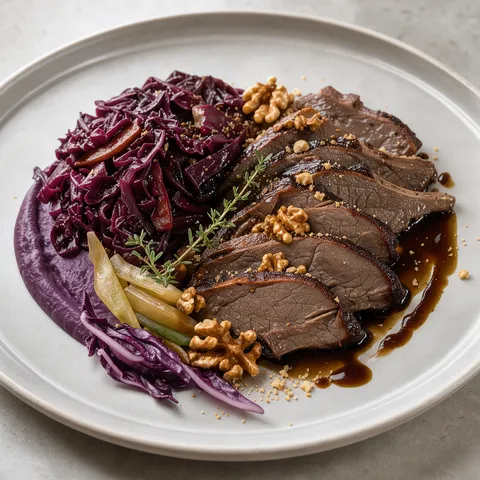
Rotkohl mit Apfel 2.0
A German main course. Takes 57 min, Serves 4. Difficulty: challenging.
At a glance
- Total time
- 57 min
- Serves
- Serves 4
- Difficulty
- Challenging
- Cuisine
- German cuisine
- Dish type
- Main course
- Diet
- Gluten-free
- Allergens
- Milk, Tree nuts, Celery, Sulphites
Ingredients
Lamb
- 600 g lamb loin (4 pieces)
- 1 tsp ground juniper (crushed)
- 1/2 tsp salt
- 1/4 tsp black pepper
- 20 g butter
- 2 thyme sprigs
- 1 garlic clove
Red cabbage purée
- 400 g red cabbage
- 1 small onion
- 1 tart apple
- 20 g butter
- 100 ml red wine
- 2 tbsp cider vinegar
- 1 tbsp honey
- 1 clove
- salt
Crisp cabbage
- 8 red cabbage leaves (inner leaves)
- 1 tbsp olive oil
- flaky salt
Apple and cabbage pickle
- 100 g red cabbage (thinly sliced)
- 1/2 green apple
- 3 tbsp cider vinegar
- 1 tbsp sugar
- 1/4 tsp salt
Lamb jus
- 200 ml Lamb Jus (Basics)
- 30 ml red wine
- 1 tsp honey
- 1 tsp cider vinegar
- 10 g cold butter
To finish
- 30 g toasted walnuts (coarsely broken)
- fresh thyme
Equipment
- Mandoline
- Oven
- Baking tray
- Baking paper
- Pressure cooker
- Colander
- Blender
- Fine sieve / chinois
- Saucepan
- Cast-iron frying pan
- Frying pan
- Probe thermometer
- Chef's knife
Method
- Make the pickle: Cut 100 g of the cabbage into 1 mm thin strips on a mandoline and cut the half apple into matchsticks. Mix the vinegar, sugar and salt, toss the cabbage and apple in it and rub with your hands for 1 min to soften, then cover loosely and leave. The acid plays a cleansing role between the hot, rich elements of the plate (5 min)
- Start the crisp cabbage: Preheat the oven to 130°C. Rub the cabbage leaves with oil, arrange in a single layer on a tray lined with baking paper and sprinkle with flaky salt. Dry in the oven for 25 min, until the edges curl and the leaves are crisp and still purple. A low temperature is essential for crispness, and they burn at a high heat (in parallel, no extra time)
- Cook the cabbage purée: Chop the remaining 400 g cabbage with a chef's knife, finely chop the onion, and peel and dice the apple. Melt the butter in the pressure cooker, fry the onion for 3 min, add the cabbage and apple and stir for 2 min. Add the wine, vinegar, honey, clove and 1 tsp salt, close the lid and cook for 12 min once the cooker reaches pressure. Let the pressure release naturally. The pressure cooker softens the vegetable fully and reduces colour loss (20 min)
- Prepare the lamb: Trim the excess fat and sinew from the edge of the lamb with a knife, rub with the juniper, salt and pepper and leave to rest. If the meat goes into the pan cold it releases water, so take it out of the fridge 15 min before cooking (in parallel, no extra time)
- Blend the purée: Drain the cabbage in a colander and keep the liquid. Blend the cabbage in a blender for 2 min, adding the liquid little by little. It should be a smooth cream that flows slowly from the spoon. Adjust the salt, pass through a fine sieve and keep warm. The purée is the base that carries the colour and body of the plate (6 min)
- Reduce the jus: In a small pan, boil the wine and honey for 2 min, until halved, add the lamb jus and boil for 4 min, until it coats the spoon. Take off the heat and whisk in the cold butter and vinegar (6 min)
- Sear the lamb: Foam the butter in a cast-iron pan over medium-high heat and add the lamb. Turn for 3 min on each side, until deep golden, add the garlic and thyme and baste the meat with the butter with a spoon for 1 min. Remove when the internal temperature on a thermometer is 55°C (8 min)
- Rest: Put the meat on a plate and rest uncovered for 5 min. During this time the internal temperature rises to 58-60°C and the juices redistribute. Cut diagonally into 1.5 cm slices with a sharp chef's knife (6 min)
- Warm the walnuts: Warm the walnuts in a dry pan for 2 min and crush coarsely (2 min)
- Plate: Put a spoonful of cabbage purée in the middle of a flat plate and spread it with the back of the spoon into a wide half-moon. Lean the lamb slices against the purée. Drain the pickle and pile it beside the slices. Drizzle the jus at the foot of the meat. Sprinkle with walnuts and fresh thyme and stand two crisp cabbage leaves on top (4 min)
Chef's note
The apple, clove and juniper balance of classic Rotkohl is gathered here in three textures: a silky purée, a crisp cabbage leaf and a fresh acidic pickle. As a surprise, the lamb brings the taste of German game cooking with juniper. If goose breast is used instead of lamb loin, it comes closer to the original German festive dish, but it is hard to find.
Frequently asked questions
- Why are the crisp cabbage leaves dried at a low temperature?
- Keeping the heat low is essential for crispness. At a high heat the leaves burn, so the oven is set to 130°C in this recipe.
- Why is the lamb taken out of the fridge before cooking?
- Meat that goes into the pan cold releases water. So take it out 15 minutes before cooking.
- What does the pickled cabbage do on the plate?
- The acid acts as a palate cleanser between the warm, rich elements on the plate. Drain the pickle and put it beside the lamb slices.
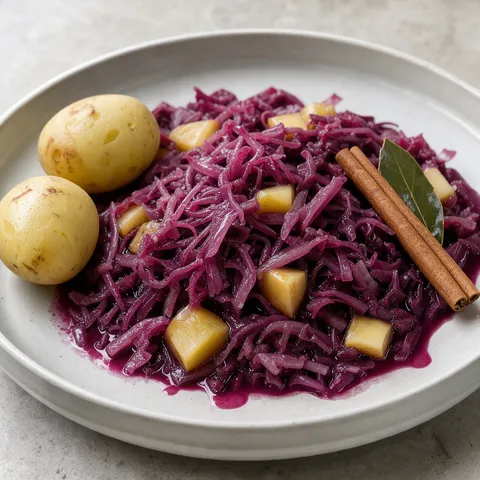 Braised Red Cabbage with Apple1 hr 5 min · Side dish
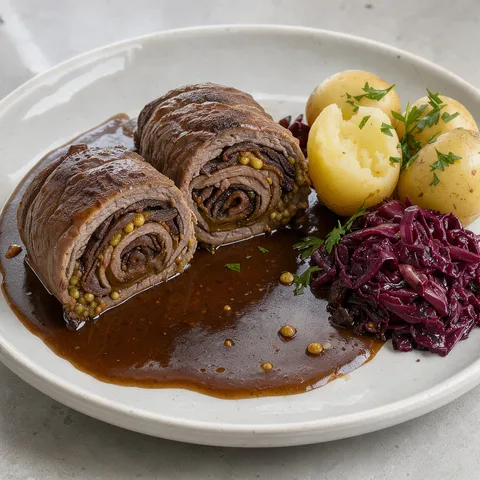 German Beef Roulades2 hr 30 min · Main course
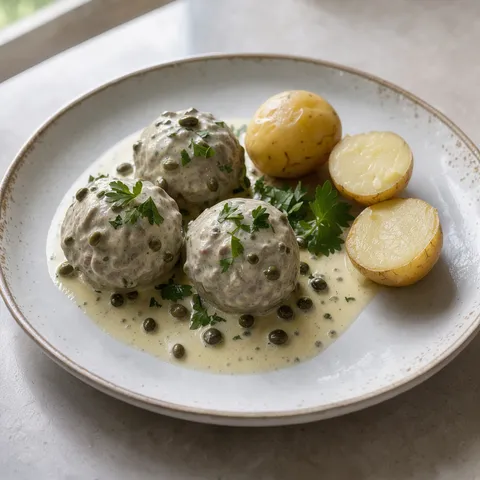 Meatballs in Caper Sauce1 hr 05 min · Main course
 Swabian Cheese Noodles55 min · Main course
 Swabian Potato Salad1 hr · Side dish
 Bavarian Pretzels1 hr 55 min · Bread & pastry
 Käsespätzle 2.01 hr 20 min · Main course