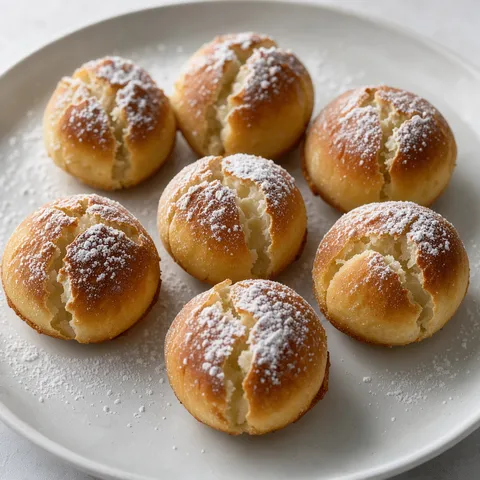
Okinawan Doughnut Balls Sata Andagi
A Japanese meze. Takes 49 min, Makes 24. Difficulty: medium.
At a glance
- Total time
- 49 min
- Serves
- Makes 24
- Difficulty
- Medium
- Cuisine
- Japanese cuisine
- Dish type
- Meze
- Diet
- Vegetarian
- Allergens
- Gluten, Milk, Eggs
Ingredients
- Dough (24 balls, about 22 g each, about 610 g): 300 g plain flour (low-protein pastry flour preferred)
- 2 tsp (8 g) baking powder
- 1/4 tsp salt
- 140 g light brown sugar (Okinawan kokuto sugar if available)
- 2 eggs (100 g)
- 2 tbsp (30 ml) sunflower oil
- 2 tbsp (30 ml) milk
Frying
- 2.5 litres sunflower oil (about 4 cm deep in a 28 cm pan)
To finish
- 3 tbsp (24 g) icing sugar
Equipment
- Mixing bowls
- Silicone spatula
- Precision scales
- Baking paper
- Heavy-based saucepan
- Probe thermometer
- Colander
- Fine sieve / chinois
Method
- Whisk the wet mixture: Whisk the eggs and light brown sugar in a bowl for 2 min, until the sugar melts and the mixture turns pale, add the oil and milk and whisk for 30 sec more. If the sugar does not dissolve well, dark specks remain on the surface of the balls (~4 min)
- Combine the dough: Sift the flour, baking powder and salt over the wet mixture and fold with a spatula for 1 min, until no dry flour remains. The dough should be dark, sticky and cling to the spoon, and should not form a neat ball. Overmixed dough develops gluten, the balls turn tough and do not puff and crack (~4 min)
- Heat the oil and rest the dough: Heat 2.5 litres of oil to 160°C with a thermometer in a heavy-based 28 cm pan, while the dough rests covered in the bowl. Sata andagi fries at a low heat, and in hot oil the outside darkens before the inside is cooked (~8 min)
- Shape: Oil your hands, pull off 24 pieces of 22 g from the dough and roll them in your palm into balls of about 3 cm, weighing the first 2 balls on the scale. The surface may stay rough, and the cracks open from this roughness. Arrange the balls on baking paper (~10 min)
- Fry: Drop the balls into the oil 8 at a time, wait for the first 1 min while the balls sink and rise to the surface, then fry for about 3 min, turning, until the top cracks and turns deep golden. The outside sets first, the inside keeps rising and the crack forms. The oil must return to 160°C after each batch. Cut a ball from the first batch in half to check that the inside is cooked and not damp. The 24 pieces are made in 3 batches (~16 min)
- Drain and sugar: Lift the balls out with a slotted spoon, drain on kitchen paper for 1 min, and while lukewarm, sift the icing sugar over them through a fine sieve. On hot balls the sugar melts, and on cold balls it does not stick (~3 min)
- Plate: Put 2 balls side by side in the middle of a flat ceramic plate. Sata andagi is served lukewarm, and the outside hardens as it cools. Serve within 10 min (~4 min)
Chef's note
Serve lukewarm. Allow 2 per person, 120 people × 2 = 240 pieces. As the recipe makes 24, the multiplier is 240/24 = 10, or 10.5 with 5% allowed for waste (3.15 kg flour, 84 g baking powder, 1.47 kg light brown sugar, 21 eggs, 315 ml sunflower oil (dough), 315 ml milk, 252 g icing sugar). The dough can be made 1 hr before serving and the balls shaped 30 min ahead. Capacity: 8 pieces in a 28 cm pan, 4 min, 252 pieces make 32 batches, about 50 min with 3 pans. Cooked balls keep at room temperature for 3 hr and are refreshed in a 160°C oven for 4 min. Sata andagi is a dough ball made in Okinawa with egg, sugar and flour that cracks as it fries, and it is traditionally made with kokuto. The 22 g mini size was designed for this recipe.
Frequently asked questions
- Why do sata andagi balls crack?
- The outside sets first while the inside keeps rising, which makes the cracks. Leave the surface rough and do not overmix the dough, because gluten makes the balls tough so they will not rise and crack.
- Why is the oil at a low temperature of about 160°C?
- Sata andagi fry at a low heat. In hot oil the outside darkens before the inside is cooked.
- When is the icing sugar sprinkled on?
- While the balls are lukewarm. The sugar melts on hot balls and will not stick to cold ones.
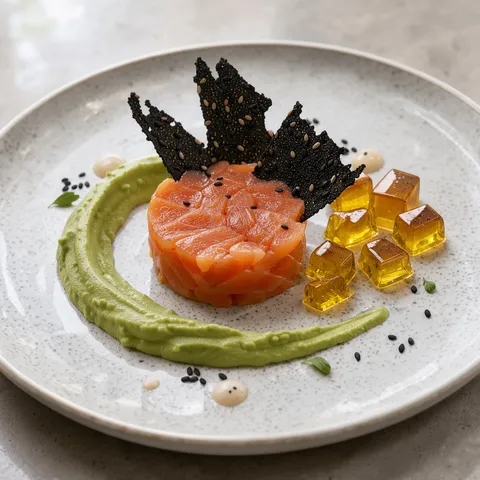 Salmon Tartare, Black Sesame Crisp, Wasabi Avocado45 min · Starter
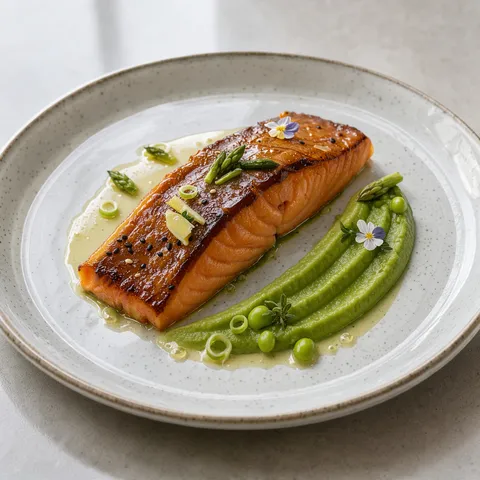 Salmon, Miso Glaze, Dashi Beurre Blanc, Edamame Purée50 min · Main course
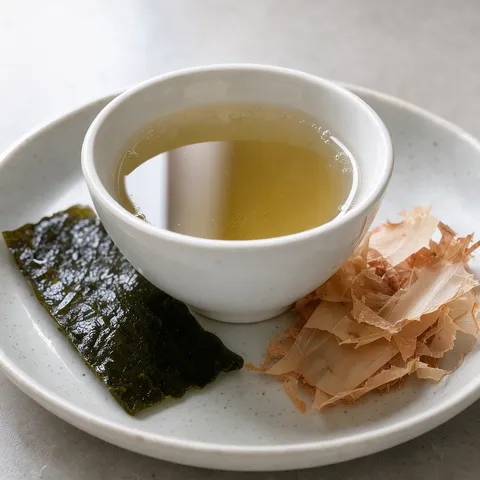 Ichiban Dashi1 hr 45 min · Basic recipe
 Miso Soup15 min · Soup
 Sushi Rice1 hr 15 min · Basic recipe
 Nigiri45 min · Main course