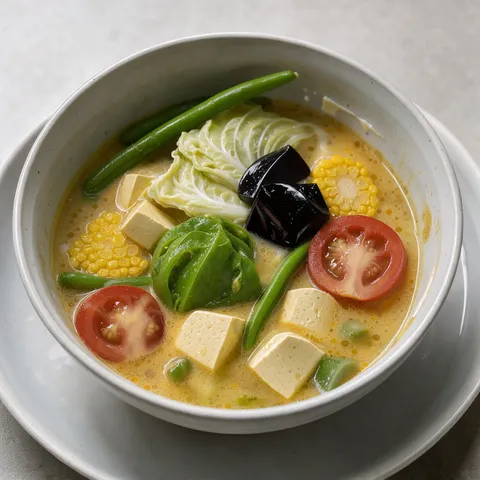
Javanese Vegetable Stew in Coconut Milk Sayur Lodeh
An Indonesian main course. Takes 50 min, Serves 4. Difficulty: medium.
At a glance
- Total time
- 50 min
- Serves
- Serves 4
- Difficulty
- Medium
- Cuisine
- Indonesian cuisine
- Dish type
- Main course
- Allergens
- Gluten, Milk, Crustaceans, Tree nuts, Soya
Ingredients
Spice paste
- 6 shallots (about 90 g)
- 4 garlic cloves
- 2 long red chillies
- 3 raw macadamias or 4 cashews (instead of candlenuts)
- 1 tsp coriander seeds
- 1 tsp shrimp paste (terasi, optional)
- 2 tbsp water
Cooking
- 2 tbsp sunflower oil
- 3 cm galangal (sliced, or ginger if unavailable)
- 2 bay leaves
- 2 makrut lime leaves
- 600 ml water
- 400 ml unsweetened coconut milk
- 1 tbsp palm sugar or light brown sugar
- 1.5 tsp salt
Vegetables
- 1 pale green courgette or chayote (about 300 g, in half-moons)
- 200 g green beans (5 cm)
- 1 aubergine (about 250 g, in 2 cm cubes)
- 200 g white cabbage (roughly chopped)
- 1 corn cob (cut into 4 rounds)
- 150 g firm Homemade Tofu (Basics) in 2 cm cubes
- 1 tomato (cut into 8 wedges)
Equipment
- Blender
- Saucepan
- Ladle
Method
- Blend the paste: Blend the shallots, garlic, chillies, macadamias, coriander seeds and shrimp paste with the 2 tbsp water in a blender for 1 min, until smooth. Shrimp paste gives a deep, salty umami. If you leave it out, add an extra 1/4 tsp salt
- Prepare the vegetables: Divide the vegetables into three bowls according to their cooking times: firm ones (corn, green beans), medium ones (aubergine, courgette) and quick-cooking ones (cabbage, tomato, tofu). As you will cook the aubergine straight after chopping, there is no need to salt it: the coconut milk softens its bitterness
- Fry the paste: Heat the oil in a 26 cm saucepan over medium heat and fry the paste with the galangal, bay leaves and lime leaves for 5-6 min, until it loses its raw smell and the oil separates. If the paste catches on the bottom, add 1 tbsp water. This stage defines the flavour of the dish, so do not rush it
- Cook the firm vegetables: Add the 600 ml water and bring to the boil. Add the corn rounds and green beans and cook over medium heat for 8 min. The beans should darken a shade from bright green but still have a little bite
- Add the medium vegetables: Add the aubergine and courgette and cook for another 6 min. The aubergine should lose its spongy whiteness and start to turn translucent
- Add the coconut milk: Reduce the heat and add the coconut milk, sugar and 1.5 tsp salt. Heat uncovered for 5 min, stirring gently with a ladle. Once the coconut milk is in, do not let it boil hard: it splits and releases its fat
- Final vegetables: Add the cabbage, tofu and tomato and cook over low heat for another 4 min. The cabbage should soften but stay glossy. Taste for salt and remove the galangal slices and bay leaves
- Serve: Divide the vegetables and plenty of the broth between deep bowls and serve hot. The broth should be pale yellow-orange, slightly oily and fragrant
Chef's note
Sayur lodeh is part of the everyday table in Java and is usually eaten with rice or lontong. The choice of vegetables changes with the season: young jackfruit, yardlong beans and melinjo leaves are also used. You can use tempeh instead of tofu: tempeh is found in Asian supermarkets. If you have no time to make tofu, firm tofu can be bought ready-made. It is thicker and tastier the next day, so add a little water when reheating. Unsweetened coconut milk and terasi are traditionally bought ready-made.
Frequently asked questions
- In what order are the vegetables cooked in sayur lodeh?
- The vegetables go in according to their cooking time. First the sweetcorn and green beans for 8 minutes, then the aubergine and courgette for 6 minutes, and last the cabbage, tofu and tomato for 4 minutes.
- Why isn't the soup boiled after the coconut milk is added?
- If the soup boils hard after the milk goes in, it splits and separates its oil. So turn the heat down and warm it slowly for 5 minutes.
- How is the flavour balanced if shrimp paste isn't used?
- Shrimp paste is optional and gives a deep, salty umami. If you don't use it, add an extra 1/4 tsp of salt to the paste.
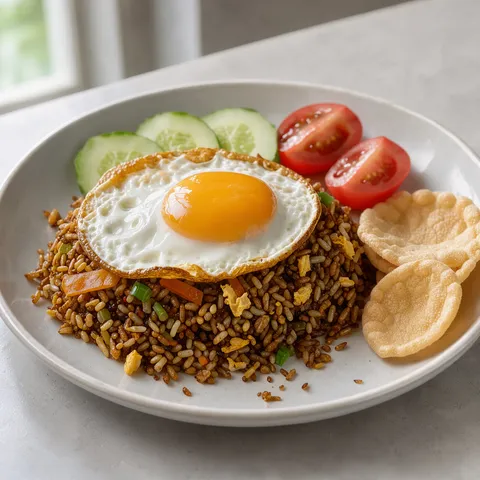 Nasi Goreng25 min · Main course
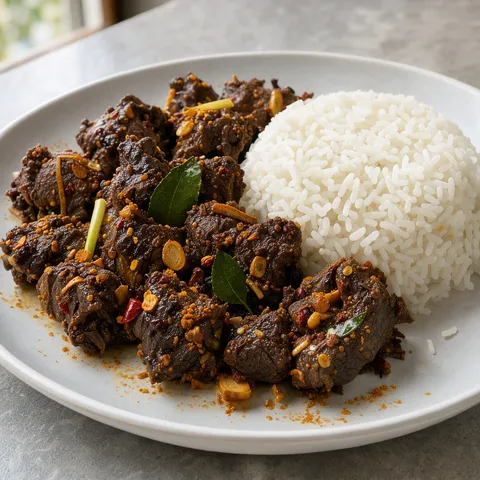 Beef Rendang1 hr 45 min · Main course
 Indonesian Yellow Chicken Soup1 hr · Soup
 Indonesian Sweet Honeycomb Pancake35 min · Bread & pastry
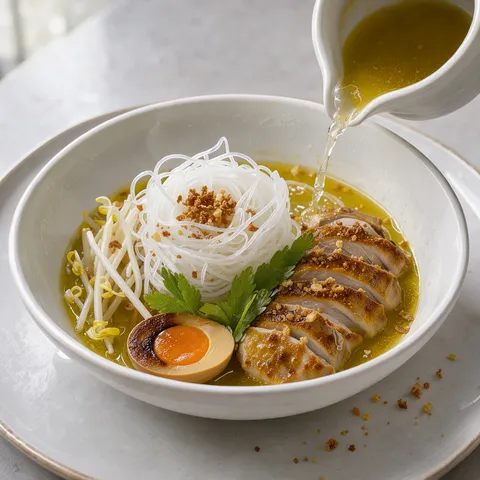 Soto Ayam 2.01 hr 20 min · Soup
 Indonesian Beef Meatball Soup2 hr 50 min · Soup