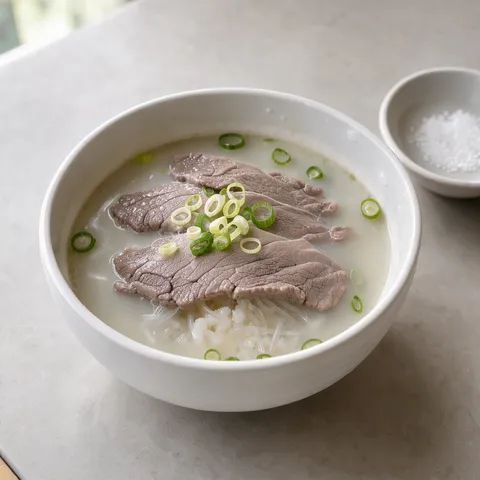
Korean White Beef Bone Soup Seolleongtang
A Korean soup. Takes 2 hr 28 min, Serves 4. Difficulty: challenging.
At a glance
- Total time
- 2 hr 28 min
- Serves
- Serves 4
- Difficulty
- Challenging
- Cuisine
- Korean cuisine
- Dish type
- Soup
- Allergens
- Gluten
Ingredients
Bones and meat
- 1.5 kg beef shin bones (with marrow)
- 500 g beef brisket or shoulder (in one piece)
- 5.5 litres cold water (2 litres for boiling + 2.5 litres for the pressure cooker + 1 litre for the second boil)
Aromatics
- 1 small onion (halved)
- 5 cm ginger (sliced)
- 6 garlic cloves
- 1 tsp black peppercorns
To serve
- 4 bowls hot rice
- 2 spring onions (thin rings)
- salt
- black pepper
- 200 g glass noodles (dangmyeon, optional)
Equipment
- Pressure cooker
- Saucepan
- Fine sieve / chinois
- Ladle
- Chef's knife
- Chopping board
- Mixing bowls
Method
- Remove the blood from the bones: Leave the bones in cold water in a large container for 20 min, then change the water. This soaking draws out traces of blood and dust and keeps the soup white and clear (~20 min)
- Boil and discard: Put the bones in a separate pan, add 2 litres water and boil over high heat for 10 min. Grey scum rises to the surface. Pour this water away completely and rinse the bones with hot water. Wash the pan, otherwise the soup turns grey and cloudy (~10 min)
- Pressure-cook: Put the clean bones, meat, onion, ginger, garlic and peppercorns in a pressure cooker and add 2.5 litres cold water. Close the lid and, once the cooker reaches pressure, cook over low heat for 60 min. Use a pressure cooker of at least 6 litres and do not go over the fill line (2/3 of the pot). If the bones do not fit, cook in two batches. The pressure cooker extracts collagen and marrow from the bones, and in an open pan this takes 4-5 hr (~60 min)
- Release the pressure and remove the meat: Leave the pressure cooker to cool by itself for 5 min and make sure no steam is coming out before opening the lid. Take out the meat, put it on a plate and rest for 10 min, then slice it thinly along the fibres on a chopping board with a knife (~15 min)
- Second boil: Strain the bone stock through a sieve, put the bones back in the pot, add 1 litre hot water and boil uncovered over medium-high heat for 30 min more. The milky colour comes from here, so the soup should boil vigorously without boiling over. Combine the two liquids (~30 min)
- Strain: Pass the soup through a fine sieve. To take off the fat, rest the pot for 5 min and skim the fat off the top with a spoon. The soup should be milk-white and slightly opaque (~5 min)
- Noodles and rice: Boil the glass noodles in separate boiling water for 6 min, drain and cut short. Put the rice in the bowls. Bring the soup back to the boil, as the soup must always be served very hot (~6 min)
- Plate: Put the rice and noodles in the bowl, spread over the sliced meat and ladle boiling soup over it. Scatter with the spring onion rings. Everyone adds salt and black pepper at the table to taste (~2 min)
Chef's note
Seolleongtang is one of the oldest soups of Korean cooking and is served unsalted, with salt added at the table. Using a pressure cooker shortens the traditional 6-12 hr simmering, and the flavour is slightly less intense. Glass noodles (dangmyeon) are a ready-made dried product.
Frequently asked questions
- Why is seolleongtang white?
- The white colour comes from the bones boiling for a long time, so the marrow and collagen blend into the soup. A pressure cooker shortens the time, but the second boil deepens the whiteness.
- Why isn't salt added to the soup?
- Traditionally, salt is added at the table to everyone's own taste. Also, boiled without salt, the flavour of the meat and bones comes forward.
- Which bones are used?
- Beef shin and marrow bones give the best result. If you cook beef brisket with them, you get meat to slice for serving.
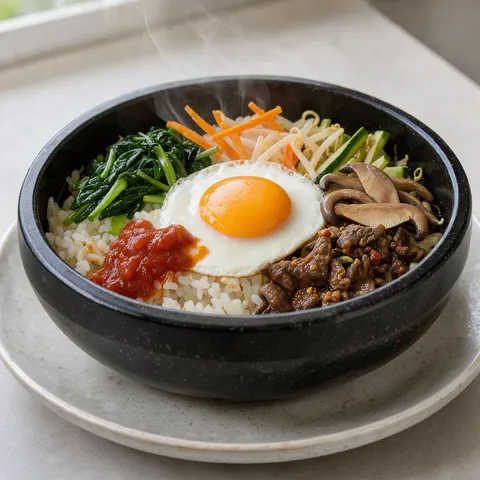 Bibimbap1 hr 15 min · Main course
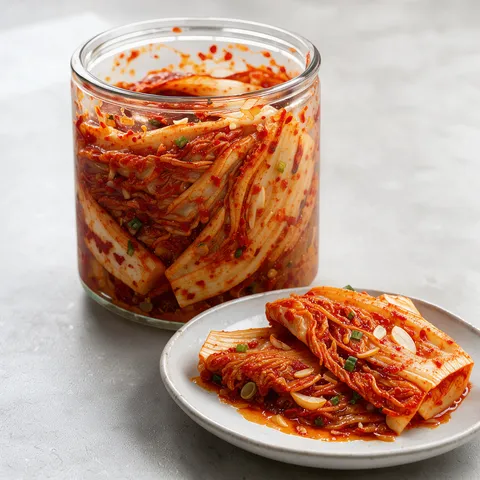 Kimchi3 hr · Side dish
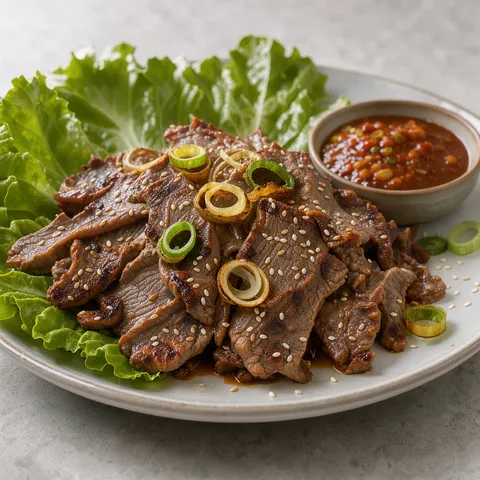 Bulgogi30 min · Main course
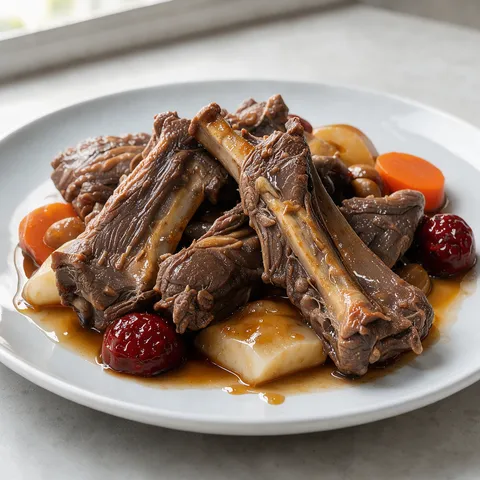 Korean Braised Short Ribs1 hr 30 min · Main course
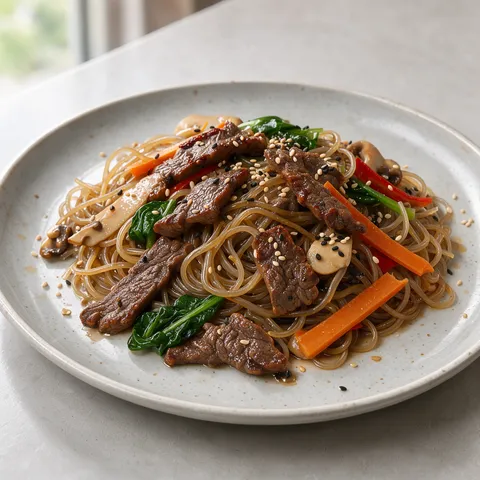 Korean Glass Noodles with Vegetables45 min · Main course
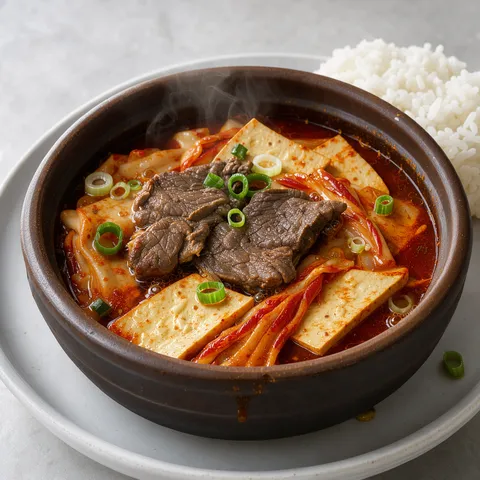 Kimchi Stew40 min · Soup