Shortbread
A Scottish patisserie. Takes 1 hr 25 min, 16 fingers. Difficulty: medium.
At a glance
- Total time
- 1 hr 25 min
- Serves
- 16 fingers
- Difficulty
- Medium
- Cuisine
- Scottish cuisine
- Dish type
- Patisserie
- Diet
- Vegetarian
- Allergens
- Gluten, Milk
Ingredients
Dough
- 225 g soft unsalted butter (at room temperature)
- 110 g caster sugar
- 280 g plain flour
- 50 g rice flour or cornflour
- 1/2 tsp fine salt
To finish
- 2 tbsp caster sugar
Equipment
- Oven
- Baking paper
- Silicone spatula
- Palette knife
- Chef's knife
- Hand mixer (optional)
- Wooden spoon / spatula (optional)
Method
- Prepare the oven and tin: Set the oven to 160°C. Line the base of a 20×20 cm square tin with baking paper. The low heat matters: shortbread should bake without colouring, the same pale yellow throughout
- Cream the butter: Beat the butter and sugar with a hand mixer or wooden spoon for 3-4 min until pale and creamy. The aim isn't a fluffy cream but to spread the sugar evenly through the butter. Overbeaten, the biscuits spread in the oven
- Add the flours: Sift the flour, rice flour and salt into the butter. Bring together with a spatula, then by hand, just until the dough comes together. Don't knead: if gluten develops, the shortbread turns hard rather than crumbly. The rice flour gives the sandy texture that melts in the mouth
- Press into the tin: Transfer the dough to the tin and press it into a flat, even layer 1.5 cm thick with your fingers, then the back of a spoon. Push it well into the corners: if they are thick, the centre overbakes
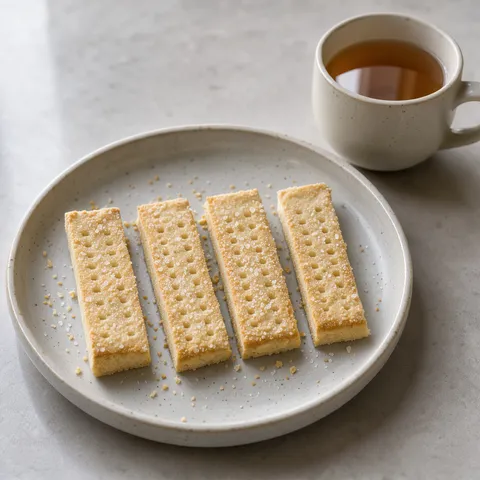
- Score and prick: Score the dough halfway through with a knife into 16 fingers (about 2.5×10 cm). Prick three neat rows of holes in each finger with a fork. The holes let steam escape so the surface stays flat. Put the tin in the fridge for 15 min: chilled butter gives a biscuit with sharp edges
- Bake: Bake at 160°C for 40-45 min. The edges should be very pale golden and the centre still pale but firm to the touch. If the surface starts to colour, lower the temperature to 150°C for the last 10 min
- Sugar and cut: As soon as the tin comes out of the oven, sprinkle the surface with a thin layer of sugar and cut right through along the scored lines while hot. Cooled shortbread doesn't cut cleanly but breaks
- Cool: Leave in the tin for 20 min, then transfer the pieces to a wire rack with a palette knife. They are very fragile while hot and firm up once completely cool
- Plate: Arrange four fingers side by side on a flat plate, pricked side up. Serve with a cup of tea
Chef's note
This makes 16 fingers. The secret of Scottish shortbread is the 1-2-3 ratio: one part sugar, two parts butter, three parts flour. Good butter is everything here, because all the flavour of the biscuit comes from it. It keeps for two weeks in an airtight tin and is the traditional treat on the Hogmanay (New Year's Eve) table.
Frequently asked questions
- Why is rice flour added to shortbread?
- Rice flour gives a sandy texture that melts in the mouth. Cornflour can do the same job.
- Why is shortbread pricked with a fork?
- The holes let the steam escape. The surface stays flat without puffing up.
- Why is shortbread baked at a low temperature?
- Keep the oven at 160°C so the biscuits bake through to the same pale golden shade without taking on colour. If the surface starts to colour, lower the temperature to 150°C for the last 10 minutes.
 Scottish Smoked Haddock and Potato Soup50 min · Soup
 Haggis with Mashed Swede3 hr 30 min · Main course
 Cranachan30 min · Dessert
 Cullen Skink 2.01 hr 10 min · Soup
 Scottish Chicken, Leek and Prune Soup1 hr 55 min · Soup
 Scottish Potatoes Stewed with Lamb and Onions1 hr 40 min · Main course