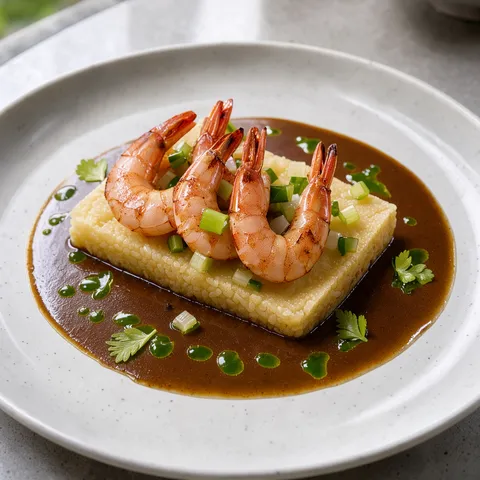
Shrimp Étouffée 2.0
An American main course. Takes 1 hr 20 min, Serves 4. Difficulty: challenging.
At a glance
- Total time
- 1 hr 20 min
- Serves
- Serves 4
- Difficulty
- Challenging
- Cuisine
- American cuisine
- Dish type
- Main course
- Allergens
- Gluten, Milk, Crustaceans, Celery
Ingredients
Prawns
- 800 g large shell-on prawns (about 16, heads on if possible)
- 1 tbsp sunflower oil
- 1/4 tsp salt
- a pinch of sweet paprika
Shell fumet
- prawn shells and heads
- 1 tbsp butter
- 1 tbsp tomato paste
- 600 ml water
- 1 bay leaf
Dark roux velouté
- 30 g butter
- 25 g plain flour
- 1 shallot (finely chopped)
- 400 ml shell fumet
- 1/2 tsp sweet paprika
- 1/4 tsp hot paprika
- 1/4 tsp dried thyme
- 1/2 tsp salt
- 20 g cold butter
- 1 tsp lemon juice
Trinity brunoise
- 1/2 onion
- 1/2 green pepper
- 1 celery stick (leaves set aside for garnish)
- 1 garlic clove
- 1 tsp butter
- a pinch of salt
Crisp rice
- 120 g short-grain rice (Turkish baldo)
- 190 ml water
- 1/4 tsp salt
- 300 ml sunflower oil (about 5 mm in a 28 cm pan)
Spring onion oil
- green parts of 4 spring onions
- 100 ml sunflower oil
To finish
- flaky salt
Equipment
- Saucepan
- Baking tray
- Cling film
- Chopping board
- Chef's knife
- Fine sieve / chinois
- Ladle
- Blender
- Muslin
- Sauté pan
- Wooden spoon / spatula
- Balloon whisk
- Frying pan
- Probe thermometer
- Cast-iron frying pan
Method
- Cook the rice: Use the rice unwashed, with its starch, because the starch makes the grains stick together. Bring the water with the salt to the boil in an 18 cm saucepan, add the rice, cover and cook on the lowest heat for 15 min. Leave to steam for 5 min. Line a 16×12 cm dish with cling film, press the rice into an even layer 1.5 cm thick, cover with cling film, compress with your palm and put in the freezer for 25 min. The cooled, compressed rice becomes a block and does not fall apart when fried
- Peel the prawns: Remove the heads and shells, leaving the tail fin on, and save them for the fumet. Score along the backs and pull out the vein. Pat dry with kitchen paper and put on an open plate in the fridge. A dried surface browns better in the pan
- Cook the shell fumet: Melt the butter in a medium saucepan over medium-high heat, add the shells and heads and cook for 4 min, until bright orange and smelling of roasted shellfish. Add the tomato paste and stir for 1 min. The paste gives a sweet, dark colour. Add the water and bay leaf and, when it boils, simmer on low heat for 20 min. Strain through a fine sieve, pressing the heads with a ladle so the rich liquid inside runs out too, and measure 400 ml
- Make the spring onion oil: Roughly chop the spring onion greens and blend with the oil in a blender for 90 sec, as the friction warms the oil and releases the colour. Drip through a fine sieve lined with muslin. A bright green, sharp-smelling oil remains
- Cook the dark roux: While the fumet cooks, melt the butter in a 20 cm sauté pan over low heat, add the flour and cook for 15 min, stirring constantly with a wooden spoon, until milk-chocolate coloured. If it smells burnt, take it off the heat. In a classic étouffée the roux is left pale. Here it is cooked to a darkness close to gumbo but used in a small amount, so it gives the sauce a deep roasted flavour without weighing it down. Add the shallot and stir for 1 min
- Thicken the velouté: Whisk in the hot fumet and add the spices and salt. Cook on low heat for 10 min, until thick enough to coat the back of a spoon. Press through a fine sieve and return to the pan. Just before serving, whisk in the cold butter and lemon juice, and the sauce turns glossy
- Cut the trinity into brunoise and sauté: Cut the onion, pepper and celery into even 3 mm cubes and finely chop the garlic. In the classic the trinity melts into the sauce, but here it is kept separate and crisp-tender. Melt the butter in a small pan on the hob ring freed up beside the rice pan, add the trinity and salt, and cook for 2 min, until the colours brighten and they soften slightly, adding the garlic for the last 30 sec
- Fry the rice: Take the rice block out of the cling film, trim the edges and cut into 4 rectangles of 8×6 cm (2×2). Only the edge trimmings are waste. Heat the oil to 180°C in a 28 cm pan. Fry the rectangles for 3 min on each side, until deep golden and glassy crisp. Lift onto kitchen paper and sprinkle with flaky salt
- Cook the prawns: Heat the 28-30 cm cast-iron pan over high heat until smoking. Sprinkle salt and sweet paprika over the prawns, add the oil to the pan and arrange the prawns in a single layer. Cook for 1 min without touching, and when the underside is browned and pink, turn and cook for another 45 sec. The prawns should form a loose C shape, with the inside only just opaque and juicy
- Plate: Pour three spoonfuls of dark velouté into the centre of a wide, slightly hollow, warm plate. Place a rice rectangle in the middle of the sauce and arrange four prawns on it with their tails up, back to back. Scatter a spoonful of brunoise trinity between the prawns and over the sauce. Drip 8-10 drops of spring onion oil over the sauce and finish with the celery leaves. Serve immediately
Chef's note
The classic étouffée's idea of prawns, roux, Cajun trinity and rice is kept, but the layers are separated. The sauce becomes a silky velouté from a concentrated fumet drawn from the shells and a dark roasted roux, the trinity becomes a crisp-tender brunoise rather than melting into the sauce, and the rice becomes a glassy rectangle of rice that nods to the crisp rice cakes of the South. The prawns are seared at high heat instead of being poached in the sauce. If you find frozen crawfish tails, you can use them instead of prawns.
Frequently asked questions
- Why isn't the rice washed?
- The rice is used unwashed with its starch, since the starch sticks the grains together. The cooked rice is pressed and frozen into a block.
- How dark should the roux get?
- Cook the roux, stirring constantly with a wooden spoon, to the colour of milk chocolate. If it smells burnt, take it off the heat.
- How do I know the prawns are overcooked?
- Prawns should form a loose C shape and be only just opaque and juicy inside.
 Louisiana Prawn Stew with Rice1 hr 10 min · Main course
 New England Clam Chowder1 hr 15 min · Soup
 Louisiana Prawn and Okra Gumbo2 hr 15 min · Soup
 Southern Fried Chicken1 hr 35 min · Main course
 Flaky Southern Scones50 min · Bread & pastry
 Bean-Free Chili con Carne3 hr · Main course
 Baked Cheddar Macaroni55 min · Main course