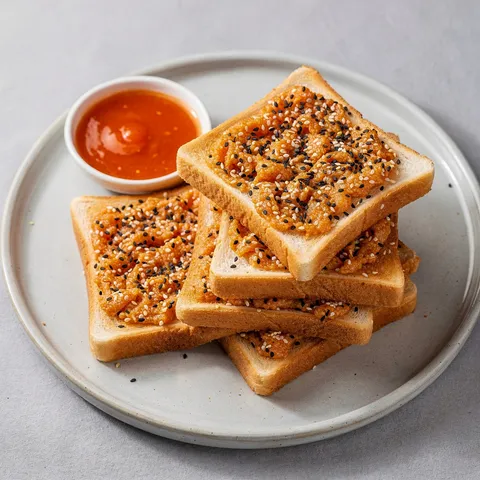
Prawn Toast
A Chinese meze. Takes 57 min, Makes 24. Difficulty: medium.
At a glance
- Total time
- 57 min
- Serves
- Makes 24
- Difficulty
- Medium
- Cuisine
- Chinese cuisine
- Dish type
- Meze
- Allergens
- Gluten, Milk, Eggs, Crustaceans, Sesame, Soya
Ingredients
- Base (24 squares, 5×5 cm): 6 slices crustless sandwich bread (10×10 cm, a day old). Prawn mousseline paste (24 × 11 g, about 270 g): 200 g raw peeled prawns (130 g to be blitzed in the food processor, 70 g to be chopped by knife to 3 mm)
- 12 g cold butter (cubed)
- 15 g egg white (about half an egg white)
- 20 ml cold double cream
- 1 tbsp (8 g) cornflour
- 1/2 tsp salt
- 1/4 tsp white pepper
- 1 tsp sesame oil
- 1 tsp grated ginger
- 1 tsp sake or rice wine
- 12 g spring onion (finely chopped)
To finish
- 1 tbsp (9 g) white sesame seeds and 1 tbsp (9 g) black sesame seeds
Frying
- 2 litres sunflower oil (about 4.4 cm deep in a 24 cm pan). Sauce (24 × 7 g, about 170 g): Sweet and Sour Sauce (Basics)
Equipment
- Oven
- Baking tray
- Food processor
- Mixing bowls
- Silicone spatula
- Palette knife
- Chef's knife
- Heavy-based saucepan
- Probe thermometer
- Colander
Method
- Dry the bread and prepare the prawns: Preheat the oven to 120°C. Put the bread slices on a tray and dry for 8 min, until the surface is dry. Cut each slice into four, 5×5 cm, to make 24 squares. Dry bread absorbs less oil and stays crisp when fried. Meanwhile peel the prawns, remove the veins, pat dry with kitchen paper and chill with the food processor bowl in the fridge (~10 min)
- Blitz the smooth part: Put 130 g prawns into the ice-cold food processor bowl, add the salt, egg white, cream, cornflour, pepper, sesame oil, ginger and sake and run for 20 sec, scrape down the bowl and blitz for 10 sec more, until you have a smooth, cold, sticky paste. The cream and cold bowl make the paste light and creamy like a mousseline, and if the mass warms up it turns rubbery (~5 min)
- Slap: Transfer the paste to a bowl and add the 70 g of prawns chopped to 3 mm with a knife, the butter cubes and the spring onion. Stir with a spatula in one direction for 2 min, then throw the mass against the side of the bowl 20 times, which is the Cantonese slapping technique. Prawn proteins loosened by salt link up: the paste becomes glossy, sticky and elastic, and when bitten after frying it springs back. The mass should weigh about 270 g (~5 min)
- Spread: Spread 11 g of paste on each bread square with a palette knife right to the edges, 4-5 mm thick and slightly domed. 11 g of paste gives this thickness on a 25 cm² square. If the paste spills over the edge of the bread it draws in oil as it fries. Smooth the surface with a knife dipped in water (~10 min)
- Two-colour sesame: Sprinkle white sesame over half the squares and black over the other half, about 3/4 g on each, pressing lightly. Even when the two colours fry, they keep the yellow-black contrast, and the sesame crust sticks to each square individually (~2 min)
- Rest: Chill the squares on a tray in the fridge for 8 min. The cold paste holds on to the bread and does not separate in the oil (~8 min)
- Fry in two stages: Heat the oil in a 24 cm pan to 160°C. Lower 8 squares at a time paste side down, fry for 1.5 min, turn and cook for 1 min more, lift onto a tray with a slotted spoon, in 3 batches. At 160°C the paste cooks through from within without taking colour. When all the squares are done, raise the oil to 180°C and refry the squares in groups of 8 for 40 sec, paste side up, until deep golden and crisp. The second frying drives off surface moisture and makes the crust crisp. If the oil is low the bread soaks up oil, and if it is high the sesame burns. Drain on kitchen paper for 30 sec (~14 min)
- Serve: Arrange the squares on a flat ceramic plate with 7 g of sauce beside each. Serve hot within the first 6 min, as the bread softens when it cools (~3 min)
Chef's note
Serve hot. Allow 2 per person, 120 people × 2 = 240 pieces. As the recipe makes 24, the multiplier is 240/24 = 10, or 10.5 with 5% allowed for waste (2.1 kg prawns (1.4 kg blitzed in the food processor, 735 g chopped by knife), 125 g butter, 210 ml cream, 63 slices of bread, 95 g white and 95 g black sesame seeds, 1.8 kg sauce. Use 2 frying pans at the same time). The original recipe uses lard in the paste; here it is made with butter and cold cream. The prawn mass is a slapped mousseline-style paste rather than a simple purée spread on bread. The slapped paste can be made 1 day ahead and kept in the fridge, and spread onto the bread 30 min before serving. The first frying can be done 3 hr ahead and the second right before serving. Fried squares are refreshed in a 180°C oven for 4 min.
Frequently asked questions
- Why use day-old bread for prawn toast?
- Dry the slices in a 120°C oven until the surface is dry. Dry bread soaks up less oil when fried and stays crisp.
- Why is the prawn paste slapped against the bowl?
- Salt breaks down the prawn proteins so they bind together. Slapping the paste against the side of the bowl makes it glossy, sticky and springy, so it bounces back when you bite.
- Why fry prawn toast twice?
- The first fry at 160°C cooks the paste through without colouring it. The second fry at 180°C drives off surface moisture and crisps the crust. If the oil is too cool the bread soaks it up.
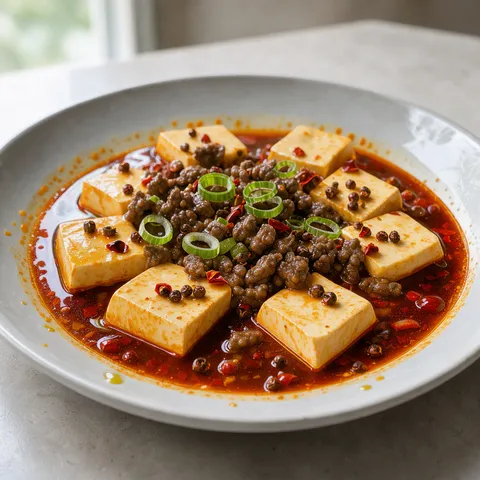 Mapo Tofu35 min · Main course
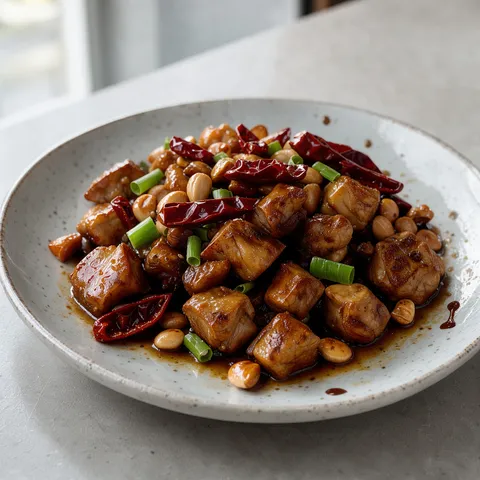 Kung Pao Chicken30 min · Main course
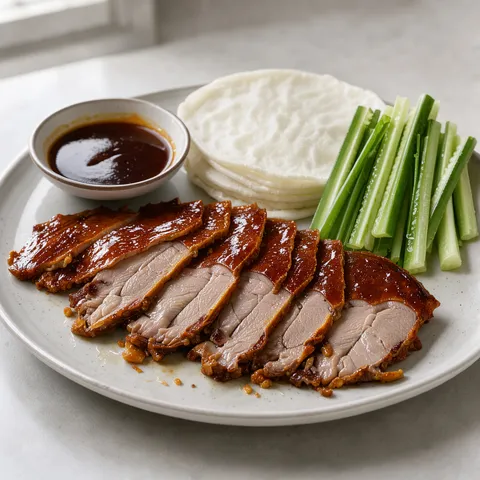 Peking Duck2 hr · Main course
 Char Siu1 hr · Main course
 Crystal Prawn Dumplings1 hr 30 min · Starter
 Open-Topped Dumplings50 min · Starter