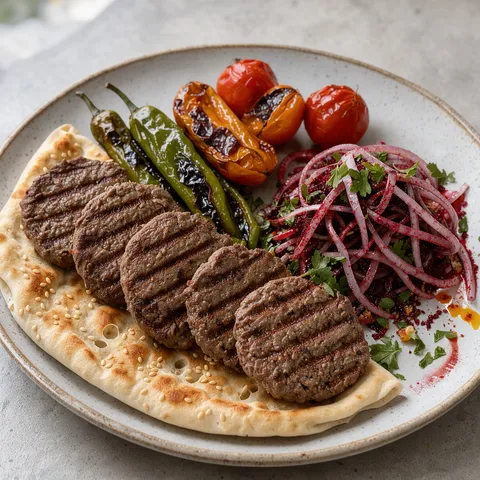
Salt-Cured Chargrilled Beef Patties
A Turkish main course. Takes 50 min · +overnight salting, Serves 4. Difficulty: medium.
At a glance
- Total time
- 50 min · +overnight salting
- Serves
- Serves 4
- Difficulty
- Medium
- Cuisine
- Turkish cuisine
- Dish type
- Main course
- Allergens
- Gluten, Milk
Ingredients
Kofte
- 700 g heifer or beef rib and brisket meat (20% fat, boneless, roughly chopped)
- 12 g rock salt (about 1.7% of the weight of the meat, finely crushed)
Optional winter style
- 40 g crustless stale bread
Charred vegetables
- 4 long green peppers (long green)
- 2 country peppers
- 4 small ripe tomatoes
To serve
- 4 small pide flatbreads or lavash
- 1 onion
- 1/2 bunch flat-leaf parsley
- 1 tsp sumac
- 1 tsp olive oil
Equipment
- Chef's knife
- Chopping board
- Baking tray
- Mixing bowls
- Meat cleaver (optional)
- Charcoal barbecue (optional)
- Griddle pan (optional)
- Probe thermometer (optional)
Method
- Salt the meat: Cut the meat into 3 cm cubes, rub in the salt so every piece gets an even share, and leave in a covered container in the fridge overnight (12-24 hr). The salt dissolves the meat proteins, which is why Sivas kofte holds together without a binder and has a slightly spongy texture
- Mince: Put the meat through the medium plate of a mincer, then mince it once more. Without a mincer, chop it on a board with a cleaver for 10 min. The meat and the mincer should be cold: if the fat warms up, it melts and the kofte dries out
- Knead: Knead the minced meat in a large bowl for 5 min, pressing and folding with your palm. It's ready when the mixture turns sticky and pulls into strands in your hand: kofte that isn't kneaded cracks as it cooks. If you're making the winter style, add the soaked and squeezed bread at this stage. Don't add spices: simplicity is the secret of the traditional flavour
- Shape: With wet hands, pinch off 40 g pieces of the mixture, roll in your palm and flatten into thin patties 8 cm across and 0.7 cm thick. Thin kofte cooks in 2 min over a hot fire and doesn't lose its juices. Arrange on a tray and firm up in the fridge for 15 min
- Prepare the embers: Light the barbecue and wait until the coals are covered in white ash, or heat a cast-iron griddle pan over high heat for 5 min. Char the peppers and tomatoes for 8-10 min, turning, until the skins are blackened in places and soft
- Sumac onions: Slice the onion into thin half-moons, rub together with the sumac, salt and chopped parsley, and drizzle with the olive oil
- Cook the kofte: Lay the kofte on the hot barbecue or griddle and cook for 1.5-2 min on each side. Turn when char marks appear and the kofte springs back when pressed. The internal temperature should reach 71°C: thin kofte gets there fast. Overcooked kofte turns tough
- Warm the pide: For the last minute, put the pide on the barbecue or griddle to soak up the fat dripping from the kofte
- Plate: Spread the pide on a plate, arrange the kofte on top in a row, put the charred peppers and tomatoes alongside and serve immediately with the sumac onions
Chef's note
Sivas kofte has a protected geographical indication, and its identity is the meat itself: heifer meat, local rock salt and patience. Master kofte makers rest the meat both after chopping and after mincing: here a single night is enough. There are home styles that add bread in winter and a little flour in summer, but onion and spices never go in. If the tomatoes burst while charring, transfer them to the plate with their juice: the pide soaks it up.
Frequently asked questions
- Why is there no binder in the salt-cured beef patties?
- Salting the meat and resting it overnight loosens the protein. The patties then hold together without a binder and have a slightly springy texture.
- Why are the patties made thin?
- Thin patties cook quickly on a hot grill and do not lose their juices.
- Are spices added to the patties?
- No. The secret of the traditional taste is simplicity, so no spices are added.
 Chilled Wheat Yoghurt Soup1 hr · Soup
 Noodle and Yoghurt Soup1 hr 10 min · Soup
 Lamb, Chickpea and Potato Stew1 hr 15 min · Soup
 Marinated Sea Bass30 min · Meze
 Crispy Fried Liver Slices25 min · Meze
 Courgette Crisps30 min · Meze