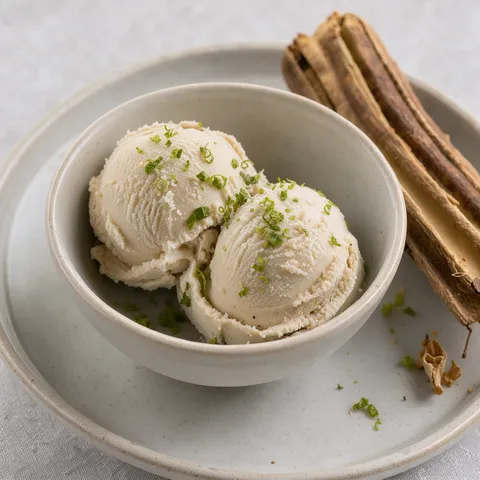
Bissau-Guinean Baobab Milk Ice Cream Sorvete de Cabaceira
A Guinea-Bissau dessert. Takes 1 hr 3 min · +3 hr freezing, Serves 4. Difficulty: medium.
At a glance
- Total time
- 1 hr 3 min · +3 hr freezing
- Serves
- Serves 4
- Difficulty
- Medium
- Cuisine
- Guinea-Bissau cuisine
- Dish type
- Dessert
- Diet
- Vegetarian, Gluten-free
- Allergens
- Milk
Ingredients
Ice cream base (about 1 litre)
- 500 ml whole milk
- 150 g caster sugar
- a pinch of salt
- 250 ml cold whipping cream (35% fat)
- 100 g baobab fruit powder (sold in organic food shops)
- 1 tsp vanilla extract
For quick cooling
- 1 large bowl of iced water
To serve
- grated zest of 1 lime (optional)
Equipment
- Saucepan
- Mixing bowls
- Silicone spatula
- Fine sieve / chinois
- Balloon whisk
- Baking paper
- Ice cream maker (optional)
- Fine grater (optional)
Method
- Sweeten the milk: Put the milk, sugar and salt in a pan and heat over medium heat for 5 min, stirring, until the sugar has dissolved completely and the milk steams (about 70°C). Do not boil, as boiling milk forms a skin and gives the ice cream a cooked-milk taste (6 min)
- Chill quickly: Sit the pan in a large bowl of iced water and stir occasionally with a spatula for 15 min, until the milk is completely cold (below 10°C). If baobab and cream meet hot milk, they can curdle (15 min)
- Make the baobab paste: Sift the baobab powder through a fine sieve into a bowl. Add 150 ml of the cooled milk to the powder a little at a time, whisking to a smooth, thick paste. Making a paste first prevents lumps (5 min)
- Combine: Add the remaining milk and the cold cream to the paste in a thin stream, whisking, and fold in the vanilla. The mixture should be pale beige, slightly tart and silky (4 min)
- Strain: Strain the base through a fine sieve into a jug and discard the remaining fibre. Fibre leaves a gritty texture in ice cream (3 min)
- Churn: Pour into the bowl of an ice cream machine and churn for 25 min, until the mixture reaches the consistency of a thick, soft cream. If you do not have a machine, pour the base into a metal container, put it in the freezer and for the first 2 hr, every 30 min, whisk the frozen parts at the edges into the centre. Whisking breaks up the ice crystals and makes the ice cream smooth (25 min)
- Freeze: Transfer the ice cream to an airtight container, press baking paper onto the surface and harden in the freezer for at least 3 hr. Paper touching the surface reduces ice crystal formation (3 hr freezing)
- Soften and serve: Move the ice cream to the fridge 5 min before serving, so the scoop goes in more easily. Dip the ice cream scoop in hot water and dry it, and put two scoops in each bowl. If you like, finely grate lime zest over the top with a microplane. Serve immediately (5 min)
Chef's note
Cabaceira is the name of the baobab tree in Guinea-Bissau. The powdery, tart flesh of the tree's fruit is used both in the milk drink called sumo de cabaceira and in this ice cream, which resembles the ice creams sold frozen in small bags on the street. Cream is added to the home version for texture, and in the traditional version milk, sugar and water are enough. The natural tartness of baobab recalls a lemon ice cream. As the base contains no egg, it should not be kept long and is best eaten within 1 week.
Frequently asked questions
- How do I make it without an ice cream machine?
- Pour the base into a metal container and freeze. For the first 2 hours, stir the frozen bits into the middle with a whisk every 30 minutes.
- Why isn't the milk boiled, and why is it cooled?
- Boiling milk forms a skin and gives the ice cream a cooked-milk taste. Cool the milk below 10°C, as the baobab and cream can curdle if they meet hot milk.
- How do I reduce ice crystals?
- Put the ice cream in an airtight container and press baking paper onto the surface. Paper touching the surface reduces the formation of ice crystals.
 Bissau-Guinean Palm Oil Fish Stew1 hr · Main course
 Bissau-Guinean Palm Oil Fish Soup1 hr 2 min · Soup
 Bissau-Guinean Tamarind Drink27 min · Drink