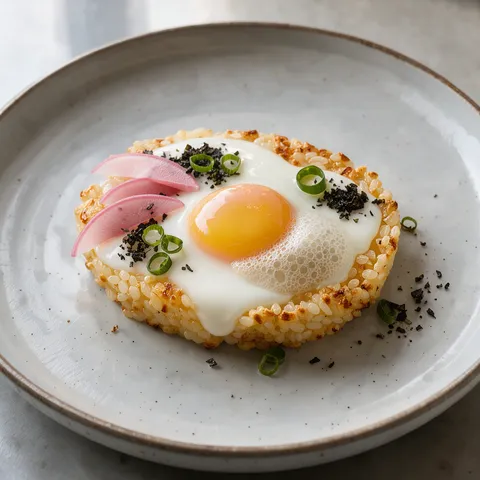
Tamago Kake Gohan 2.0
A Japanese breakfast. Takes 1 hr 4 min, Serves 4. Difficulty: challenging.
At a glance
- Total time
- 1 hr 4 min
- Serves
- Serves 4
- Difficulty
- Challenging
- Cuisine
- Japanese cuisine
- Dish type
- Breakfast
- Allergens
- Gluten, Milk, Eggs, Fish, Sesame, Soya
Ingredients
Onsen eggs
- 4 eggs (at room temperature)
- 2 litres water
Rice
- 300 g Japanese short-grain rice
- 360 ml water
- 2 tbsp sunflower oil
Dashi foam
- 300 ml water
- 3 g kombu
- 6 g katsuobushi (quick dashi)
- 1 tbsp Japanese soy sauce
- 1 tsp mirin
- 50 ml milk
- a pinch of salt
Pickled radish
- 120 g radish
- 60 ml rice vinegar
- 60 ml water
- 1 tbsp caster sugar
- 1/2 tsp salt
Nori powder
- 2 sheets nori
- 1 tbsp toasted sesame seeds
- a pinch of salt
To finish
- 2 spring onions
- 1 tsp Japanese soy sauce
Equipment
- Probe thermometer
- Chef's knife
- Colander
- Ladle
- Mixing bowls
- Stick blender
- Pestle and mortar
- Frying pan
- Saucepan
- Fine sieve / chinois
- Mandoline (optional)
Method
- Prepare the onsen egg water: Bring 2 litres of water to the boil in a deep pan, take it off the heat and add cold water to bring it down to 64°C. Check the temperature with a thermometer, then lower the eggs into the water with a spoon. Keep the heat under the pan very low or switch it on for 1 min now and then, so that the water stays between 62-65°C. At this temperature the white sets softly and the yolk stays creamy. The eggs need 40 min, and the steps below run alongside this (~6 min).
- Wash the rice: Rub the 300 g rice between your palms in a bowl with cold water 3-4 times and pour off the cloudy water. Leave to drain in a colander for 4 min. If starch remains on the surface, the rice turns sticky (alongside, 3 min).
- Cook the rice: Put the rice in a heavy-based pan with 360 ml water and cover. Bring to the boil over high heat for 3 min, cook on the lowest heat for 10 min, then take off the heat and leave to steam, still covered, for 5 min (alongside, 18 min).
- Make the pickled radish: Cut the radish into half-moons 1-2 mm thick with a mandoline or chef's knife. Whisk the vinegar, water, sugar and salt until the sugar dissolves, pour over the radish and leave for 20 min. The radish should stay half pink and crisp (alongside, 4 min).
- Make the dashi foam: Heat 3 g kombu in 300 ml water in a small pan over low heat for 10 min, without boiling (about 60°C), then remove the kombu. Bring the water to 85°C, add 6 g katsuobushi and strain through a fine sieve after 2 min. Heat this quick dashi with 1 tbsp soy sauce, the mirin and salt and take off the heat at 80°C. Add 50 ml milk and blitz the surface with a stick blender for 30 sec, until a generous, light foam forms. The foam is balanced: if the dashi is too salty, the milk softens it (alongside, 15 min).
- Make the nori powder: Toast the nori sheets in a dry pan for 20 sec, until crisp and dark green. Grind coarsely with the sesame seeds and salt in a mortar. Nori softens quickly with moisture, so store it in an airtight container (alongside, 3 min).
- Lift out the eggs: After 40 min, lift the eggs out with a slotted spoon, hold them in cold water for 1 min and transfer to a bowl without breaking them. Crack the shell and slide the contents into the bowl. The white should be thin and trembling and the yolk creamy (~3 min).
- Make the crispy rice cakes: Divide the cooked rice into 4 equal portions and shape each with wet hands into an 8 cm disc about 1 cm thick. Heat 2 tbsp oil in a non-stick pan over medium-high heat and add the discs one by one. Fry each side for 4 min, until a golden, crisp crust forms, and do not move them or they will fall apart. The base should be crisp and the inside soft (~10 min).
- Plate: Put one crispy rice cake on each plate and set an onsen egg on top. Scatter the nori powder, drained pickled radish and finely chopped spring onion around the egg. Drip 1/4 tsp soy sauce over the egg (~4 min).
- Serve: Spoon the dashi foam around the egg. Break the yolk and eat it, mixing it with the crispy rice and the foam (~1 min).
Chef's note
Classic tamago kake gohan is raw egg and soy sauce over hot rice. In this version, an onsen egg cooked at 64°C replaces the raw egg, which is both safe and gives a creamy texture. The rice cake provides a contrast of crisp and soft. A thermometer is essential for success.
Frequently asked questions
- What temperature should the water be for onsen eggs?
- Keep the water between 62-65°C, and the recipe starts at 64°C. At this temperature the white is semi-set and the yolk stays creamy.
- Why do the crispy rice cakes fall apart in the pan?
- The discs fall apart if you move them in the pan. Fry each side for 4 minutes without touching until a golden, crisp crust forms.
- How should I store the nori powder?
- Nori softens quickly in damp air, so keep it in a sealed container. Toast it in a dry pan and grind it with sesame seeds and salt in a mortar.
 Rice with Raw Egg and Soy30 min · Breakfast
 Salmon Tartare, Black Sesame Crisp, Wasabi Avocado45 min · Starter
 Salmon, Miso Glaze, Dashi Beurre Blanc, Edamame Purée50 min · Main course
 Ichiban Dashi1 hr 45 min · Basic recipe
 Miso Soup15 min · Soup
 Sushi Rice1 hr 15 min · Basic recipe
 Nigiri45 min · Main course