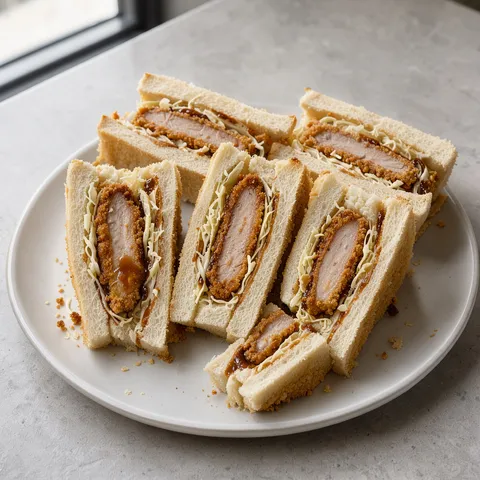
Chicken Katsu Sando Crustless Milk Bread Sandwiches
A Japanese meze. Takes 3 hr 8 min · 1 hr 15 min if the bread is ready, Makes 20. Difficulty: challenging.
At a glance
- Total time
- 3 hr 8 min · 1 hr 15 min if the bread is ready
- Serves
- Makes 20
- Difficulty
- Challenging
- Cuisine
- Japanese cuisine
- Dish type
- Meze
- Allergens
- Gluten, Milk, Eggs, Fish, Soya, Mustard, Sulphites
Ingredients
- Milk bread (25 × 11 cm tin, 20 slices of 1 cm, slice size without crusts about 9 × 8.5 cm, about 755 g dough in total): 400 g plain flour
- 8 g fast-action dried yeast
- 40 g sugar
- 6 g salt
- 220 ml lukewarm milk
- 1 egg
- 30 g softened butter
- 10 g butter (for greasing the tin). Katsu (10 pieces, 7 × 8 cm, about 59 g raw): 700 g chicken breast (2 large breasts, each sliced in half horizontally and flattened to 1 cm)
- 1 tsp salt
- 1/2 tsp black pepper
Coating
- 40 g plain flour
- 2 eggs and 1 tbsp water
- 100 g Breadcrumbs
- Panko and Toasted Crumbs (Basics)
Frying
- 1.5 litres sunflower oil (about 4.8 cm deep in a 20 cm pan)
Sandwich filling
- 150 g white cabbage (1 mm thin strips)
- 1 tsp lemon juice
- 80 g Tonkatsu and Okonomi Sauce (Basics)
- 60 g Homemade Mayonnaise (Basics)
- 10 g butter (for spreading on the bread)
Extras
- wire rack
- cling film
- baking paper
Equipment
- Mixing bowls
- Stand mixer
- Cake tin
- Oven
- Bread knife
- Heavy-based saucepan
- Probe thermometer
- Rolling pin / oklava
- Colander
- Precision scales
- Baking tray
Method
- Knead the bread: Froth the yeast, sugar and lukewarm milk in the bowl of a stand mixer for 5 min, add the flour, salt and egg and knead with the hook for 8 min. Add the soft butter piece by piece and knead for 5 min more. The dough should be smooth, slightly sticky and an elastic mass that comes away from the bowl. Butter added after the gluten has formed keeps the bread soft and moist (~18 min)
- Shape and prove: Weigh the dough and divide into 3 equal pieces, roll each with a rolling pin into a rectangle 11 cm wide and 20 cm long, roll up tightly from the long edge and arrange side by side in the greased 25 × 11 cm tin with the seams facing down. Cover the tin and prove for 50 min, until the dough rises 1 cm above the edge of the tin. Bread made with three rolls slices evenly and leaves no gaps in the slices. The katsu is prepared while the bread proves (~60 min)
- Prepare the chicken: Slice the chicken breast in half horizontally, flatten to 1 cm thick between cling film with a rolling pin, cut 10 pieces of 7 × 8 cm and season with salt and pepper. Even thickness cooks evenly, whereas a thick part leaves the inside raw while the thin part dries out. Coat in the flour, beaten egg and water, and panko in turn, pressing the panko on. Rest on a tray in the fridge for 10 min. Do this while the bread proves
- Bake the bread: Preheat the oven to 180°C. Bake the proved bread uncovered on the middle shelf for 30 min, until the top is deep golden and it sounds hollow when tapped on the underside after being turned out of the tin. The internal temperature should be 92°C. Turn out of the tin and cool on a wire rack for at least 45 min, until the inside is completely cool to the touch, because warm or lukewarm bread is squashed and crushed when sliced 1 cm thick (~75 min)
- Fry the katsu: Heat the oil to 175°C in a heavy-based 20 cm pan, checking with a thermometer. Fry the katsu in batches of 3, 2.5 min, until golden and crisp on each side, which makes 10 pieces in 4 batches. The internal temperature should be 74°C. Lift out with a slotted spoon, drain on a wire rack and rest for 2 min. Put on the rack rather than kitchen paper, so the crisp surface does not hold moisture. Do this while the bread cools
- Slice and assemble: Cut the crusts off the cooled bread with a bread knife and cut 20 slices 1 cm thick. Spread butter on one side of the slices. Mix the cabbage with the lemon juice and squeeze out the liquid. On 10 slices put 15 g cabbage, 1 katsu, 8 g tonkatsu sauce and 6 g mayonnaise, and close with a second slice, buttered side facing in. Wrap the sandwich in baking paper and rest for 10 min, pressing lightly, so that the sauce soaks into the bread (~30 min)
- Cut and plate: Cut the wrapped sandwich in half through the wrapping with a sharp bread knife to make two finger sandwiches. A sharp knife cuts cleanly without crushing the panko. Stand the 2 halves side by side on a flat ceramic plate, cut side up, so that the cross-section of the katsu shows (~5 min)
Chef's note
Serve the katsu hot and the bread at room temperature. Allow 2 per person, 120 people × 2 = 240 pieces. As the recipe makes 20, the multiplier is 240/20 = 12, or 13 with 5% allowed for waste (5.2 kg flour (bread), 9.1 kg chicken breast, 1.3 kg panko, 1.95 kg white cabbage, 39 eggs (bread and coating)). The bread can be baked 1 day ahead and stored in cling film, in which case the total time drops to 1 hr 15 min. If baking fresh, the bread needs to cool for at least 45 min before slicing. The coated raw katsu keep in the fridge for 3 hr and are fried when serving. Capacity: 3 katsu per 2.5 min in a 20 cm pan, 10 katsu in 4 batches, 130 katsu for 13 times the recipe make 44 batches, and with 3 pans about 50 min are needed. Oven capacity: 1 tin bakes per round, so 13 loaves for 13 times the recipe take 6.5 rounds (in an oven with 2 shelves), and must be baked ahead. The original recipe uses pork chop; here it is made with chicken breast. The chicken's internal temperature must not fall below 74°C. The multiplier 240/20 = 12, or 12.6 with 5% allowed for waste, that is 13 times
Frequently asked questions
- Why is the milk bread cooled completely before making the sandwiches?
- Hot or warm bread squashes and crushes when sliced to 1 cm. Leave the loaf on a wire rack for at least 45 minutes, until the inside has cooled completely too.
- Why are the katsu drained on a wire rack and not on kitchen paper?
- So the crisp coating does not trap moisture, drain the katsu on a wire rack and rest them for 2 minutes.
- Why is the sandwich wrapped in baking paper and left to rest?
- Leave the wrapped sandwich for 10 minutes under light pressure so the sauce soaks into the bread. Then cut it in half through the wrapping with a sharp bread knife. A sharp knife cuts cleanly without crushing the panko.
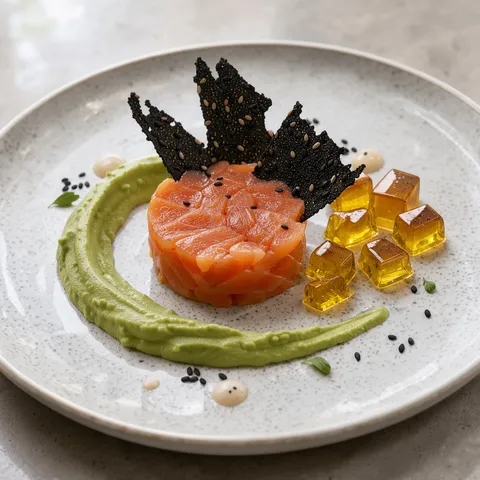 Salmon Tartare, Black Sesame Crisp, Wasabi Avocado45 min · Starter
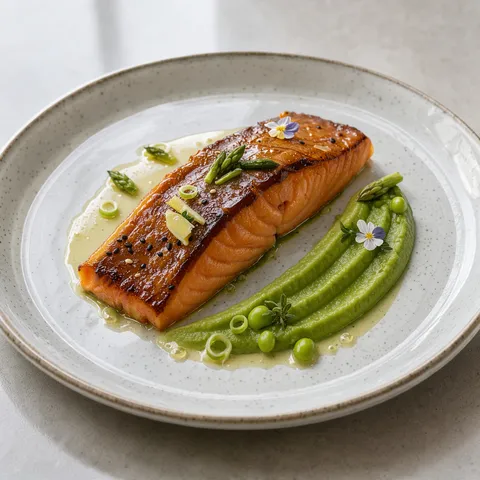 Salmon, Miso Glaze, Dashi Beurre Blanc, Edamame Purée50 min · Main course
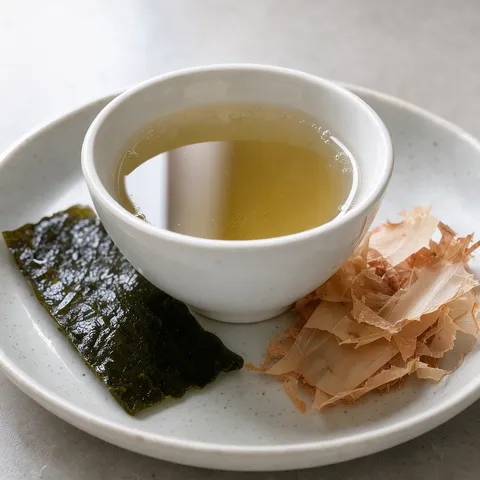 Ichiban Dashi1 hr 45 min · Basic recipe
 Miso Soup15 min · Soup
 Sushi Rice1 hr 15 min · Basic recipe
 Nigiri45 min · Main course