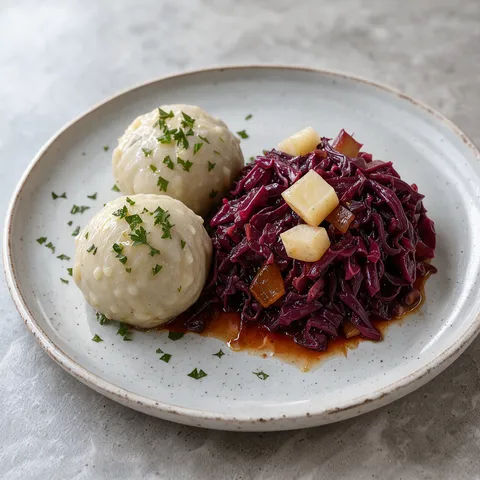
Thuringian Potato Dumplings Thüringer Klöße
A German side dish. Takes 1 hr 25 min, Serves 4. Difficulty: medium.
At a glance
- Total time
- 1 hr 25 min
- Serves
- Serves 4
- Difficulty
- Medium
- Cuisine
- German cuisine
- Dish type
- Side dish
- Allergens
- Gluten, Milk
Ingredients
Red cabbage
- 1 small red cabbage (about 900 g)
- 1 sour apple (about 150 g)
- 1 onion (about 120 g)
- 30 g butter
- 1 tbsp sugar (15 g)
- 60 ml cider vinegar
- 200 ml water
- 1 bay leaf
- 3 cloves
- 1/2 cinnamon stick
- 1 tsp salt
- 1/4 tsp black pepper
Klöße
- 1.2 kg floury potatoes (peeled weight: 800 g to be grated raw, 400 g to be boiled)
- 150 ml milk
- 1 1/2 tsp salt
- a pinch of nutmeg
Cooking water
- 4 litres water and 1 tbsp salt (for the dumplings)
- plus 1 litre water and 1 tsp salt for boiling the potatoes
Crouton filling
- 1 slice stale white bread (about 40 g)
- 15 g butter
To serve
- 30 g butter
- 1 tbsp finely chopped flat-leaf parsley
Equipment
- Heavy-based saucepan
- Saucepan
- Chef's knife
- Chopping board
- Box grater
- Muslin
- Mixing bowls
- Potato ricer
- Frying pan
- Ladle
- Colander
- Wooden spoon / spatula
- Vegetable peeler (optional)
Method
- Start the cabbage: Remove the outer leaves of the cabbage, quarter it, cut out the hard core and shred into 3 mm strips with a chef's knife. Thinly slice the onion into half-moons. Peel and core the apple and cut it into 1 cm cubes. Melt 30 g butter in a heavy-based saucepan over medium heat and soften the onion for 4 min without colouring, then sprinkle over the sugar and let it melt for 1 min. Add the cabbage, apple, vinegar, water, bay leaf, cloves, cinnamon, salt and pepper and stir. Cover and cook over low heat for 50 min, stirring now and then. The vinegar keeps the cabbage's purple-red colour bright and, with the sugar, sets up the sweet-sour balance
- Grate and squeeze the raw potatoes first: Quickly grate 800 g of the potatoes on the fine side of a grater into a large bowl, as grated potato turns dark if left to stand. Tip the gratings into a piece of muslin and squeeze as hard as you can over a second bowl: about 250-300 ml liquid should come out. You are left with dry, crumbly potato fibres. Leave the squeezed liquid to stand for 10 min so a white starch settles at the bottom. Slowly pour off the liquid on top, scrape out the starch and mix it into the squeezed potato. This starch holds the dumplings together
- Potatoes for boiling: While the raw potato liquid stands, cut 400 g of the potatoes into even pieces and put them in a small saucepan with 1 litre cold water and 1 tsp salt. Bring to the boil, then cook over medium heat for 18-20 min until a knife slides in easily. These potatoes bind the dough and must be used hot
- Croutons: Cut the bread into 1 cm cubes. Heat 15 g butter in a small frying pan until foaming and toss the bread over medium heat for 3-4 min until golden and crisp on all sides, then drain on kitchen paper. The croutons in the centre give the dumpling a small core of flavour and a slight crunch
- Prepare the cooking water: Bring 4 litres water to the boil with 1 tbsp salt in a large pan (at least 26 cm, 6 litres), then reduce the heat and keep it just below the boil, with only small bubbles rising to the surface (about 90-95°C). Rapidly boiling water breaks the dumplings apart
- Hot potato paste: Drain the boiled potatoes and pass them through a potato ricer while hot. Bring the milk to the boil in a small pan, pour it over the potatoes and beat with 1 1/2 tsp salt and the nutmeg using a wooden spoon to make a thick, sticky paste. While it is still hot, pour the paste straight over the raw potato fibres and mix for 1-2 min until the dough forms a ball and comes away from the side of the bowl. The hot paste partly cooks the raw starch and binds the dough
- Shape: Wet your hands with cold water. Divide the dough into 8 equal pieces (each about 135 g). Flatten each piece in your palm, put 3-4 croutons in the centre, seal the edges and roll into smooth, crack-free balls about 6.5 cm across. If cracks remain on the surface, water gets in during cooking and the dumpling falls apart
- Cook the dumplings: Lower the dumplings one at a time into the gently bubbling water with a ladle and leave uncovered. Cook for 20-22 min without letting the water boil at all. Within a few minutes the dumplings rise to the surface and keep cooking as they float. When ready, their surface is firm and slightly glossy. Lift out with a slotted spoon and drain for 1 min
- Finish the cabbage and serve: Remove the bay leaf, cloves and cinnamon from the cabbage and taste for salt and sharpness. The cabbage should be soft but with a little bite, with most of its liquid absorbed. If needed, uncover and boil for 3-4 min to reduce the liquid. Melt the serving butter in a small pan. Put two dumplings and a heap of cabbage on each warmed plate, drizzle the melted butter over the dumplings and scatter with parsley
Chef's note
In Thuringia, Thüringer Klöße are often the side dish of the Sunday table, usually eaten with plenty of gravy alongside braised meats such as pot roast or Rinderrouladen. Floury (starchy) potatoes are essential, as waxy potatoes won't bind the dough. Squeezing the potato liquid out thoroughly through muslin is the key to this recipe: locally, special presses are said to be used for the job. If the first dumpling falls apart, add 1-2 tbsp potato starch or cornflour to the remaining dough. You can also use 4-5 juniper berries instead of the cloves and cinnamon.
Frequently asked questions
- Why do Thüringer Klöße fall apart as they cook?
- If any cracks are left on the surface, water gets in while cooking and the dumpling falls apart. Fiercely boiling water also breaks the dumplings up, so keep the water just below boiling, at about 90-95°C.
- What do you do with the liquid squeezed from the raw potato?
- Let the liquid stand for 10 minutes and a white starch settles at the bottom. Pour off the water on top, scrape up the starch and mix it into the squeezed potato, where it holds the dumplings together.
- Why is a crouton put inside each dumpling?
- Put 3-4 croutons in the centre of each dumpling. The croutons leave a small core of flavour and a slight crunch inside.
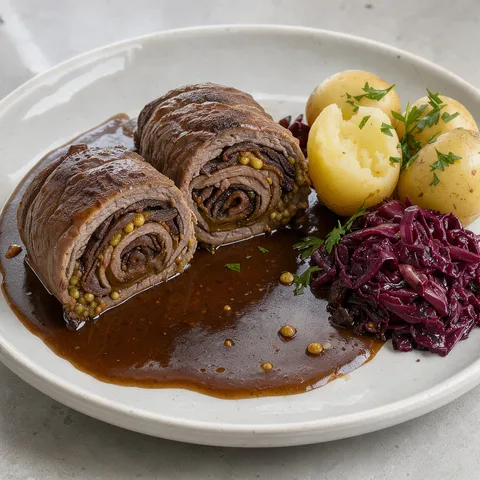 German Beef Roulades2 hr 30 min · Main course
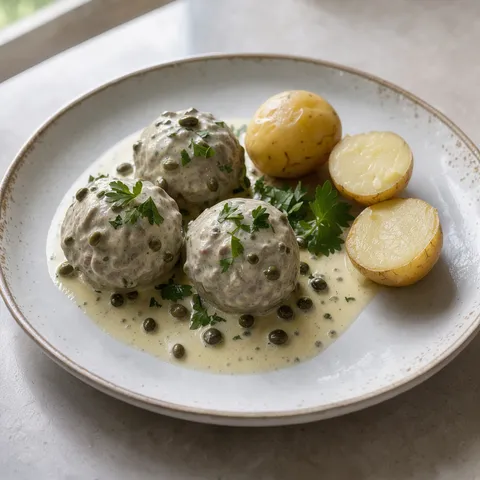 Meatballs in Caper Sauce1 hr 05 min · Main course
 Swabian Cheese Noodles55 min · Main course
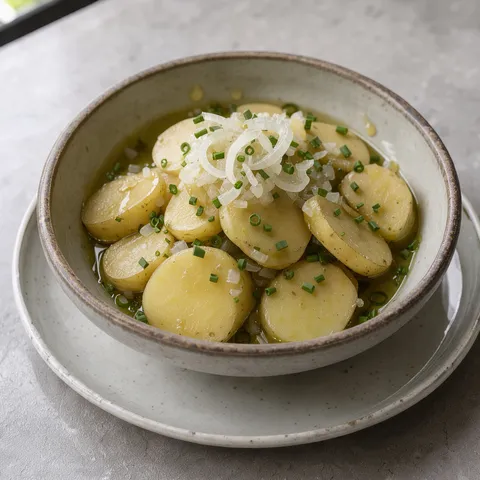 Swabian Potato Salad1 hr · Side dish
 Bavarian Pretzels1 hr 55 min · Bread & pastry
 Käsespätzle 2.01 hr 20 min · Main course