
Greek Cheese Triangle Pastries Tiropitakia
A Greek meze. Takes 1 hr 21 min, Makes 24. Difficulty: medium.
At a glance
- Total time
- 1 hr 21 min
- Serves
- Makes 24
- Difficulty
- Medium
- Cuisine
- Greek cuisine
- Dish type
- Meze
- Diet
- Vegetarian
- Allergens
- Gluten, Milk, Eggs, Sesame
Ingredients
- Dough (24 triangles, 9 cm circles, 2.5 mm thick, about 17 g per circle, about 485 g dough in total): 280 g plain flour
- 125 g strained yoghurt
- 80 ml olive oil
- 1 tsp salt
- 1/2 tsp baking powder
- 1 tbsp water (if needed). Filling (24 × 12 g, about 290 g): 150 g feta (mashed with a fork)
- 100 g ricotta from Homemade Ricotta and Fresh Curd Cheese (Basics) or strained fresh curd cheese
- 1 egg (half for the filling)
- 2 tbsp finely chopped fresh mint
- 1/4 tsp black pepper
- a pinch of nutmeg
Topping
- the remaining half of the egg
- 1 tbsp milk
- 1 tsp sesame seeds
Tray
- baking paper
Equipment
- Mixing bowls
- Rolling pin / oklava
- Cake ring / food ring
- Pastry brush
- Baking tray
- Baking paper
- Oven
- Colander
- Silicone spatula
- Precision scales (optional)
Method
- Knead the dough: Mix the flour, salt and baking powder in a bowl, make a well in the centre and add the yoghurt and olive oil. Knead by hand for 3 min, until smooth, soft and pliable like an earlobe, and add 1 tbsp water if it stays dry. The yoghurt makes the dough soft and crisp, and the olive oil gives the flavour typical of Greek pies. Over-kneading develops the gluten and toughens the dough (~8 min)
- Rest: Shape the dough into a ball, cover it in the bowl with a damp cloth and rest at room temperature for 20 min. As it rests, the gluten relaxes and the dough does not spring back when rolled. Meanwhile preheat the oven to 190°C (conventional) and prepare the filling (~20 min)
- Prepare the filling: Drain the ricotta in a colander for 5 min, because a watery filling leaks as it bakes. Mash the feta with a fork, then add the ricotta, half the egg (beaten, about 25 g), the mint, black pepper and nutmeg and mix with a spatula. Do not add salt, as the feta is salty. Test for doneness: the filling holds its shape when it falls from the spoon and does not run. It makes about 290 g
- Roll out and cut: Roll out the dough on a floured worktop with a rolling pin to 2.5 mm thick. Cut 24 circles with a 9 cm cutter. Re-roll the remaining 75 g of dough once to make 4 spare circles. Keep the circles covered with a damp cloth, because exposed edges dry out and will not seal (~12 min)
- Fill and form the triangles: Put 12 g of filling in the centre of each circle and lightly wet the edge with a brush. Fold the circle in from three sides towards the centre to make a triangle with sides of about 5 cm, and press the corners firmly with your fingers, leaving a small window of cheese in the middle. A weak corner opens as it bakes and the cheese runs onto the tray. Weigh the first three, each should be about 29 g. Arrange the triangles on two trays lined with baking paper, 12 on each, 3 cm apart (~14 min)
- Brush with egg: Whisk the remaining half of the egg with 1 tbsp milk, brush thinly over the triangles and sprinkle with sesame seeds. The egg gives a golden, glossy surface (~3 min)
- Bake: Put the trays on the middle and top shelves of the oven and bake at 190°C for 18 min, swapping the trays at 9 min. Test for doneness: the edges and top are deep golden, the underside golden brown and the filling slightly puffed at the corners. At a low heat the dough stays hard and pale (~18 min)
- Rest and serve: Rest the triangles on the tray for 5 min so that the cheese sets and does not burn the mouth. Arrange on a flat ceramic plate. Serve warm and eat within the first 25 min, as the dough loses its crispness when it cools (~6 min)
Chef's note
Serve warm. Allow 3 per person, 80 people × 3 = 240 pieces. As the recipe makes 24, the multiplier is 240/24 = 10, or 10.5 with 5% allowed for waste (2.95 kg flour, 1.3 kg strained yoghurt, 840 ml olive oil, 1.6 kg feta, 1.05 kg ricotta or fresh curd cheese, 11 eggs, 21 tbsp mint, 11 tsp baking powder). Vegetarian, but not gluten-free (flour). In Greece tiropitakia are traditionally made with filo sheets. Ready-made yufka is not used here, so a hand-rolled yoghurt and olive oil dough was chosen, which gives a short, crisp crust rather than layers. Feta and other cheeses may contain animal rennet, so for vegetarian guests choose cheese made with microbial rennet. Capacity: 252 triangles on 21 trays, 11 rounds in an oven with 2 shelves, 18 min per round, about 3 hr 20 min in a single oven, about 1 hr 45 min with 2 ovens. Shaped raw triangles can be frozen on the tray and kept for 1 month, and baked from frozen at 190°C for 22 min. Baked triangles keep in a closed container for 1 day and are refreshed in a 170°C oven for 6 min.
Frequently asked questions
- Why is no salt added to the tiropitakia filling?
- Feta is salty, so no extra salt is needed. Mash the feta and mix it with the ricotta, egg, mint and spices.
- Why do the triangles open at the corners while baking?
- A poorly sealed corner opens as it bakes and the cheese runs onto the tray. Press the corners down firmly with a finger.
- When should tiropitakia be eaten?
- Serve them warm and eat them within the first 25 minutes. The pastry loses its crispness as it cools.
 Greek Tahini Cake1 hr 2 min · Patisserie
 Moussaka2 hr 15 min · Main course
 Greek Egg and Lemon Chicken Soup1 hr 05 min · Soup
 Greek Spinach and Feta Pie2 hr 10 min · Bread & pastry
 Moussaka 2.01 hr 25 min · Main course
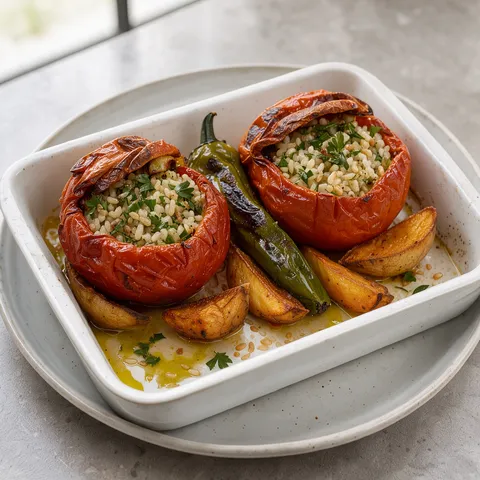 Greek Stuffed Tomatoes and Peppers1 hr 50 min · Main course