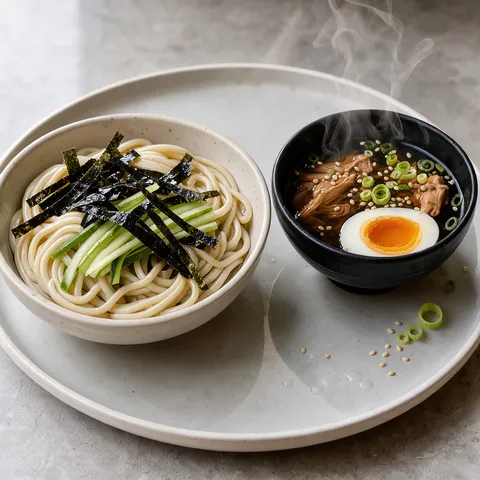
Tsukemen Cold Dipping Noodles
A Japanese main course. Takes 1 hr 18 min, Serves 4. Difficulty: medium.
At a glance
- Total time
- 1 hr 18 min
- Serves
- Serves 4
- Difficulty
- Medium
- Cuisine
- Japanese cuisine
- Dish type
- Main course
- Allergens
- Gluten, Milk, Eggs, Fish, Sesame, Soya
Ingredients
Broth
- 600 g chicken wings
- 1.2 litres water
- 15 g kombu
- 15 g katsuobushi
- 3 garlic cloves
- 20 g ginger
- 1 small onion
Seasoning
- 120 ml soy sauce
- 40 ml mirin
- 2 tbsp vinegar
- 1 tbsp caster sugar
- 1 tbsp sesame oil
- 1 tbsp neutral oil
Noodles
- 320 g thick fresh udon or fresh egg noodles
Eggs
- 4 eggs
To serve
- 4 sheets nori
- 2 spring onions
- 1/2 cucumber
- 1 tbsp toasted sesame seeds
- 1 tsp chilli oil (optional)
Equipment
- Pressure cooker
- Saucepan
- Mixing bowls
- Fine sieve / chinois
- Colander
- Chopping board
- Chef's knife
- Kitchen scissors
Method
- Brown the chicken: Pat the wings dry with kitchen paper. In a pressure cooker, heat the oil over high heat and fry the wings for 2 min on each side, until golden. Frying gives the broth a deep roasted flavour (~6 min)
- Bring to the boil: Add the garlic, ginger, chopped onion and water. Close the lid of the pressure cooker and, once it reaches pressure, cook over low heat for 25 min. In an ordinary pan with the lid ajar it takes 1 hr 15 min. Turn off the heat and let the pressure release naturally (~30 min)
- Make the dashi: Open the lid, add the kombu and leave for 5 min, then remove it (do not boil, as it turns bitter). Add the katsuobushi, leave for 2 min and strain through a fine sieve. Pull the meat of the wings off the bones and keep it. Set 200 ml of the strained dashi aside in a separate container for the soup wari in the last step (~8 min)
- Boil the eggs: Lower the eggs into boiling water and cook for exactly 6 min 30 sec, then transfer to iced water and leave for 5 min. This timing keeps the yolk jammy and the white set. Peel and halve (~8 min)
- Make the dipping broth: Add the soy sauce, mirin, vinegar, sugar and sesame oil to the strained liquid and simmer over low heat for 5 min. Tsukemen broth is clearly saltier and more concentrated than a normal soup, because the noodles dilute it with cold water. It should taste balanced between salty, sour and sweet (~6 min)
- Cook the noodles: Bring the water to the boil in a large pan and cook the noodles for the time on the packet (3-4 min for fresh udon, 8-9 min for dried noodles). Drain, wash the starch off the surface of the noodles thoroughly by hand under cold running water and hold them in iced water for 30 sec. Drain. Without the starch the noodles do not stick in the broth and are chewier (~10 min)
- Prepare the garnishes: Cut the cucumber into matchsticks, slice the spring onions into thin rings and cut the nori into strips with scissors. Heat the pulled chicken in the broth for 2 min (~4 min)
- Plate: Arrange the noodles on a large plate in four nests and place the nori strips and cucumber on top. Divide the very hot broth alongside, one bowl per person, and top with the chicken, half an egg, spring onion and sesame seeds (~3 min)
- Serve: Pick up the noodles with chopsticks, dip them into the broth and eat. If the broth cools, reheat it in the pan and serve again. When the noodles are finished, you can add the hot dashi you set aside (200 ml, or hot water if you have none) to the broth bowl and drink it (soup wari) (~3 min)
Chef's note
Tsukemen is said to have been invented by a ramen master in Tokyo in the 1950s. The thick noodles come cold and the broth hot, so washing the noodles well is essential. It is made with chicken and kombu-katsuobushi, with no pork bones used. If you cannot find fresh udon, use thick egg noodles.
Frequently asked questions
- What is tsukemen?
- Tsukemen is a way of eating noodles by dipping cold or room-temperature noodles into a very hot, concentrated ramen broth served separately.
- Why do I rinse the noodles in cold water?
- It washes off the starch and makes the noodles firm and slippery, so they do not clump in the broth and have a better chew.
- What is soup wari?
- When the noodles are finished, hot dashi is added to the dipping bowl and drunk as a soup. This thins out the strong broth so you can finish it.
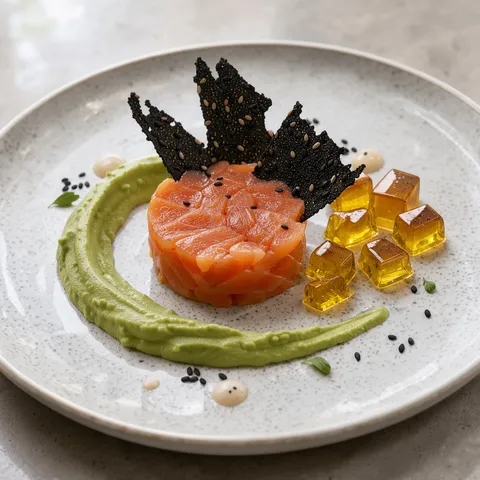 Salmon Tartare, Black Sesame Crisp, Wasabi Avocado45 min · Starter
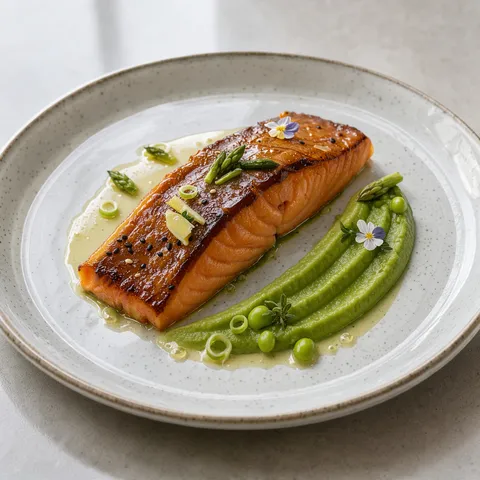 Salmon, Miso Glaze, Dashi Beurre Blanc, Edamame Purée50 min · Main course
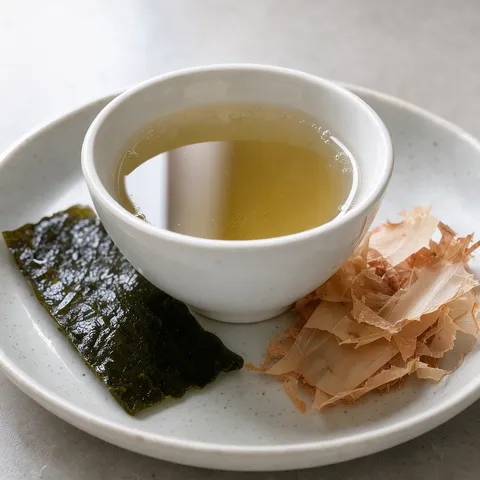 Ichiban Dashi1 hr 45 min · Basic recipe
 Miso Soup15 min · Soup
 Sushi Rice1 hr 15 min · Basic recipe
 Nigiri45 min · Main course