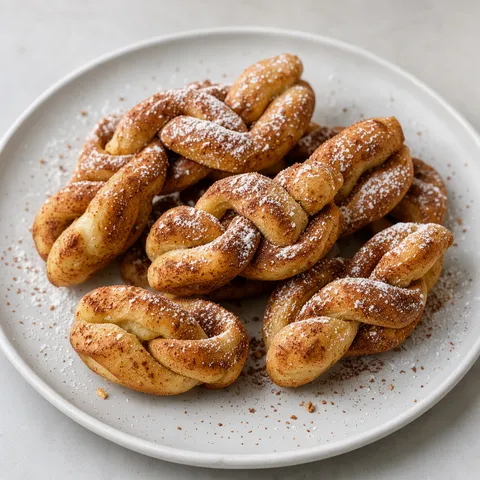
Luxembourg Fried Yeast Dough Knots Verwurelter
A Luxembourgish dessert. Takes 1 hr 10 min · +1 hr 30 min rising, Serves 4. Difficulty: challenging.
At a glance
- Total time
- 1 hr 10 min · +1 hr 30 min rising
- Serves
- Serves 4
- Difficulty
- Challenging
- Cuisine
- Luxembourgish cuisine
- Dish type
- Dessert
- Allergens
- Gluten, Milk, Eggs
Ingredients
Dough (makes about 21)
- 400 g plain flour (+30 g for rolling)
- 10 g fresh yeast (or 4 g fast-action dried yeast)
- 150 ml lukewarm milk
- 50 g caster sugar
- 2 eggs (room temperature)
- 60 g butter (soft)
- 1 tbsp rum (alcohol-free: 1 tbsp milk + 1/2 tsp vanilla extract)
- grated zest of 1 lemon
- 1/2 tsp salt
Frying
- 1.5 litres sunflower oil
Topping
- 40 g icing sugar
- 1/2 tsp cinnamon
Equipment
- Mixing bowls
- Fine grater
- Cling film
- Rolling pin / oklava
- Chef's knife
- Baking tray
- Heavy-based saucepan
- Probe thermometer
- Colander
- Fine sieve / chinois
Method
- Activate the yeast: Put the lukewarm milk (about 35°C, it should feel warm when dripped on your wrist) in a bowl, add 1 tsp of the sugar and the yeast and stir. Leave for 10 min. Foam should form on the surface. If there is no foam, the yeast is dead and the dough cannot be saved
- Knead the dough: In a large bowl, mix the flour, the remaining sugar, the salt and the lemon zest finely grated on a microplane. Add the yeasted milk, eggs and rum and bring together in the bowl. Turn out onto the work surface and knead for 6 min, then add the soft butter piece by piece and knead for 5 min more. The dough is sticky at first, but as it takes in the butter it becomes smooth, silky and elastic, and should let light through when stretched thin
- Prove: Shape the dough into a ball, put it in a lightly oiled bowl and cover with cling film. Prove in a warm place without draughts for 1 hr, until doubled in volume. Dip your finger in flour and press into the dough: if the dent fills back slowly, it is ready
- Roll out: Knock the air out of the dough by pressing lightly with your palm. On a floured surface, roll with a rolling pin into a 30×36 cm rectangle about 7-8 mm thick. The thickness must be even, as thin spots harden in frying
- Cut and knot: With a floured chef's knife, cut the dough into strips 4 cm wide and 12 cm long, giving about 21. Cut a 4 cm slit in the middle of each strip, pass one end of the strip through the slit and pull back, so that the strip twists around itself into a small knot. The Luxembourgish name Verwurelter is said to mean "tangled together"
- Second prove: Arrange the knots on a floured tray 3 cm apart, cover with a clean tea towel and leave for 30 min, until slightly puffed. Start heating the oil in the meantime
- Heat the oil: In a heavy-based 20 cm pan, heat 1.5 litres oil to 170-175°C, checking with a thermometer. The oil should be about 5 cm deep. In hotter oil the outside burns and the inside stays raw, and in cooler oil the dough absorbs oil
- Fry: Lower the knots into the oil in batches of 4 (about 6 batches) and fry for 1.5-2 min on each side, until deep golden, turning with a slotted spoon. Tear one open: the inside should be cotton-soft and dry. Lift out onto kitchen paper and check the oil temperature between batches
- Sugar: Mix the icing sugar and cinnamon. Dust generously over the knots through a fine sieve while they are warm. If sprinkled while hot, the sugar melts, and once completely cold it will not stick. Serve on the same day, ideally warm
Chef's note
Verwurelter is the sweet of the carnival season (Fuesent) in Luxembourg. Some recipes use baking powder and cream instead of yeast, which makes the dough more biscuit-like. Part of the oil used here can be strained and reused once more if it has not picked up a frying smell. It is also common to serve them with plum purée.
Frequently asked questions
- How can you tell if the yeast is alive?
- Leave it for 10 minutes with the lukewarm milk and sugar. A foam should form on the surface. If there is no foam, the yeast is dead and the dough cannot be saved.
- How do you stop Luxembourg Fried Yeast Dough Knots from staying raw inside?
- Keep the oil at 170-175°C. In hotter oil the outside burns while the inside stays raw, and in cooler oil the dough soaks up oil.
- When should the icing sugar be sprinkled on?
- Sprinkle it while the knots are warm. On hot knots the sugar melts, and once they are completely cold it will not stick.
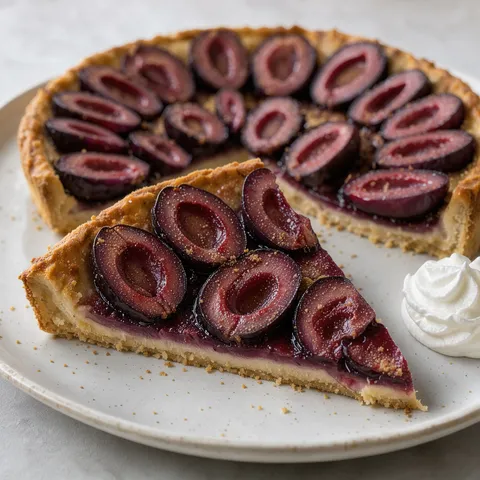 Luxembourg Damson Plum Tart1 hr 25 min · Dessert
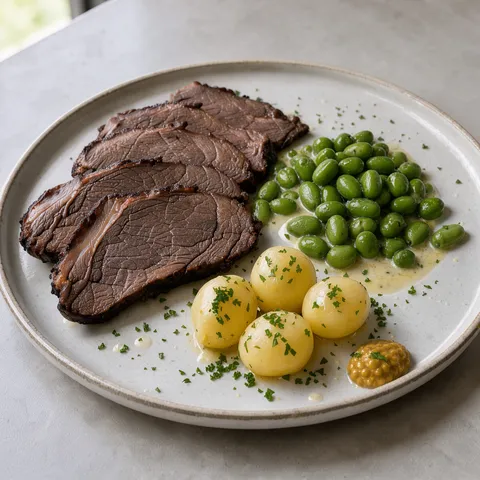 Smoked Beef with Broad Beans2 hr 30 min · Main course
 Luxembourg Green Bean Soup1 hr · Soup
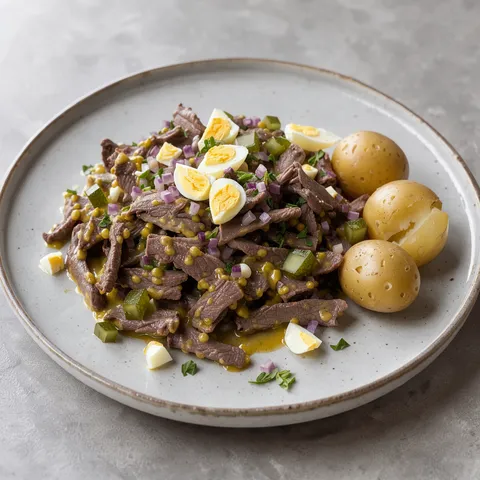 Luxembourg Cold Boiled Beef Salad3 hr 45 min · Starter
 Luxembourg Spoon-Cut Flour Dumplings45 min · Main course
 Luxembourg Breaded Beef Tripe3 hr 50 min · Main course