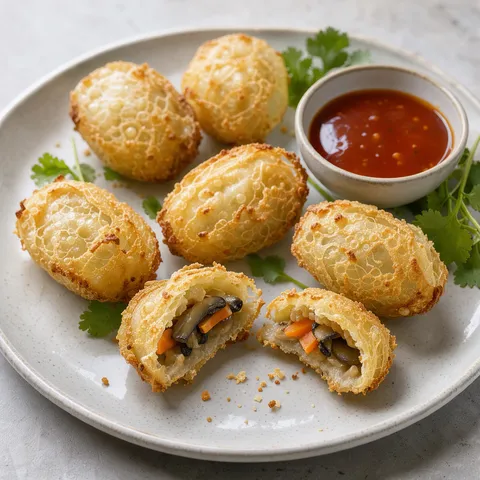
Cantonese Fried Taro Dumplings Wu Gok
A Chinese meze. Takes 1 hr 17 min, Makes 24. Difficulty: medium.
At a glance
- Total time
- 1 hr 17 min
- Serves
- Makes 24
- Difficulty
- Medium
- Cuisine
- Chinese cuisine
- Dish type
- Meze
- Allergens
- Gluten, Molluscs, Sesame, Soya
Ingredients
- Taro dough (24 pieces, 22 g of dough each): 450 g taro (peeled)
- 60 g wheat starch
- 30 ml neutral oil
- 1 tsp caster sugar
- 1/2 tsp salt
- 1/2 tsp Five-Spice (Basics, the first blend in Five-Spice and Garam Masala). Filling (24 × 6 g, about 145 g): 150 g oyster mushrooms (3 mm cubes)
- 40 g carrot (3 mm cubes)
- 2 spring onions (finely chopped)
- 1 garlic clove
- 1 tsp grated ginger
- 1 tbsp soy sauce
- 1 tsp sesame oil
- 1 tsp cornflour and 1 tbsp water
- 1 tbsp neutral oil
Frying
- 1.5 litres neutral oil (about 4.8 cm deep in a 20 cm pan)
To serve
- Sweet and Sour Sauce (Basics, 24 × 6 g, about 145 g)
- 24 coriander leaves
Equipment
- Steamer basket
- Potato masher
- Sauté pan
- Saucepan
- Probe thermometer
- Colander
- Mixing bowls
- Baking tray
- Baking paper
- Precision scales
- Fine grater (optional)
Method
- Steam the taro: Peel the taro wearing gloves, because raw taro makes hands itch, and cut into 2 cm cubes. Steam in a steamer basket or in a colander over boiling water for 20 min, until a knife tip goes in with no resistance. If the cubes are all the same size, the outside will not turn mushy while the inside stays firm. Make the filling while it steams (~22 min)
- Cook the filling: While the taro steams, heat 1 tbsp oil in a sauté pan over high heat and fry the mushroom cubes for 4 min, until they release their liquid and it cooks off. Add the carrot, garlic and ginger and cook for 1 min, then add the soy sauce and cook for 30 sec. Loosen 1 tsp cornflour with 1 tbsp water, pour into the pan and stir for 20 sec: the filling turns glossy and sticky. Take off the heat, stir in the spring onion and sesame oil and spread on a plate. Once cool it should weigh about 145 g, as a wet filling soaks the dough and bursts in the frying
- Mash and knead the dough: Mash the hot taro in a bowl at once with a smooth masher or a fork, as it is harder to mash once cool and stays lumpy. Add the starch, oil, sugar, salt and five-spice and knead with a spoon and then by hand for 3 min. Test for doneness: the dough should be an elastic paste that does not stick to your hands. If it sticks add 1 tbsp starch, and if it is dry add 1 tbsp hot water. It should come to about 545 g in total (~8 min)
- Shape: Oil your hands. Make 24 balls of 22 g (weigh the first three), flatten each into a 6 cm circle in your palm, put 6 g of filling in the middle, close the edges and shape in your palm into an egg shape of 6×3.5 cm. Arrange seam side down on a tray lined with baking paper. The filling must stay in the centre, since filling that leaks to the edge mixes into the oil in frying and splits the piece (~20 min)
- Chill: Chill the tray in the fridge for 10 min. The chilled dough firms up and does not fall apart in the oil. Heat the oil in the pan in the meantime (~10 min)
- Fry: Heat the oil in a 20 cm pan to 170°C with a thermometer. Lower in 6 pieces at a time and fry for 3 min, turning, until the crust puffs up like lace and turns deep golden (4 batches). If the oil is low the taro soaks up oil and turns heavy, and if it is high the outside burns while the inside stays cold. Lift out with a slotted spoon and drain on kitchen paper for 30 sec (~14 min)
- Serve: Arrange the pieces on a flat ceramic plate with 6 g of Sweet and Sour Sauce and a coriander leaf beside each. Eat hot within the first 8 min, as the crust softens when it cools (~3 min)
Chef's note
Serve hot. Allow 2 per person, 120 people × 2 = 240 pieces. As the recipe makes 24, the multiplier is 240/24 = 10, or 10.5 with 5% allowed for waste (4.7 kg taro, 630 g wheat starch, 1.6 kg oyster mushrooms, 420 g carrot, 1.5 kg Sweet and Sour Sauce). The original recipe uses pork mince and dried mushrooms for the filling of Cantonese wu gok; here it is made with an entirely plant-based mushroom filling. At yum cha tables, wu gok stands out for its lacy crisp crust. Taro is found in Asian and Mediterranean grocers. If you cannot find it, use half sweet potato and half potato, but the lacy crust is less pronounced. Shaped raw pieces keep 1 day in the fridge and 1 month in the freezer and are fried without thawing at 175°C for 4 min. Fried pieces are refreshed in a 180°C oven for 6 min. Capacity: 252 pieces in 42 batches (about 3 min per batch), about 2 hr in one pan, about 45 min in 3 pans. It is entirely plant-based, but not gluten-free because it contains wheat starch.
Frequently asked questions
- Why are gloves worn when peeling taro?
- Raw taro makes the hands itch, so peel it with gloves on.
- What if the taro dough sticks too much to my hands?
- If the dough is sticky add 1 tablespoon of wheat starch, and if it is dry add 1 tablespoon of hot water. A dough of the right consistency is a pliable paste that does not stick to your hands.
- Why do wu gok turn heavy or burst when fried?
- If the oil stays below 170°C the taro soaks up oil, and if it is too hot the outside burns while the inside stays cold. A wet filling also soaks the dough and makes it burst, so cook the filling until dry and chill the pieces for 10 minutes before frying.
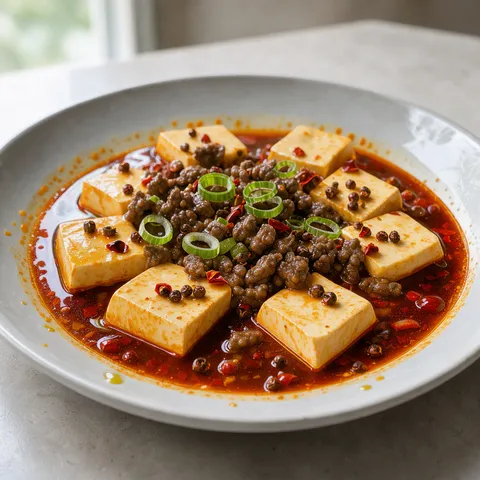 Mapo Tofu35 min · Main course
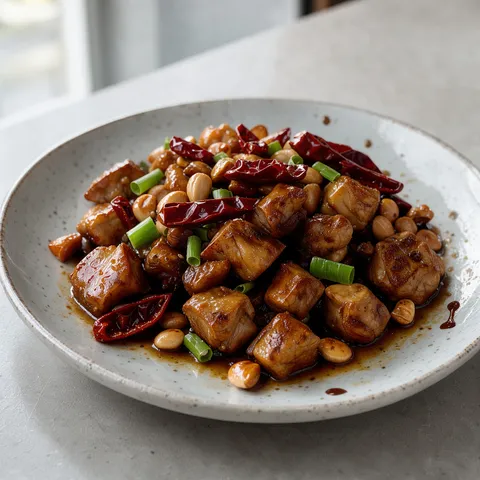 Kung Pao Chicken30 min · Main course
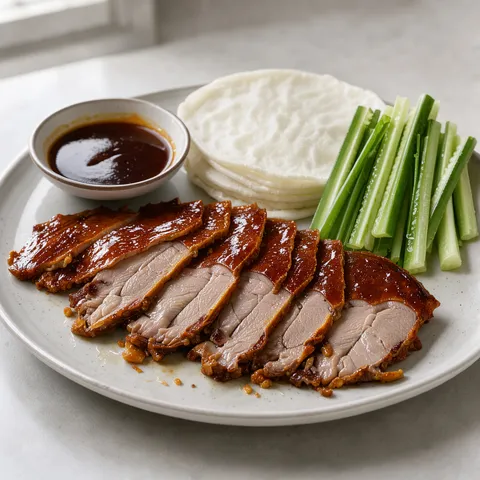 Peking Duck2 hr · Main course
 Char Siu1 hr · Main course
 Crystal Prawn Dumplings1 hr 30 min · Starter
 Open-Topped Dumplings50 min · Starter