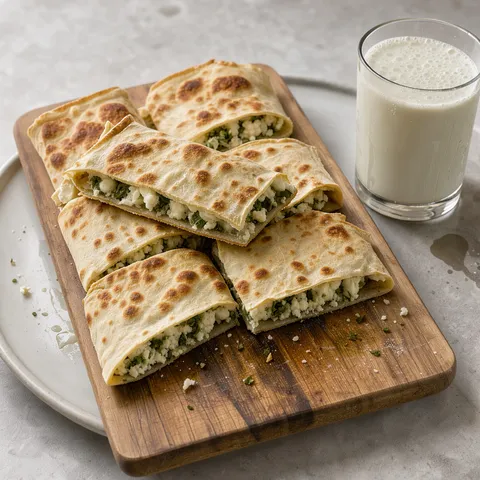
Griddle Rolls with Dry Curd Cheese Yoruk Sikmasi
A Turkish bread & pastry. Takes 1 hr 20 min, 8 pieces (4 servings). Difficulty: medium.
At a glance
- Total time
- 1 hr 20 min
- Serves
- 8 pieces (4 servings)
- Difficulty
- Medium
- Cuisine
- Turkish cuisine
- Dish type
- Bread & pastry
- Allergens
- Gluten, Milk
Ingredients
Dough
- 400 g plain flour
- about 240 ml lukewarm water
- 1 tsp salt
- 3-4 tbsp plain flour for rolling out
Filling
- 250 g dry dry curd cheese (crumbled)
- 1/2 bunch flat-leaf parsley (about 25 g, finely chopped)
- 4 spring onions (finely chopped)
- 1 tsp Aleppo pepper
- 1/4 tsp salt
Butter
- 60 g butter (melted)
To serve
- 400 ml cold ayran (salted yoghurt drink)
Equipment
- Mixing bowls
- Rolling pin / oklava
- Cast-iron frying pan
- Pastry brush
- Chef's knife
- Chopping board
- Saj (optional)
Method
- Knead the dough: Put the flour and salt in a bowl and knead for 8 min, adding the lukewarm water a little at a time. The dough should be smooth, soft and pliable, like an earlobe. As this yeast-free dough is rolled out as thin as yufka, the gluten must be well developed
- Rest: Divide the dough into 8 equal balls of about 80 g each. Roll them, cover with a damp cloth and rest for 20 min. Rested dough does not spring back or tear as you roll it out
- Make the filling: While the dough rests, mix the dry curd cheese with the chopped parsley, spring onions, Aleppo pepper and salt in a bowl. If the dry curd cheese is salty, use less salt. The filling should be dry and fine-grained, as a wet filling soaks and tears the yufka
- Heat the saj or pan: Heat the saj or a 30 cm cast-iron frying pan over medium heat for 5 min. A pinch of flour sprinkled on the surface should brown lightly within 10 sec. If it blackens at once, turn down the heat
- Roll out: Roll a ball out on a floured surface with a rolling pin into a thin sheet, like yufka, about 30 cm across and 1 mm thick. Held up to the light, it should look slightly translucent
- Cook: Wrap the sheet around the rolling pin and unroll it onto the hot saj. After 40-50 sec, when bubbles form on the surface and brown speckles appear underneath, turn it and cook the other side for 30-40 sec. Overcooked yufka dries out, cracks and cannot be rolled
- Roll and squeeze: Transfer the cooked yufka to the work surface and immediately brush thinly with melted butter. Spread an eighth of the filling, about 35 g, in a strip along one edge and roll up tightly. Squeeze the hot roll once along its length with both hands, so the butter and dry curd cheese stick to the yufka and it takes the flat, tight shape that gives sikma ("squeezed") its name. Cook one while you roll out the next. The 8 sikma take about 30 min in total
- Plate: Cut each sikma in half diagonally with a knife, stack them on a wooden board with the cut sides showing and brush with the remaining butter. Serve hot, with cold ayran
Chef's note
Sikma is known as a pastry from the Yoruk villages of Mersin and the Taurus Mountains, in which yufka cooked on the saj is rolled up with butter and dry curd cheese, squeezed and eaten. The filling varies from place to place and is also made with boiled potato, nettles or fried mince. If dry curd cheese is unavailable, use fresh curd cheese drained in muslin. If you have no saj, a cast-iron frying pan does the same job.
Frequently asked questions
- Why does the dough tear when I roll it out?
- Knead the dough to the softness of an earlobe and rest the dough balls for 20 minutes. Rested dough does not spring back when rolled, so it does not tear.
- What happens if the filling is wet?
- A wet filling soaks the dough and tears it. So keep the curd cheese fine and dry, and use less salt if the cheese is salty.
- What do I serve with Yoruk Sikmasi?
- Serve them hot with cold ayran. Cut the rolls in half on the diagonal and brush with the remaining butter.
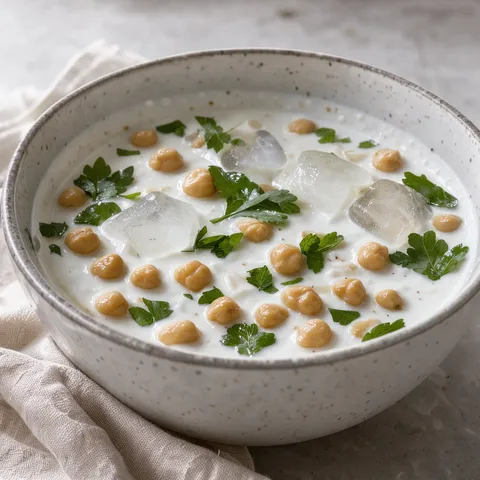 Chilled Wheat Yoghurt Soup1 hr · Soup
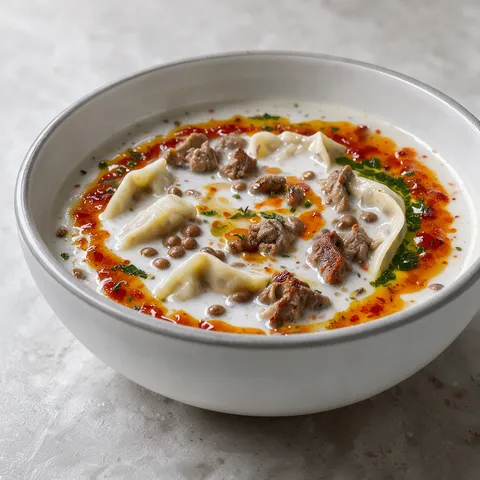 Noodle and Yoghurt Soup1 hr 10 min · Soup
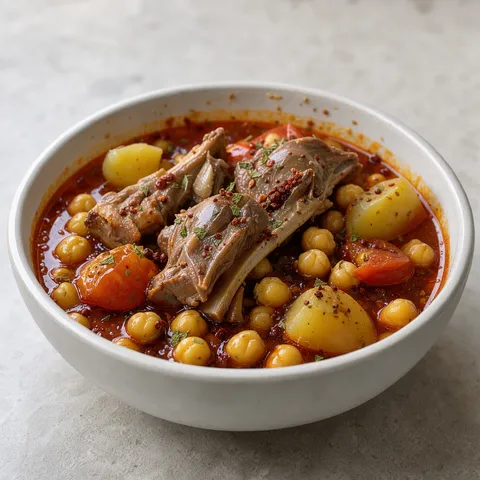 Lamb, Chickpea and Potato Stew1 hr 15 min · Soup
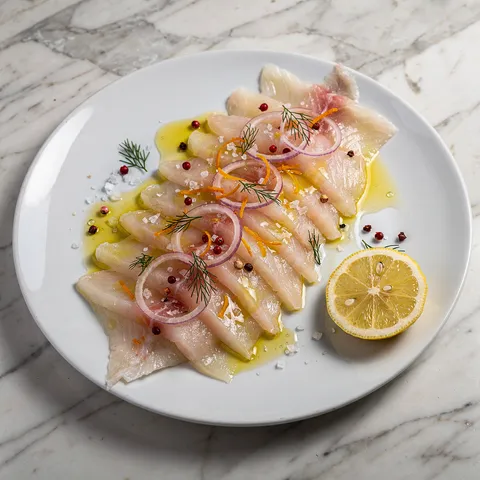 Marinated Sea Bass30 min · Meze
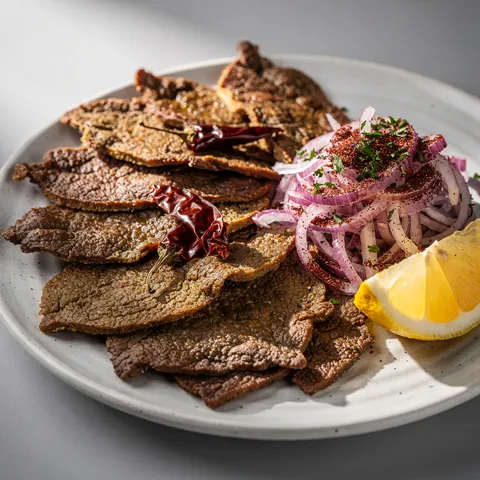 Crispy Fried Liver Slices25 min · Meze
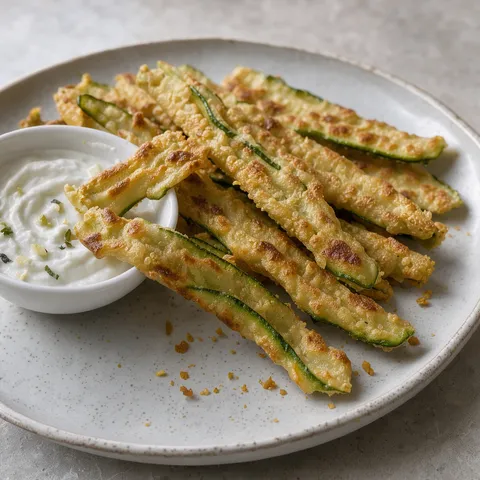 Courgette Crisps30 min · Meze