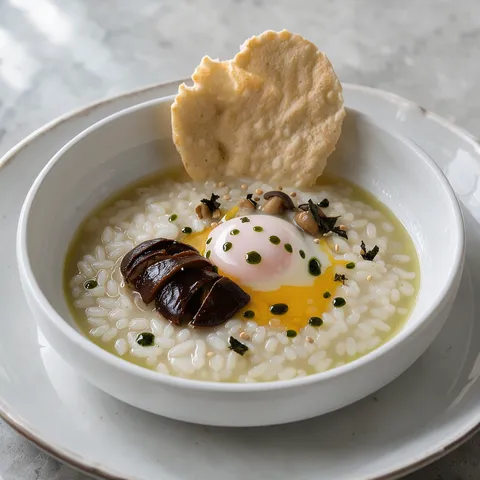
Zosui 2.0
A Japanese main course. Takes 1 hr 6 min, Serves 4. Difficulty: professional.
At a glance
- Total time
- 1 hr 6 min
- Serves
- Serves 4
- Difficulty
- Professional
- Cuisine
- Japanese cuisine
- Dish type
- Main course
- Allergens
- Gluten, Milk, Eggs, Fish, Sesame, Soya
Ingredients
Dashi
- 1 litre water
- 10 g kombu
- 10 g dried shiitake
- 1 tsp salt
Risotto
- 250 g sushi rice (dry)
- 1 tbsp neutral oil
- 1 tbsp soy sauce
- 1 tbsp mirin
- 20 g cold butter
- 1 tsp finely grated fresh ginger
Onsen eggs
- 4 eggs (fridge temperature)
- 1 litre water
Crisp rice
- 120 g cooked sushi rice (leftover rice from the day before)
- 1 tbsp cornflour
- 1/2 tsp salt
- 300 ml neutral oil (for frying)
Shiitake confit
- 8 fresh shiitake caps
- 150 ml neutral oil
- 1 garlic clove
- 1/4 tsp salt
Nori oil
- 2 nori sheets
- 60 ml neutral oil
To finish
- 2 spring onions
- toasted sesame seeds
- flaky salt
Equipment
- Saucepan
- Frying pan
- Oven
- Baking tray
- Baking paper
- Rolling pin / oklava
- Probe thermometer
- Blender
- Fine sieve / chinois
- Muslin
- Colander
- Ladle
- Wooden spoon / spatula
- Mixing bowls
- Chef's knife
Method
- Make the dashi: Put the kombu and shiitake in 1 litre cold water in a pan and heat over medium heat. When bubbles rise at the edges, take out the kombu, simmer the shiitake for 5 min more, then lift out and slice thinly. Season the dashi with the salt and keep hot on the hob. Kombu left in the boiling dashi turns bitter (~12 min)
- Onsen eggs: In a pan bring 1 litre water to 80°C, take off the heat and add 200 ml cold water. When the water falls to 66-67°C, gently lower in the eggs and cover. Leave for 45 min, keeping the temperature between 63-65°C with a thermometer. If the temperature falls below 63°C, turn the heat on very briefly, without letting it exceed 65°C. When the eggs come out, put them in cold water, and the white sets softly and the yolk turns creamy (~45 min)
- Spread the rice crisps: While the eggs wait, preheat the oven to 170°C. In a bowl mix the cooked rice with the cornflour and salt, working without crushing the grains. Transfer to a tray lined with baking paper, put a second sheet on top and roll out to 2 mm thick with a rolling pin. If it is not spread thin, the middle does not crisp (~5 min)
- Dry the rice: Put the tray in the oven and dry for 20 min. The edges should turn golden and the rice sheet should harden like glass. Take out and leave to cool, and it crisps as it cools (~20 min)
- Shiitake confit: While the rice dries, in a small pan heat the oil with the thinly sliced garlic and salt to 90°C. Lay the mushroom caps in the oil and cook over low heat for 20 min, keeping the temperature below 90°C with a thermometer. The mushroom absorbs the oil and gains a silky texture. Drain in a colander (~20 min)
- Make the nori oil: While the rice dries, warm the nori sheets lightly in a dry pan for 20 sec and crumble by hand. Blend vigorously with the oil in a blender for 1 min. Pass through a fine sieve and muslin. The oil should be dark green and glossy (~5 min)
- Toast the rice: While the eggs are still waiting, heat the neutral oil in a large pan over medium heat. Add the unwashed dry rice and stir with a wooden spoon for 2 min until the grains turn translucent. Because the starch is not washed off, it gives the risotto a creamy texture (~3 min)
- Add the dashi gradually: Add two ladles of hot dashi and stir constantly with a wooden spoon. When the liquid is absorbed, add another ladle. Add the dashi slowly over a total of 16 min and fold in the shiitake slices for the last 5 min. The rice should be al dente but creamy (~16 min)
- Finish the risotto: Take off the heat, add the soy sauce, mirin, ginger and cold butter, stir vigorously for 30 sec and rest covered for 1 min. The consistency should be like a cream that runs off the spoon and spreads slightly on the plate (~3 min)
- Fry the crisps: Heat 300 ml oil to 180°C in a pan. Break the cooled rice sheet into 4-5 cm pieces and fry in the oil for 15 sec, drain at once on kitchen paper and sprinkle with flaky salt. The rice puffs up in the oil immediately and turns golden (~3 min)
- Plate: Spoon the risotto onto a warmed deep plate. Break an onsen egg in the centre. Arrange the shiitake confit and drops of nori oil around it. Stand the crisps upright beside the egg and scatter over the spring onion and sesame. When the yolk bursts, the part that turns into soup recalls classic zosui (~3 min)
Chef's note
Classic zosui is hot and comforting in a bowl; here the same flavours are split into four textures: the risotto is creamy, the onsen egg runny, the rice crisp crunchy and the nori oil gives a sea aroma. The rice crisp must be spread thin on the tray, because if thick, the inside stays raw. If you go over 65°C with the onsen egg, the yolk hardens. Soy sauce and mirin are traditional ready-made products.
Frequently asked questions
- At what temperature are onsen eggs cooked?
- Keep the water between 63 and 65°C with a thermometer. If it drops below 63°C, switch the hob on for a very short time, and never go above 65°C.
- Why isn't the risotto rice washed?
- Unwashed dry rice keeps its starch and gives the risotto a creamy texture. Add the hot dashi a little at a time.
- Why is the rice crisp spread thin?
- If it isn't spread thin, the middle won't crisp up. Roll the layer of rice out to 2 mm thick between two sheets of baking paper with a rolling pin.
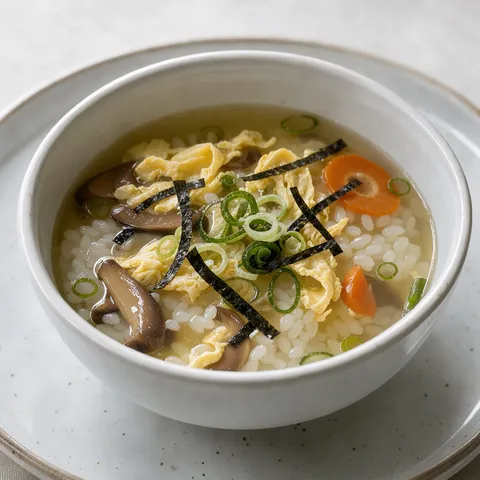 Zosui28 min · Soup
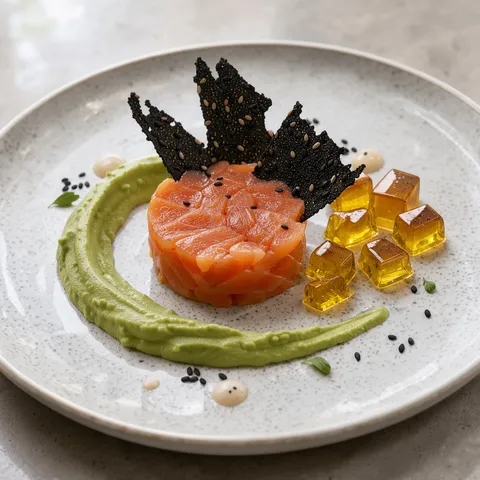 Salmon Tartare, Black Sesame Crisp, Wasabi Avocado45 min · Starter
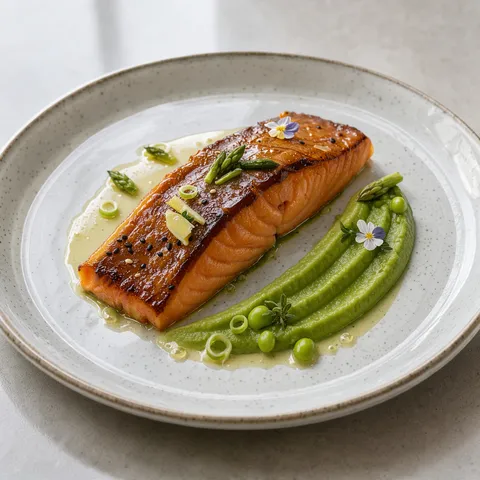 Salmon, Miso Glaze, Dashi Beurre Blanc, Edamame Purée50 min · Main course
 Ichiban Dashi1 hr 45 min · Basic recipe
 Miso Soup15 min · Soup
 Sushi Rice1 hr 15 min · Basic recipe
 Nigiri45 min · Main course