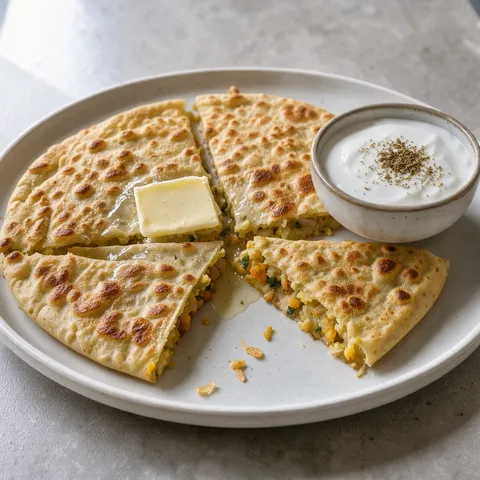
Punjabi Potato-Stuffed Flatbread Aloo Paratha
An Indian bread & pastry. Takes 1 hr 35 min, 8 pieces (4 servings). Difficulty: medium.
At a glance
- Total time
- 1 hr 35 min
- Serves
- 8 pieces (4 servings)
- Difficulty
- Medium
- Cuisine
- Indian cuisine
- Dish type
- Bread & pastry
- Allergens
- Gluten, Milk
Ingredients
Dough (makes 8)
- 320 g wholemeal flour (atta or finely ground wholemeal flour)
- 1/2 tsp salt
- 1 tbsp Clarified Butter (Basics)
- 200-210 ml lukewarm water
- 50 g wholemeal flour for rolling
Filling
- 600 g floury potatoes (3-4 medium)
- 2 green chillies (very finely chopped)
- 1 tbsp freshly grated ginger
- 1/2 bunch coriander (very finely chopped)
- 1 tsp toasted ground cumin
- 1/2 tsp ajwain
- 1 tsp amchur (or 1 tbsp lemon juice)
- 1/2 tsp Kashmiri chilli powder
- 1/2 tsp Garam Masala (Basics)
- 1 tsp salt
For cooking
- 80 g Clarified Butter (Basics) or butter
To serve
- 300 g yoghurt (whisked with a pinch of salt and 1/2 tsp toasted cumin)
- 40 g butter
Equipment
- Saucepan
- Mixing bowls
- Baking tray
- Box grater
- Rolling pin / oklava
- Cast-iron frying pan
- Silicone spatula
- Chef's knife
- Chopping board
- Precision scales (optional)
- Saj (optional)
Method
- Boil the potatoes: Put the potatoes in their skins in cold water, bring to the boil and cook for 20-25 min, until a knife slides in without resistance. Potatoes boiled in their skins absorb less water, so the filling stays dry and does not tear the dough when you roll it
- Knead the dough: While the potatoes boil, put the flour and salt in a bowl, add the ghee and knead for 8 min, adding the lukewarm water a little at a time. The dough should be as soft as an earlobe, smooth and not sticky. Cover with a damp cloth and rest for 30 min: the gluten relaxes and the dough does not spring back when rolled thin
- Make the filling: Peel the potatoes, spread them on a tray and leave for 10 min to cool completely. Grate them on the fine side of the grater or mash until no lumps remain: lumps pierce the dough when rolling. Add the green chillies, ginger, coriander and all the spices. Mix in the salt just before filling: salt draws water from the potato and the wet filling soaks the dough
- Divide: Divide the dough into 8 equal pieces (about 65 g) and the filling into 8 equal balls (about 75 g). Keep the dough balls under a cloth: if they dry out, they crack
- Fill: Press a dough ball in your palm into a 10 cm disc, thick in the centre and thin at the edges. Put a ball of filling in the middle, gather the edges up like a pouch and pinch them together, tear off the excess dough and flatten the top with your palm
- Roll out: Dredge the parcel in flour and set it on the worktop, seam-side up. Roll it out with light pressure to 18-20 cm across, giving it a quarter turn after each roll. The filling should spread evenly to the edges: if it tears anywhere, sprinkle over a pinch of flour and carry on
- Cook: Heat a cast-iron pan over medium-high heat for 2 min. Put the paratha in the dry pan and wait 30-40 sec, until small bubbles and dry spots appear underneath, then flip and cook for 30 sec more. Spread 1 tsp ghee on top, flip and fry for 1 min, pressing the edges down with a spatula, then spread ghee on the other side and cook for 1 min more. Both sides should be speckled golden brown and the edges cooked through. The first side, cooked dry, seals the dough, and the fat then adds crispness. Roll out the next paratha while one is cooking
- Keep warm: Stack the cooked parathas between the folds of a clean tea towel. They stay soft in their own steam, while a paratha left uncovered goes hard
- Plate: Put a hot paratha on a plate, top with a knob of cold butter and cut into quarters. Set the cumin yoghurt alongside in a small bowl. Serve at once
Chef's note
The star of the Punjabi winter breakfast, it is eaten with white homemade butter (makhan) and spicy pickle (achar). Atta is sold in Indian shops: if unavailable, replace a fifth of the finely ground wholemeal flour with white flour, and the dough will be easier to roll. The same technique is used for parathas stuffed with cauliflower (gobi) or white radish (mooli).
Frequently asked questions
- Why does aloo paratha tear when rolled out?
- If the potato filling is lumpy or watery from salt, it punctures the dough. Boil the potatoes in their skins, cool and finely grate them, and add the salt just before filling.
- Why is the dough rested for 30 minutes?
- Resting relaxes the gluten, so the dough doesn't spring back when rolled thin. The dough should be as soft as an earlobe and not sticky.
- How do I keep the parathas soft once cooked?
- Stack the cooked parathas between clean cloths so that they stay soft in their own steam. Paratha left uncovered turns hard.
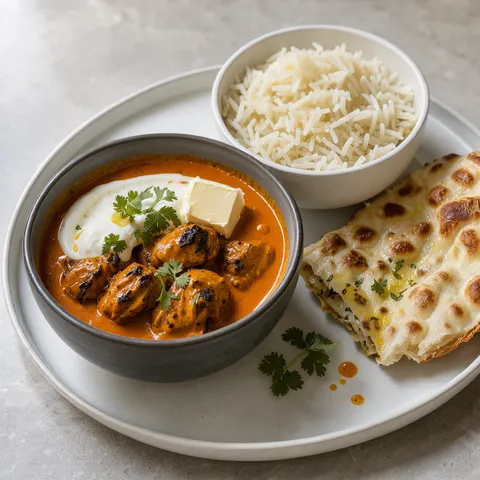 Indian Butter Chicken50 min · Main course
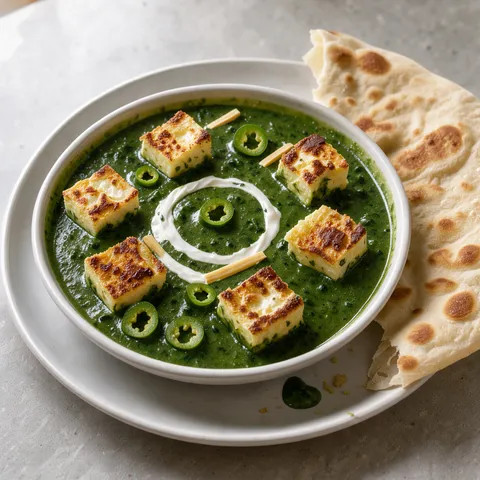 Spinach with Homemade Paneer45 min · Main course
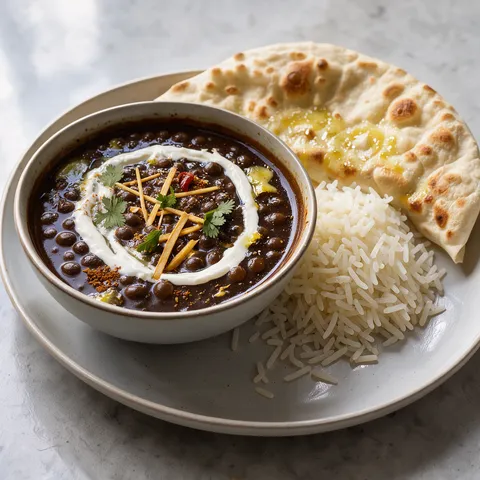 Black Lentil and Kidney Bean Stew1 hr 30 min · Main course
 Chicken Dum Biryani1 hr 30 min · Main course
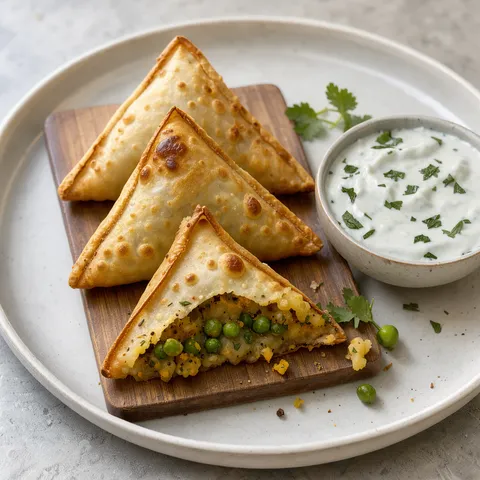 Indian Potato Pastries1 hr 30 min · Bread & pastry
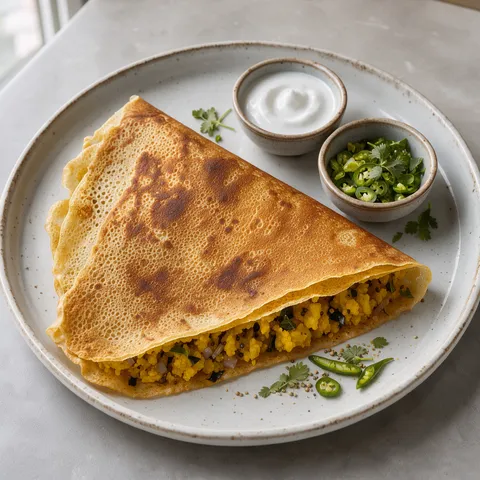 Fermented Rice Crêpes with Spiced Potato50 min · Bread & pastry