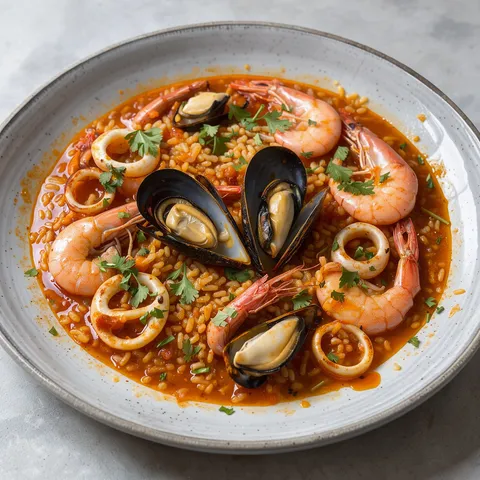
Portuguese Seafood Rice with Coriander Arroz de Marisco
A Portuguese main course. Takes 1 hr 25 min, Serves 4. Difficulty: medium.
At a glance
- Total time
- 1 hr 25 min
- Serves
- Serves 4
- Difficulty
- Medium
- Cuisine
- Portuguese cuisine
- Dish type
- Main course
- Diet
- Gluten-free
- Allergens
- Crustaceans, Molluscs, Sulphites
Ingredients
Seafood
- 500 g medium shell-on prawns (about 16)
- 500 g live mussels
- 300 g cleaned squid
Seafood stock
- prawn shells and heads
- 1 tbsp extra virgin olive oil
- 1.3 litres water
- 1 bay leaf
Sofrito
- 4 tbsp extra virgin olive oil
- 1 medium onion (about 150 g)
- 1 pale green Charleston pepper (about 60 g)
- 1 red romano pepper (about 150 g)
- 3 garlic cloves
- 1 tbsp tomato paste
- 400 g ripe tomatoes (grated)
- 100 ml dry white wine (alcohol-free: 100 ml water + 1 tbsp lemon juice)
- 1/2 tsp Aleppo pepper
- 1 tsp salt
Rice
- 300 g baldo rice (in place of Portuguese carolino rice)
To finish
- 1/2 bunch fresh coriander
Equipment
- Saucepan
- Heavy-based saucepan
- Fine sieve / chinois
- Muslin
- Chef's knife
- Chopping board
- Box grater
- Wooden spoon / spatula
- Ladle
Method
- Clean the seafood: Pull off the prawn heads and peel off the shells. Score along the back of each prawn with a knife and remove the dark vein. Put the heads and shells in a separate bowl. Pull the beards off the mussels and scrub the shells with a brush. Discard any mussels that are broken, or open and do not close when tapped. Cut the squid into 1 cm rings and halve the tentacles. Keep everything in the fridge
- Make the seafood stock: Heat 1 tbsp olive oil in a 22 cm saucepan over medium-high heat. Add the prawn heads and shells and fry for 4 min, pressing them with a wooden spoon, until orange and fragrant. Add the 1.3 litres water and the bay leaf, bring to the boil, then lower the heat and simmer for 20 min. This quick stock carries the real flavour of the rice: the juices in the heads go into the liquid
- Open the mussels: While the stock simmers, put the mussels in a 26 cm heavy-based saucepan, cover and cook over high heat for 4-5 min, shaking the pan now and then, until the shells open. Discard any that stay closed. Transfer the mussels to a bowl, keep 8 in their shells and take the meat out of the rest. Strain the mussel liquor left in the pan through a fine sieve lined with muslin into a bowl
- Strain the stock: Pass the seafood stock through a fine sieve, pressing the shells with the back of a ladle to extract their juices, then discard them. Add the mussel liquor. You should have about 1.1 litres of liquid. If not, top up with hot water. Keep hot over low heat
- Cook the sofrito: Wipe out the pan you used for the mussels and heat the 4 tbsp olive oil over medium heat. Cook the finely chopped onion and peppers for 8 min, until soft. Add the finely chopped garlic and stir for 1 min, then add the squid and stir for 2 min. Add the tomato paste and fry for 1 min. Pour in the wine and let it bubble for 1 min. Add the grated tomatoes, Aleppo pepper and salt and cook for 6-8 min, until the sauce thickens
- Cook the rice: Add the rice to the sofrito without rinsing and stir for 1 min so the grains are coated in the sauce. Add 1 litre of the hot seafood stock and bring to the boil. Lower the heat and cook uncovered for 15 min, stirring gently now and then. In Portugal arroz de marisco is cooked loose and soupy (malandrinho): somewhere between risotto and soup, it should run off a spoon. If the rice absorbs too much liquid, add more of the hot stock
- Add the prawns and mussels: When the rice is still slightly firm to the bite, add the prawns and the mussel meat, stir and cook for 3 min, until the prawns are pink and opaque. Arrange the mussels in their shells on top. Taste and adjust the salt if needed
- Finish with coriander and serve: Roughly chop the coriander and stir half into the rice. Turn off the heat and leave to rest for 2 min. Divide the rice and its sauce between deep plates straight away and top each plate with 2 mussels in their shells and the remaining coriander. The rice keeps absorbing liquid as it stands, so eat it at once
Chef's note
Arroz de marisco is a sharing dish found everywhere from Portugal's coastal towns to the restaurants of Lisbon, and it usually comes to the table in its pan. Unlike Spanish paella, it is not dry with a crust but generously saucy. In Portugal clams, crab or lobster are often added too. Carolino rice is a starchy, medium-grain rice, and baldo is a good substitute. If you like a little heat, use Portuguese piri-piri chilli instead of Aleppo pepper.
Frequently asked questions
- What consistency should arroz de marisco have?
- In Portugal it is cooked soupy (malandrinho), somewhere between risotto and soup, loose enough to run off a spoon. If the rice absorbs too much liquid, add some of the remaining hot water.
- Are the prawn heads and shells thrown away?
- No. Fry them in olive oil, simmer with water for 20 minutes and strain. This quick stock carries the real flavour of the rice.
- Why is arroz de marisco eaten straight away?
- As it stands, the rice soaks up the liquid and thickens. So rest it for 2 minutes off the heat, then serve immediately.
 Portuguese Kale, Potato and Sausage Soup50 min · Soup
 Salt Cod with Eggs and Crisp Potatoes50 min · Main course
 Portuguese Custard Tarts1 hr 20 min · Patisserie
 Caldo Verde 2.01 hr 15 min · Soup
 Alentejo Coriander Bread Soup30 min · Soup
 Algarve-Style Barbecued Chicken1 hr 40 min · Main course