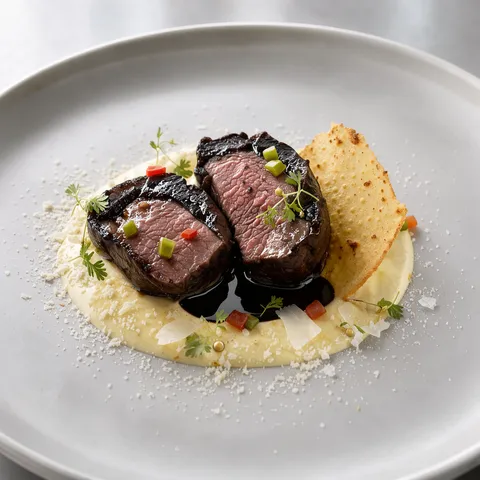
Asado Negro 2.0
A Venezuelan main course. Takes 1 hr 20 min, Serves 4. Difficulty: challenging.
At a glance
- Total time
- 1 hr 20 min
- Serves
- Serves 4
- Difficulty
- Challenging
- Cuisine
- Venezuelan cuisine
- Dish type
- Main course
- Diet
- Gluten-free
- Allergens
- Milk, Sulphites
Ingredients
Beef fillet
- 700 g beef fillet (middle section, to give 4 medallions of 150 g, trimmings and sinew go into the sauce)
- 1 tsp salt
- 1/2 tsp black pepper
- 1 tbsp sunflower oil
- 15 g butter
Negro sauce
- trimmings and sinew from the fillet (about 100 g)
- 1 tbsp sunflower oil
- 60 g papelón (panela; if unavailable, dark brown sugar)
- 2 shallots (finely chopped)
- 2 garlic cloves
- 1/2 red romano pepper (chopped)
- 1 clove
- 1 bay leaf
- 200 ml red wine (alcohol-free: 200 ml red grape juice + 1 tbsp red wine vinegar)
- 300 ml water
- 20 g cold butter
- a pinch of salt
Plantain cream
- 2 very ripe plantains (skins blackened, about 500 g; if unavailable, 450 g orange-fleshed sweet potato)
- 1 tsp salt for boiling
- 30 g butter
- 80 ml milk
- a pinch of nutmeg
Rice crisp
- 40 g long-grain rice
- 100 ml water
- 1/4 tsp salt
- 3 tbsp sunflower oil
Pepper pickle
- 1/2 red romano pepper + 1 sweet long pepper (in place of ají dulce)
- 3 tbsp cider vinegar
- 2 tbsp water
- 1 tsp sugar
- a pinch of salt
To finish
- 30 g firm
- salty white cheese (in place of queso añejo)
- coriander shoots
- flaky sea salt
Equipment
- Chef's knife
- Chopping board
- Saucepan
- Fine sieve / chinois
- Baking paper
- Blender
- Mixing bowls
- Frying pan
- Silicone spatula
- Cast-iron frying pan
- Probe thermometer
- Pastry brush
- Fine grater
Method
- Trim the fillet: Peel the silverskin off the fillet with a thin knife. Cut off the head and tail ends and chop them small together with the skin and sinew (about 100 g, for the sauce). From the middle section, cut 4 medallions of 150 g, each 4 cm tall. Rub with salt and black pepper and leave at room temperature until cooking, as cold meat burns on the outside while the centre stays raw
- Start the negro sauce: In a small saucepan, heat the oil over high heat and brown the meat trimmings for 6 min, until deep brown. Add the papelón and stir for 2-3 min, until it melts into a dark caramel and the first thin wisp of smoke rises. Add the shallots, garlic and romano pepper and stir for 2 min. Pour in the wine (it may spit, so step back). Scrape up the bottom, add the water, clove and bay leaf and cook uncovered over medium heat for 20 min, until the volume has reduced to about 280 ml. Where the classic has the depth of long-cooked meat, here the caramelised trimmings and the reduction provide it
- Cook the rice for the crisp: While the sauce cooks, put the rice, water and salt in a small saucepan, bring to the boil, cover and cook on the lowest heat for 12 min, then leave to steam for 5 min. Spread the hot rice on baking paper and press with the back of a wet spoon into a sheet 5 mm thick, about 15×15 cm. Leave to cool for 10 min, as the cooled rice sheet stays in one piece
- Make the plantain cream: Peel the plantains, cut into 3 cm pieces and boil in salted water for 12-15 min, until a knife slides through without resistance (15-18 min for sweet potato). Drain and, while hot, blend with the butter, milk and nutmeg for 1 min until smooth, then pass through a fine sieve. Keep warm in a small covered saucepan. The consistency should be a thick cream that falls slowly from a spoon
- Make the pickle: Cut the peppers into 2 mm cubes. Bring the vinegar, water, sugar and salt to the boil in a small pan, pour over the peppers and leave for at least 15 min. The sweet pepper aroma of the classic's ají dulce comes back here as an acidic brightness
- Fry the crisp: Heat the oil in a non-stick frying pan over medium heat. Cut the rice sheet into 4 pieces, lift into the pan with a spatula and fry for 5-6 min on each side, until the edges are golden and completely firm. Drain on kitchen paper and sprinkle with flaky sea salt at once. When turning, slide the spatula fully under the sheet, so that it turns in one piece without breaking
- Strain the sauce: Press the sauce through a fine sieve with a spoon into a frying pan. About 180 ml of dark, glossy liquid remains. Set aside until serving
- Sear the fillet: Heat a cast-iron frying pan over high heat until lightly smoking, then add the oil. Sear the medallions for 2-3 min on each side, until a dark crust forms, and turn the edges for 30 sec too. Lower the heat, add the butter and spoon the foaming butter over the meat for 1 min. When the internal temperature reaches 52-54°C, transfer to a board and rest for 5 min. It rises by another 2-3°C while resting
- Glaze: Boil the sauce for 2-3 min, keeping it at 180 ml and at a spoon-coating consistency (if it is thin, reduce a little, and if too thick, add 1-2 tbsp water). Take off the heat, whisk in the cold butter for a shine and adjust the seasoning. Brush 1 tbsp of the sauce over each rested medallion with a pastry brush, which gives a near-black glossy glaze that recalls the caramelised crust of asado negro
- Cut: Cut each medallion in half vertically with a sharp knife. The cut faces should show an even pink centre
- Plate: Put 2 tbsp of plantain cream on the left third of a warm flat plate and drag the back of the spoon to the right to make a comma. Place two fillet halves, cut-side up, at the end of the comma. Pour 1 tbsp of negro sauce at the base of the meat to make a small pool. Stand a piece of rice crisp upright, leaning against the meat. Top the meat with 1 tsp of pepper pickle, finely grate the cheese over the cream with a microplane and finish with coriander shoots and flaky sea salt
Chef's note
The classic asado negro quartet is kept: meat blackened with caramelised sugar, dark sweet-and-sour sauce, white rice and sweet plantain. But each has moved to a new texture: glazed fillet instead of long-cooked leg, a crisp instead of rice, silky plantain cream instead of tajadas. The ají dulce pickle and the salty cheese add points of acidity and salt that the classic lacks. Workflow: while the sauce reduces, the rice and cream are made, and the meat is prepared while the crisp fries. Three hob rings and one cast-iron frying pan are enough.
Frequently asked questions
- How do you adjust the consistency of the negro sauce?
- Once strained through a fine sieve the sauce should come to about 180 ml and coat the spoon. If it is thin, reduce it a little, and if it is too thick, add 1-2 tbsp of water.
- How do you stop the fillet medallions from being raw in the middle?
- Leave the medallions at room temperature until cooking, because cold meat burns outside while the middle stays raw. Take them off at an internal temperature of 52-54°C and rest on a board for 5 minutes.
- What can I use in the cream if I can't find plantain?
- Use 450 g of orange sweet potato in place of the plantain. Boil the sweet potato for 15-18 minutes.
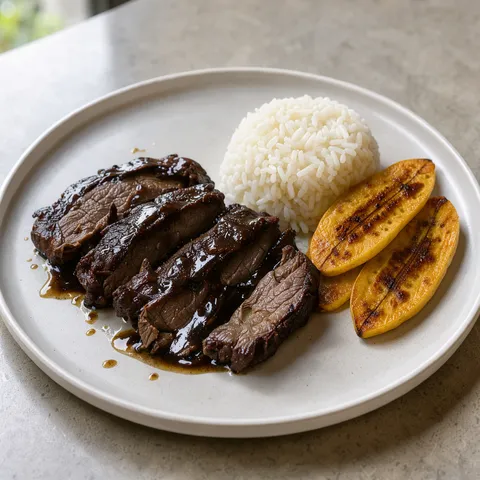 Beef in Dark Caramel Sauce2 hr · Main course
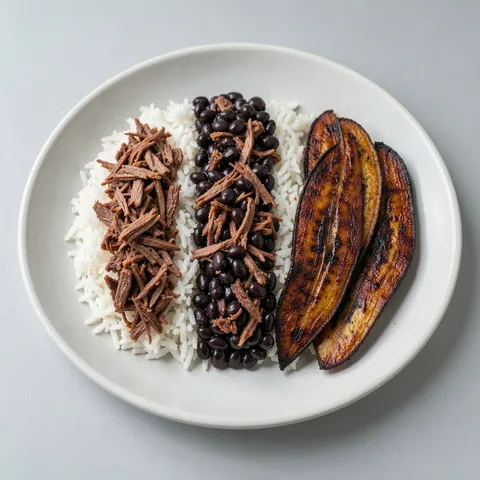 Shredded Beef, Beans and Rice2 hr 30 min · Main course
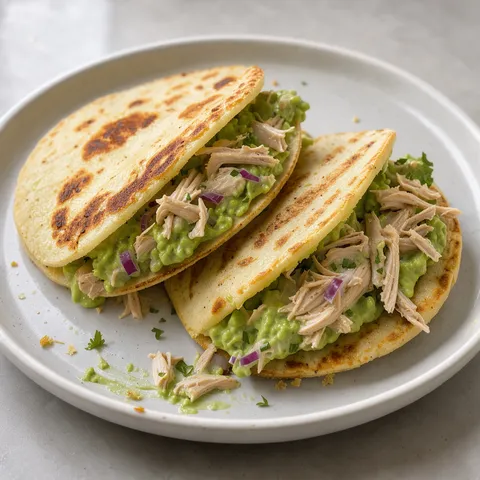 Chicken and Avocado Arepa1 hr 20 min · Bread & pastry
 Venezuelan Caramel Egg Pudding1 hr 50 min · Dessert
 Tequeños with Guasacaca1 hr 45 min · Meze
 Venezuelan Fresh Corn Pancakes28 min · Bread & pastry