Barszcz 2.0
A Polish soup. Takes 1 hr 20 min, Serves 4. Difficulty: challenging.
At a glance
- Total time
- 1 hr 20 min
- Serves
- Serves 4
- Difficulty
- Challenging
- Cuisine
- Polish cuisine
- Dish type
- Soup
- Diet
- Vegetarian
- Allergens
- Gluten, Milk, Eggs, Tree nuts, Celery
Ingredients
Beetroot consommé
- 800 g raw beetroot
- 1 onion
- 1 carrot
- 1 celery stick
- 1 litre Vegetable Stock (Basics)
- 2 dried porcini
- 1 bay leaf
- 3 allspice berries
- 1 garlic clove
- 2-3 tbsp cider vinegar
- 1 tsp sugar
- salt
Mushroom raviolo
- 70 g plain flour
- 1 small egg
- 1 egg yolk
- 1/2 tsp olive oil
- a pinch of salt
Raviolo filling
- 20 g dried porcini
- 200 g chestnut mushrooms
- 1 shallot
- 20 g butter
- 1 tsp fresh thyme leaves
- 15 g breadcrumbs (Basics)
- salt
- black pepper
Beetroot tartare
- 2 small beetroot (about 200 g, skin on)
- 1 tsp cider vinegar
- 1 tsp walnut oil
- 1 tsp finely chopped shallot
- salt
Horseradish cream
- 120 g soured cream (śmietana, 30% fat) or Crème Fraîche (Basics)
- 1.5 tbsp freshly grated horseradish (chrzan)
- 1 tsp lemon juice
- salt
Dill oil
- 30 g dill
- 80 ml neutral oil
To finish
- dill fronds
- 4 radishes (very thinly sliced)
- flaky salt
Equipment
- Box grater
- Saucepan
- Pressure cooker
- Fine sieve / chinois
- Muslin
- Frying pan
- Rolling pin / oklava
- Blender
- Piping bag
- Chef's knife
- Chopping board
- Colander
Method
- Start the consommé: Peel the beetroot and grate on the coarse side of a grater. Finely chop the onion, carrot and celery. Put everything in a saucepan with the vegetable stock, porcini, bay leaf, allspice and crushed garlic. Bring to boiling point, then lower the heat until the surface only trembles and cook for 30 min. Grating the beetroot halves the hour-and-a-half infusion of the classic, as the large surface area passes the colour and sweetness into the liquid very quickly
- Pressure-cook the beetroot: While the consommé cooks, put the small unpeeled beetroot reserved for the tartare in a pressure cooker, add water to cover and cook for 15 min once it reaches pressure. Release the pressure, cool the beetroot in cold water and peel. A knife should slide in without resistance
- Make the raviolo filling: Soak the porcini in 150 ml hot water for 10 min, squeeze out and add the soaking water to the consommé. Very finely chop the porcini and chestnut mushrooms. Soften the shallot in the butter for 2 min, add the mushrooms and thyme and cook over high heat for 8 min, until all the liquid has evaporated and they brown. Add the breadcrumbs, salt and pepper: the filling should be dry and mouldable. Spread on a large plate to cool
- Knead the dough: Knead the flour, egg, yolk, olive oil and salt for 5 min to a smooth, firm dough. Wrap in cling film and rest for 15 min. A dough rich in yolk stays silky even when rolled thin, giving a translucent raviolo
- Make the ravioli: Roll out the dough with a rolling pin or pasta machine to 1 mm thick. Cut out 8 rounds with an 8 cm cutter. Put a domed tablespoon of filling in the centre of four rounds, moisten the edges with water, cover with a second round and press the edges, pushing out the air inside with your fingers. Trim the edges with a 7 cm cutter. Instead of uszka ears, each plate gets a single large mushroom dome
- Tartare and cream: Cut the cooked beetroot into small 4 mm dice and mix with the vinegar, walnut oil, shallot and salt. Whisk the soured cream with the horseradish, lemon juice and salt: after resting for a few minutes the cream firms up enough to pipe. Spoon into a piping bag
- Dill oil: Blend the dill and oil for 2 min, until the mixture warms up, then strain through muslin. You will get a bright green, clear oil
- Clarify the consommé: Strain the consommé through a fine sieve lined with muslin and let it drip through on its own, without pressing the vegetables. If you press, the soup turns cloudy. Set the sweet-sour balance with the vinegar, sugar and salt: the vinegar fixes the ruby colour. The liquid should be clear and deep ruby. Keep hot at around 80°C without boiling until serving and transfer to a teapot or jug
- Boil the ravioli: Boil the ravioli in salted boiling water for 3 min, until they rise to the surface and the edges are soft. Lift out with a slotted spoon and glaze with a little melted butter
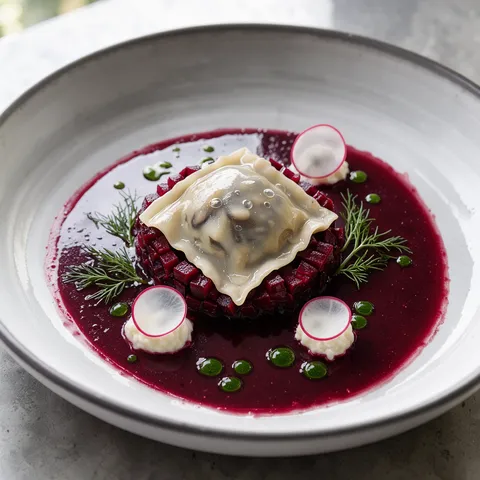
- Plate: In the centre of a warm, wide, deep plate, make a thin disc of beetroot tartare using a 6 cm ring, then lift off the ring. Place the raviolo on top of the tartare. Pipe three small drops of horseradish cream beside the raviolo, stand very thin radish slices upright between them and add dill fronds
- Pour at the table: Bring the plate to the table as it is. Pour the hot consommé from the jug around the raviolo in front of the guest, leaving the top of the raviolo uncovered. Drizzle a few drops of dill oil over: the oil forms green pearls on the ruby base. Sprinkle a pinch of flaky salt over the raviolo
Chef's note
The barszcz z uszkami of the Wigilia table is broken down into layers here: the soup becomes a clear consommé, and dozens of small uszka a single large mushroom raviolo. Two elements not found in the classic, raw horseradish and beetroot tartare, bring to the plate the sharpness and freshness of ćwikła (beetroot with horseradish) from the Polish Easter table. When the consommé is poured at the table, its meeting with the hot raviolo is the plate's first moment.
Frequently asked questions
- How does the consommé stay clear and ruby-coloured?
- Let the consommé drip through a sieve lined with muslin without pressing, as pressing clouds it. The vinegar sets the ruby colour, and it's kept hot at around 80°C without boiling until serving.
- What does grating the beetroot do?
- Grating increases the surface area, so the beetroot gives up its colour and sweetness to the liquid very quickly. This halves the long simmering time of the classic recipe.
- Why must the raviolo filling be dry?
- Cook the filling until the mushrooms have given up all their liquid, bind it with breadcrumbs and cool it. A dry filling that holds its shape makes the raviolo easy to form and stops it breaking during boiling.
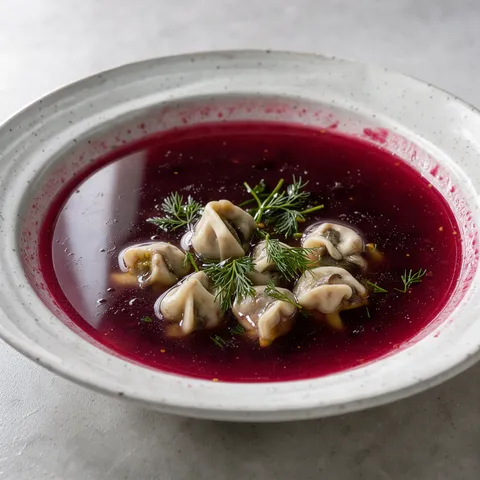 Barszcz Czerwony with Uszka1 hr 40 min · Soup
 Polish Potato and Cheese Pierogi2 hr · Bread & pastry
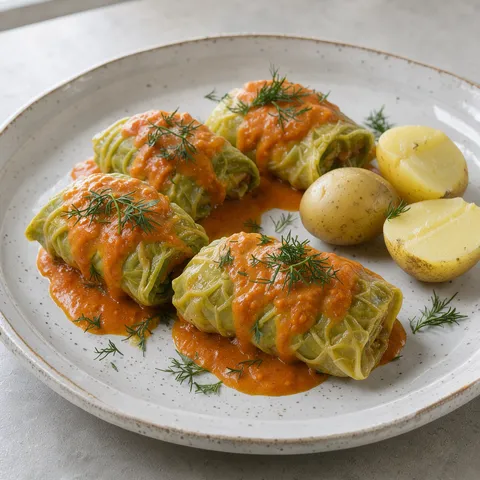 Polish Stuffed Cabbage Rolls2 hr · Main course
 Polish Potato Pancakes55 min · Starter
 Kraków-Style Cheesecake2 hr 45 min · Patisserie
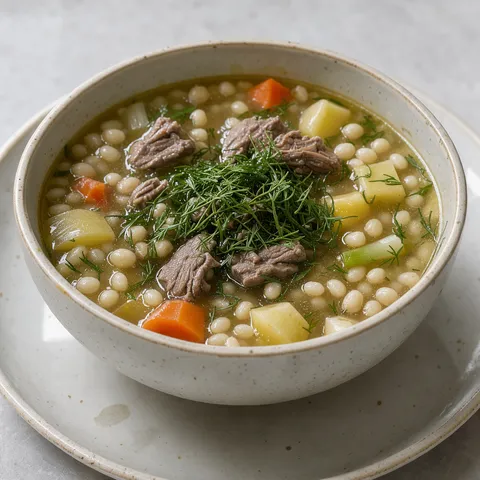 Polish Barley, Vegetable and Beef Soup2 hr 15 min · Soup
 Polish Hunter's Stew with Beef and Sauerkraut2 hr 45 min · Main course