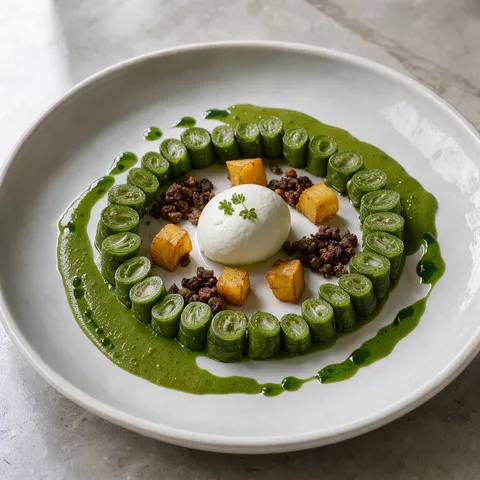
Bouneschlupp 2.0
A Luxembourgish soup. Takes 1 hr 15 min, Serves 4. Difficulty: challenging.
At a glance
- Total time
- 1 hr 15 min
- Serves
- Serves 4
- Difficulty
- Challenging
- Cuisine
- Luxembourgish cuisine
- Dish type
- Soup
- Allergens
- Gluten, Milk, Celery, Sulphites
Ingredients
Quick vegetable stock
- green bean tops (from the velouté beans)
- 1 onion (about 150 g, halved)
- 1 carrot (about 100 g)
- green part of 1 leek
- 1 bay leaf
- 1.2 litres water
Velouté
- 400 g green beans
- 200 g floury potatoes
- white part of 1 leek (about 100 g)
- 30 g butter
- 800 ml quick vegetable stock (from above)
- 1 tsp dried summer savory
- 60 g soured cream
- 20 g cold butter
- 3/4 tsp salt
- 1/4 tsp white pepper
Green oil
- 1 bunch flat-leaf parsley (leaves)
- 1/2 tsp dried summer savory
- 100 ml sunflower oil
- 1 litre water and 1 bowl of iced water (for blanching)
Green bean tartare
- 100 g fine green beans
- 1 shallot
- 1 tsp white wine vinegar
- 1 tsp sunflower oil
- a pinch of salt
Crisps
- 80 g beef bacon (smoked beef brisket without fenugreek coating)
- 200 g potatoes
- 20 g butter
- a pinch of salt
Soured cream
- 100 g soured cream
- 1 tbsp chives (finely chopped)
- a pinch of salt
Equipment
- Saucepan
- Fine sieve / chinois
- Blender
- Muslin
- Squeezy bottle
- Mixing bowls
- Chopping board
- Chef's knife
- Heavy-based saucepan
- Balloon whisk
- Sauté pan
- Colander
- Cake ring / food ring
- Probe thermometer (optional)
Method
- Start the vegetable stock: Snap the tops off the velouté beans and put the tops in a pan. Add the onion, the roughly chopped carrot, the leek green, the bay leaf and 1.2 litres water. Bring to the boil and cook over medium-low heat with the lid ajar for 25 min, then strain through a fine sieve. About 900 ml remains. A stock made from the beans' own tops gives the velouté a deep bean flavour that chicken stock cannot match
- Make the green oil: In a separate pan, bring 1 litre water to the boil, blanch the parsley leaves for 10 sec and plunge immediately into iced water, then squeeze out well. Blend with the oil and dried savory in a blender for 2 min, until the blender jug is lukewarm. Drip through a fine sieve lined with muslin without squeezing, so the oil stays clear and emerald green. Transfer to a squeeze bottle
- Blanch the tartare beans: Blanch the fine beans for 1 min in the water used for the green oil and transfer to iced water, which fixes the colour and keeps the texture crisp-tender. Pat dry and, on a chopping board, cut into 3 mm rings with a chef's knife. Chop the shallot very finely and mix with the beans, vinegar, oil and salt in a bowl. Set aside
- Cook the velouté: Cut the velouté beans into 2 cm pieces, the potato into 1 cm cubes and finely slice the leek white. In a heavy-based pan, melt the 30 g butter and sweat the leek for 3 min without colour. Add the potato, beans, savory and 800 ml hot vegetable stock, bring to the boil and cook for 15 min, until the beans are soft but still green. Overcooked beans turn olive-coloured
- Blend the velouté: Take the pan off the heat, transfer the contents to a blender and blend for 2 min, until completely smooth. Press back into the pan through a fine sieve, leaving the fibres behind. Whisk in the soured cream and cold butter and season with salt and white pepper. The consistency should coat the back of a spoon. If it is thick, loosen it with vegetable stock. Keep hot on the lowest heat with the lid on, without boiling. If it boils, the soured cream curdles
- Crisp the bacon: Cut the bacon into 5 mm cubes and fry in a dry sauté pan over medium heat for 6 min, until crisp and deep red. Lift out with a slotted spoon onto kitchen paper and leave the fat in the pan
- Fry the potato cubes: Cut the potato into even 6 mm cubes and pat dry with kitchen paper. Add the butter to the pan with the bacon fat, spread the potatoes in a single layer and fry for 10 min, shaking now and then, until crisp and golden all over. Season with salt. The soft potato of the classic soup returns here as a crisp texture
- Prepare the soured cream: Mix the soured cream with the chives and salt. Dip two teaspoons in hot water and shape 4 quenelles (oval balls). Put them in the fridge
- Heat and taste: Heat the velouté, stirring, to 75-80°C just before serving, checking with a thermometer if you like. Taste the tartare beans and, if needed, add a drop of vinegar
- Build the base: Put a 6 cm pastry ring in the centre of a warmed deep plate, fill it with the bean tartare, pressing lightly, and lift off the ring. Scatter the potato cubes and crisp bacon around the tartare and set a soured cream quenelle on top
- Finish at the table: Put the velouté in a jug and, at the table, pour about 200 ml from the edge of the plate around the tartare. Leave 6-8 drops of the green oil on the surface and serve immediately
Chef's note
The classic counterpart is Bouneschlupp (Luxembourg Green Bean Soup): the Luxembourg soup of green beans, potatoes, bacon and soured cream is taken apart into its components here. The beans come in three textures (smooth velouté, crisp-tender tartare, the stock made from their tops), the potato both thickens and crisps, the smoked meat becomes crisp crumbs and the soured cream a quenelle. The original recipe uses pork bacon; here it is made with beef bacon. Order of work: stock and green oil first, velouté and crisps in parallel, the tartare prepared at the very start and left to wait. At most three hob rings are in use at the same time.
Frequently asked questions
- Why are the bean tops used for the vegetable stock instead of thrown away?
- A stock made from the tops of the veloute beans gives the soup an intense bean flavour. Chicken stock would not be able to carry that flavour.
- How do you keep the green colour of the veloute?
- Stop cooking when the beans are soft but still green, since overcooked beans turn olive-coloured. In this recipe that is 15 minutes after it boils.
- What happens if the veloute is boiled after it is made?
- The soured cream splits if it boils. So keep the veloute warm with the lid on over the lowest heat, without boiling.
 Luxembourg Green Bean Soup1 hr · Soup
 Luxembourg Damson Plum Tart1 hr 25 min · Dessert
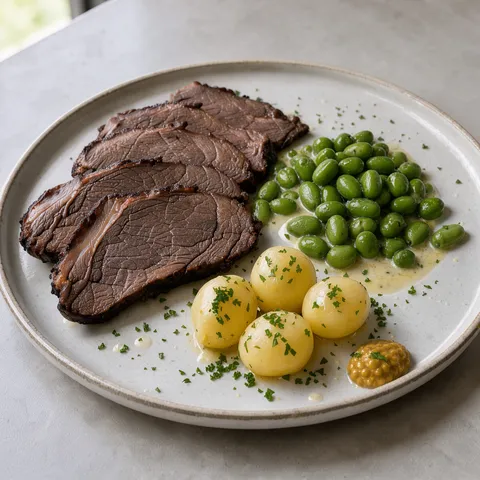 Smoked Beef with Broad Beans2 hr 30 min · Main course
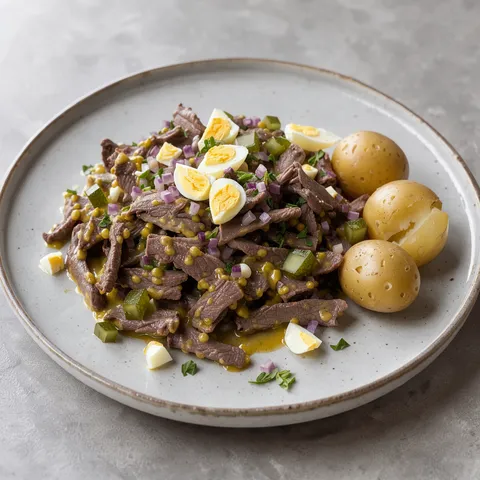 Luxembourg Cold Boiled Beef Salad3 hr 45 min · Starter
 Luxembourg Spoon-Cut Flour Dumplings45 min · Main course
 Luxembourg Breaded Beef Tripe3 hr 50 min · Main course
 Luxembourg Fried Yeast Dough Knots1 hr 10 min · Dessert