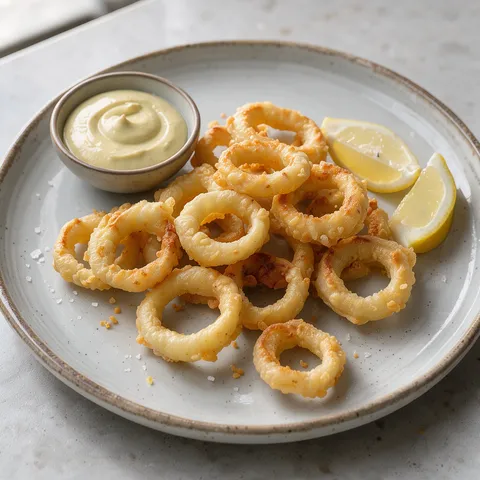
Spanish Fried Squid Rings Calamares a la Romana
A Spanish meze. Takes 1 hr, Serves 4. Difficulty: medium.
At a glance
- Total time
- 1 hr
- Serves
- Serves 4
- Difficulty
- Medium
- Cuisine
- Spanish cuisine
- Dish type
- Meze
- Allergens
- Gluten, Milk, Eggs, Molluscs
Ingredients
Squid
- 600 g cleaned squid tubes
- 200 ml milk
Batter
- 100 g plain flour (plus 30 g for dredging)
- 1 egg
- 150 ml ice-cold sparkling water
- 1/2 tsp salt
Alioli
- 2 garlic cloves
- a pinch of salt
- 1 egg yolk (fresh, pasteurised if possible)
- 100 ml sunflower oil
- 50 ml extra virgin olive oil
- 1 tsp lemon juice
For frying
- 1 litre sunflower oil
To serve
- 1/2 tsp fine salt (to sprinkle over the fried squid)
- 1 lemon (cut into wedges)
Equipment
- Chef's knife
- Chopping board
- Mixing bowls
- Pestle and mortar
- Balloon whisk
- Heavy-based saucepan
- Probe thermometer
- Colander
- Baking tray
Method
- Prepare the squid: Pull out any cartilage left inside the squid tubes and, if the outer membrane is still on, rub it off with your fingers. Cut the tubes into 1 cm rings. Cover the rings with the milk in a bowl and leave in the fridge for 30 min. The milk softens the slight smell of the sea and helps the coating cling to the surface
- Pound the alioli: While the squid soaks, crush the garlic with the salt in a pestle and mortar for 2 min to a smooth paste. Add the egg yolk and stir with the pestle in one direction. Combine the two oils and add them drop by drop at first, then in a thin stream once the emulsion forms and thickens, over 6-8 min in total. Finally, stir in the lemon juice. It should be a glossy, pale yellow sauce that holds on a spoon. If the oil goes in too quickly the sauce splits: rescue it by putting a fresh yolk in a clean bowl and adding the split sauce drop by drop
- Make the batter: Mix the 100 g flour and the salt in a bowl, make a well in the centre, add the egg and cold sparkling water and whisk for 1 min until lump-free. It should have the consistency of pouring cream. Put it in the fridge to rest for 10 min. Cold batter and the bubbles in the sparkling water give a puffed, light crust in hot oil
- Heat the oil: Put the oil in a 22 cm heavy-based pan (1 litre gives a depth of about 2.5 cm) and heat to 180°C on a thermometer, about 8 min
- Pat dry and flour: Drain the rings in a colander and pat thoroughly dry with kitchen paper. Dredge in the 30 g flour and shake off the excess. This thin layer of flour stops the batter sliding off the wet squid
- Fry: Dip a few rings at a time into the batter, let the excess drip off in a colander, then drop them into the oil one by one. Fry in 5 batches, each for 2 min, until pale golden. Squid cooked for longer than 2 min turns rubbery, so lift it out even if the colour is still light. Let the oil return to 180°C between batches
- Drain: Lift the fried rings onto a tray lined with kitchen paper and season lightly straight away, sprinkling the 1/2 tsp fine salt evenly over them. Keep them in a single layer without piling up: rings trapped in steam go soft
- Serve: Pile the rings onto a warm plate with the lemon wedges alongside and the alioli in a small bowl. Serve straight away: they are at their crispest in the first 5 min
Chef's note
Found in almost every tapas bar in Spain, and in Madrid it is also hugely popular stuffed into a sandwich. The name "a la romana" refers to the technique of coating in a frying batter. Fresh squid is best: thaw frozen squid overnight in the fridge and pat it thoroughly dry. Classic alioli is pounded from just garlic and olive oil: here an egg yolk is added so it holds more easily at home. Using only olive oil can make it bitter, and a blend of oils balances this. The alioli contains raw egg yolk (the same principle as the Aioli in the Basics section, where the yolk is also fresh and pasteurised if possible): raw-egg sauces should not be served to pregnant women, young children, the elderly or anyone with weakened immunity, so give them garlic yoghurt or olive oil with lemon instead.
Frequently asked questions
- Why is the squid soaked in milk?
- The milk softens the mild sea smell and helps the coating cling to the surface.
- Why does squid turn rubbery?
- Squid turns rubbery if cooked for more than 2 minutes. Even if the colour stays pale, frying is done in that time.
- What if the alioli splits?
- Put a fresh egg yolk in a clean bowl and rescue the split sauce by adding it drop by drop. To stop it splitting in the first place, add the oil drop by drop at first and then in a thin stream.
 Cold Córdoba Tomato and Bread Soup25 min · Soup
 Spanish Potato Omelette1 hr 5 min · Main course
 Paella Valenciana1 hr 20 min · Main course
 Sizzling Garlic Prawns20 min · Starter
 Meatballs in Almond Sauce1 hr 10 min · Main course
 Catalan Burnt Cream35 min · Dessert