Flemish Beef and Beer Stew Carbonade Flamande
A Belgian main course. Takes 3 hr (pressure cooker: ~1 hr 30 min), Serves 4. Difficulty: challenging.
At a glance
- Total time
- 3 hr (pressure cooker: ~1 hr 30 min)
- Serves
- Serves 4
- Difficulty
- Challenging
- Cuisine
- Belgian cuisine
- Dish type
- Main course
- Allergens
- Gluten, Milk, Celery, Mustard, Sulphites
Ingredients
Meat
- 900 g beef shin or chuck (well marbled, 5 cm pieces)
- 1.5 tsp salt
- 1 tsp black pepper
- 30 g butter
- 1 tbsp sunflower oil
Onions
- 3 onions (thin half-moons)
- 20 g butter
Sauce
- 2 tbsp plain flour
- 500 ml dark Belgian beer (oud bruin or dubbel)
- 250 ml Brown Beef Stock (Basics) or water
- 2 tbsp light brown sugar
- 1 tbsp cider vinegar
- 3 thyme sprigs
- 2 bay leaves
- 2 cloves
Bread
- 2 slices of stale brown bread
- 2 tbsp Homemade Dijon-Style Mustard (Basics)
Frites
- 1 kg floury potatoes (Bintje type)
- 2 litres beef dripping or sunflower oil
- flaky salt
Equipment
- Cast-iron casserole
- Oven
- Chef's knife
- Chopping board
- Mixing bowls
- Heavy-based saucepan
- Probe thermometer
- Colander
- Wooden spoon / spatula
- Pressure cooker (optional)
Method
- Sear the meat: Pat the meat dry with kitchen paper and rub with the salt and pepper. Heat the butter and oil in a cast-iron casserole over high heat until the foam subsides. Fry the meat in three batches for 6-7 min in total, until deep brown on all sides, then lift out. This brown crust gives the sauce its colour and depth
- Caramelise the onions: Lower the heat to medium-low and add the 20 g butter and the onions. Cook for 20 min, scraping up the sediment from the bottom, until the onions are soft and the colour of dark honey. The sweetness of the onions balances the bitterness of the beer
- Toast the flour: Sprinkle the flour over the onions and stir for 2 min. Toasted in the fat, the flour loses its raw taste and thickens the sauce
- Deglaze with the beer: Pour in the beer slowly, stirring, and scrape the bottom of the pan well. Add the stock, brown sugar, vinegar, thyme, bay leaves and cloves. Return the meat and its juices to the pan: the liquid should come just above the meat
- Add the bread: Spread one side of each bread slice thickly with mustard and lay them on top of the stew, mustard side down. As it cooks, the bread breaks down and thickens the sauce, and the mustard adds a gentle sharpness
- Slow-cook: Bring to the boil, cover and cook in a 150°C oven or over the lowest heat on the hob for 2 hr 15 min. Stir every 45 min, working the bread into the sauce. The meat is ready when it falls into fibres when pressed with a fork. In a pressure cooker this drops to 45 min. If the sauce is too thin, uncover and boil for 10 min to thicken: it should taste balanced between sweet and sour
- Cut the potatoes: While the stew cooks, peel the potatoes and cut into 1 cm thick chips. Soak in cold water for 20 min: with the starch drawn out, the chips don't stick when frying and come out crisper. Pat completely dry with kitchen paper, as wet potatoes make the oil spit
- First fry: Heat the oil to 150°C in a deep saucepan. Fry the chips in two batches for 6-7 min, until soft but still pale and uncoloured. Lift out with a slotted spoon and cool on a wire rack for 10 min. This stage cooks the inside of the potato
- Second fry: Raise the oil to 180°C. Fry the chips for 2-3 min, until deep golden and crisp. Lift straight onto kitchen paper and sprinkle with flaky salt. Double frying gives Belgian frites their identity: creamy inside, crisp outside
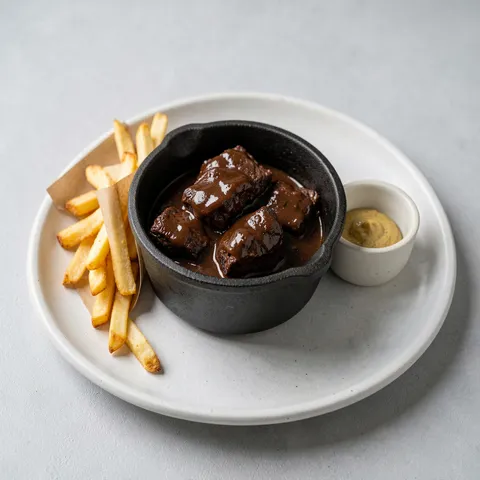
- Plate: Put 4-5 pieces of meat and plenty of dark sauce into a deep plate or a small cast-iron pot. Set the frites alongside in a bowl or paper cone, with a small bowl of mustard. Serve hot: a glass of the same beer goes well with it
Chef's note
Carbonade (stoofvlees) is the home stew of Flanders and is almost always eaten with frites. Some households use peperkoek, a spiced Belgian loaf cake, instead of bread. Belgians traditionally fry their frites in beef dripping, which gives them their distinctive flavour.
Frequently asked questions
- Why are bread and mustard added to carbonade?
- Lay slices of mustard-spread bread on top of the stew, mustard-side down. The bread breaks down as it cooks and thickens the sauce, and the mustard adds a gentle sharpness.
- What if the carbonade sauce is too thin?
- Take off the lid and simmer the sauce for 10 minutes to thicken it. The flavour should be balanced between sweet and sour.
- Can carbonade be cooked in a pressure cooker?
- Yes, in a pressure cooker the cooking time drops to 45 minutes. It is ready when the beef breaks into strands when pressed with a fork.
 Ghent-Style Creamy Chicken Stew1 hr 20 min · Main course
 Liège Meatballs in Sweet-Sour Sauce1 hr 15 min · Main course
 Liège Waffles1 hr 40 min · Dessert
 Waterzooi 2.01 hr 25 min · Main course
 Flemish White Asparagus40 min · Starter
 Belgian Spiced Brown Sugar Biscuits1 hr 10 min · Dessert