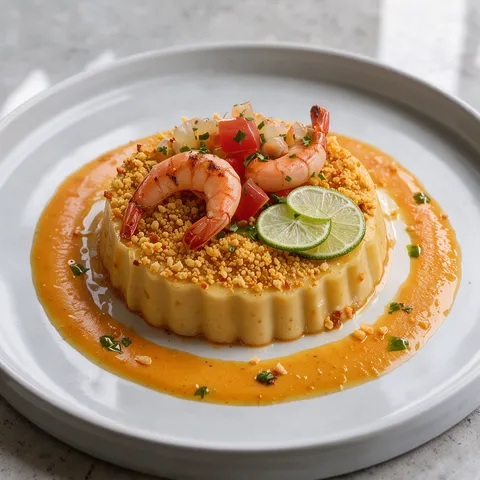
Casquinha de Siri 2.0
A Brazilian starter. Takes 1 hr 25 min, Serves 4. Difficulty: challenging.
At a glance
- Total time
- 1 hr 25 min
- Serves
- Serves 4
- Difficulty
- Challenging
- Cuisine
- Brazilian cuisine
- Dish type
- Starter
- Allergens
- Gluten, Milk, Eggs, Crustaceans
Ingredients
Crab flan
- 250 g cooked crab meat
- 3 eggs
- 200 ml double cream
- 100 ml milk
- 2 tbsp coriander (chopped)
- 1/2 tsp salt
- 1 tbsp soft butter (for the moulds)
Prawn bisque
- 400 g large shell-on prawns
- 1 tbsp olive oil
- 1 tbsp butter
- 1 onion
- 1 tbsp tomato paste
- 1 tomato
- 400 ml water
- 1 tsp dendê (palm oil)
- 1 tbsp lime juice
- salt
Seared prawns
- 1 tbsp neutral oil
Pico
- 1 tomato
- 1/4 red onion
- 1 tbsp coriander
- 1 tbsp lime juice
- 1/4 tsp salt
- 1 tsp olive oil
Crispy farofa
- 60 g cassava flour
- 2 tbsp butter
- 3 tbsp grated Parmesan
- 1 tsp dendê
Coriander oil
- 1/2 bunch coriander
- 60 ml neutral oil
- a pinch of salt
To finish
- 8 thin lime slices
Equipment
- Bain-marie bowl
- Baking tray
- Blender
- Fine sieve / chinois
- Mixing bowls
- Oven
- Saucepan
- Frying pan
Method
- Peel the prawns: Peel the prawns, set aside the head and tail shells for the bisque and devein each one. The shells and heads carry all the flavour of the bisque, so all of them are used for the bisque and discarded after straining. Preheat the oven to 150°C. Keep the meat of 8 large prawns in the fridge for the garnish (~7 min)
- Make the flan mixture: Loosen the crab meat with a fork and pick out shell fragments. Whisk the eggs, cream, milk, salt and coriander in a bowl and pass through a fine sieve. Straining removes the egg strands and makes the flan smooth. Grease 4 small moulds with butter, divide the crab meat between them and pour the mixture over (~8 min)
- Bake the flan and start the bisque: Put the moulds in a deep roasting tin and fill the tin with hot water to come halfway up the moulds (bain-marie), then bake in the 150°C oven for 30 min until the centre wobbles slightly (internal temperature 82-85°C). Meanwhile, in a heavy-based saucepan, fry the prawn shells in the olive oil and butter for 4 min until their reddish aroma is released, add the chopped onion, tomato paste and chopped tomato, and after 1 min add 400 ml water and cook over low heat for 18 min. The browning gives the bisque colour and aroma (~30 min)
- Strain and reduce the bisque: Push the bisque through a fine sieve with a spoon and discard the shells. Boil the strained liquid in a saucepan for 5-8 min until it is reduced to about 120 ml and coats the back of a spoon. Add the dendê, lime juice and salt and take off the heat. The bisque should be dense and orange, and if it stays runny, it washes the flan out on the plate (~8 min)
- Make the pico: Deseed the tomato and cut into 3 mm dice, and chop the red onion very finely. Mix with the coriander, lime juice, salt and olive oil and set aside. The small-diced pico sits neatly on the plate and gives a sour, lively contrast to the creamy texture of the flan (~6 min)
- Make the crispy farofa: In a small frying pan, heat the butter and dendê over medium heat, add the cassava flour and toast, stirring constantly, for 4 min until golden brown and crisp. Add the Parmesan, stir for 1 more min and transfer to kitchen paper. The farofa adds crunch to the flan on the plate (~6 min)
- Blend the coriander oil: Blend the coriander, neutral oil and salt in a blender for 1 min until smooth and pass through a fine sieve. A bright green, clear oil remains. To keep the oil green, blanch the coriander in boiling water for 10 sec before blending, plunge it into iced water and pat it thoroughly dry (~6 min)
- Sear the prawns: Sear the garnish prawns in 1 tbsp hot neutral oil in a frying pan for 1-2 min on each side until pink and curled. Overcooked prawns turn hard and rubbery (~4 min)
- Unmould the flans: Take the moulds out of the hot water and rest for 5 min. Run a thin knife around the edge of each mould, invert and slide the flan onto the plate. Rested flan holds together and does not fall apart when unmoulded (~5 min)
- Plate: Put the flan in the centre of a warm flat plate and pour two spoonfuls of hot bisque beside it. Sprinkle crispy farofa over the flan and place two prawns beside it. Spoon the pico on and drop 5-6 drops of coriander oil, and add two lime slices. Serve at once (~5 min)
Chef's note
In the classic casquinha de siri, the crab filling is bound with béchamel and gratinated in its dish. Here the filling becomes a flan: the crab has a creamy texture, the bisque gives the plate a deep taste of the sea, the farofa gives crunch and the pico gives sourness. The crab flavour is completed in the bisque by the prawn shells. Dendê is available at African and Latin American grocers. You can bake the flan a day ahead and keep it in the fridge, then warm it in hot water for 5 min before serving.
Frequently asked questions
- Why does the crab flan crack?
- It happens if the oven is too hot or it is baked without a water bath. A gentle heat of 150°C and a hot water bath give a smooth texture.
- Can the prawn bisque be made ahead?
- Yes, the bisque keeps in the fridge for 2 days and is reheated to use. Add the dendê oil just before serving.
- What can I use in place of dendê oil?
- You can give colour by adding a pinch of sweet paprika to olive oil. The aroma won't be as earthy as dendê.
 Carioca Baked Crab Gratin with Tomato, Coriander and Breadcrumbs, 4 Small Dishes30 min · Starter
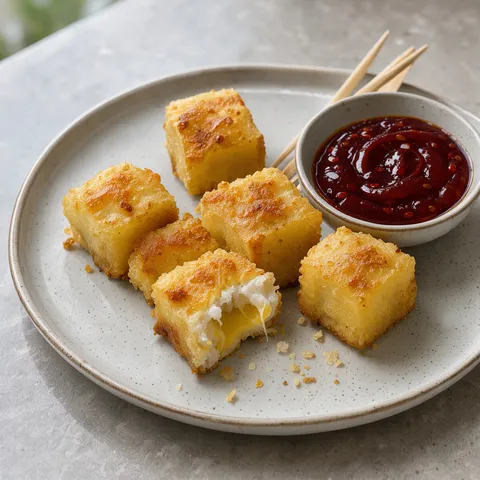 Brazilian Fried Tapioca Cheese Cubes1 hr 5 min · Meze
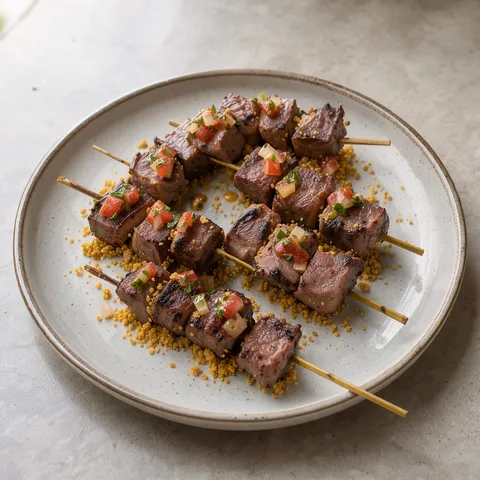 Brazilian Street Picanha Skewers1 hr 2 min · Meze
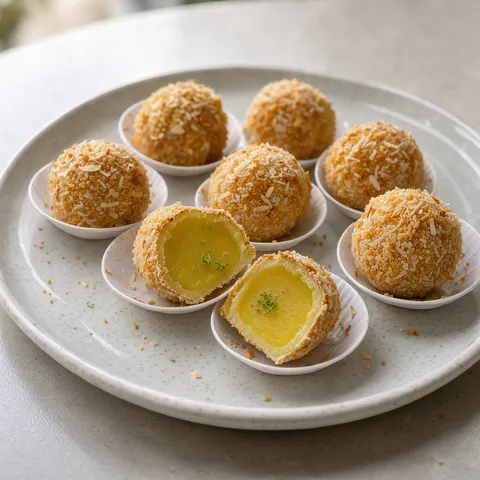 Brazilian Coconut Condensed Milk Balls1 hr 19 min · Meze
 Brazilian Cachaça and Lime Cocktail12 min · Drink
 Bolo de Laranja1 hr 10 min · Patisserie
 Tutu de Feijão1 hr 5 min · Main course