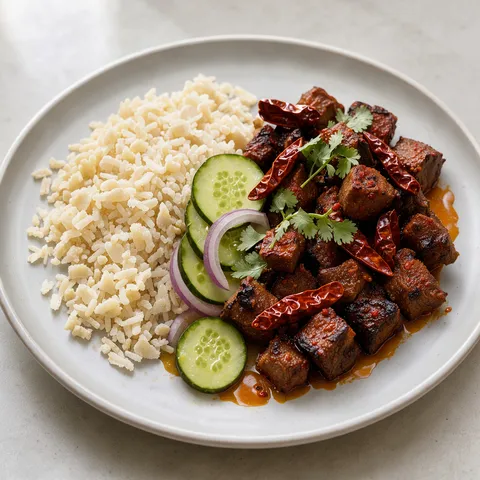
Newar-Style Charred Spiced Beef Choila
A Nepalese meze. Takes 50 min, Serves 4. Difficulty: medium.
At a glance
- Total time
- 50 min
- Serves
- Serves 4
- Difficulty
- Medium
- Cuisine
- Nepalese cuisine
- Dish type
- Meze
- Diet
- Gluten-free
- Allergens
- Celery, Mustard, Sulphites
Ingredients
Meat
- 600 g beef sirloin or topside (lean, in strips 3 cm thick)
- 1/2 tsp turmeric
- 1 tsp salt
Mixture
- 1 tbsp ginger paste
- 1 tbsp garlic paste
- 4 green chillies (finely chopped)
- 1 tsp chilli powder
- 1 tsp ground cumin (toasted)
- 1/2 tsp timur (crushed in a mortar)
- 3 spring onions
- 1/2 bunch coriander
- 2 tbsp lemon juice
- 3 tbsp mustard oil
- 1/2 tsp salt
Tempering
- 2 tbsp mustard oil
- 1/2 tsp fenugreek seeds
- 3 dried red chillies
- a pinch of turmeric
To serve
- 200 g baji (beaten rice flakes, chiura)
- 1 cucumber
- 1 red onion
Equipment
- Griddle pan
- Chopping board
- Chef's knife
- Mixing bowls
- Frying pan
- Charcoal barbecue (optional)
- Probe thermometer (optional)
Method
- Prepare the meat: Rub the beef strips with the turmeric and salt and leave at room temperature for 10 min. Thick strips stay juicy inside while the outside chars over the embers
- Char: Heat barbecue embers or a griddle pan thoroughly over very high heat. Char the strips for 6-8 min, turning with tongs, until each side has charred spots and a smoky dark crust. The inside should stay medium and slightly pink, with an internal temperature of 60-63°C when cut. In Newar cooking the meat is charred over a straw fire, which gives it its smoky flavour
- Rest and dice: Rest the meat on a board for 5 min, then cut into 1.5 cm cubes with a chef's knife. Meat cut without resting loses its juices onto the board
- Make the mixture: In a bowl, mix the ginger, garlic, green chillies, chilli powder, cumin, timur, finely chopped spring onions, coriander, lemon, salt and raw mustard oil. Add the hot meat cubes and mix with your hand to coat them. Hot meat soaks up the aroma of the spices and raw mustard oil straight away
- Make the tempering: Heat the mustard oil in a small frying pan until smoking. Add the fenugreek seeds and fry for 10-15 sec until deep brown, then add the dried chillies and turmeric and hold for 10 sec more. If the fenugreek turns black it goes bitter, so take it off the heat at once
- Sizzle: Pour the hot oil over the meat: it coats the meat with a sizzle and a smoky, pungent smell rises. Cover the bowl with a plate and leave to rest for 10 min, during which the choila gathers its flavour. Adjust the salt and lemon
- Prepare the baji and salad: Stir the baji in a dry frying pan over low heat for 2 min, until slightly crisp and fragrant. Thinly slice the cucumber and red onion
- Plate: Pile the baji high on one half of a flat plate. Pile the choila on the other half with its red, glossy oil, and top with coriander leaves and the fried dried chillies. Put the cucumber and onion slices between them and serve at room temperature
Chef's note
Choila is a meze of the feast and festival tables of the Newar people of the Kathmandu Valley, and part of the Newar samay baji platter. The original recipe uses water buffalo: here it is made with beef. Baji is traditionally bought ready-made. It is usually accompanied by rice beer or ayla. In Türkiye, use mustard oil labelled for cooking; if unavailable, use sunflower oil plus 1/2 tsp mustard powder.
Frequently asked questions
- Why is the meat charred in choila?
- In Newar cooking the meat is charred over a straw fire, and that is where the smoky taste comes from. Over a very high heat it cooks until every side has charred spots, with the inside left slightly pink.
- Why is the meat rested after charring?
- Meat cut without resting leaks its juices onto the board. Resting the meat on the board keeps it juicy.
- What happens if the fenugreek seeds go black?
- Fenugreek turns bitter if it goes black. Take the pan off the heat straight away once the seeds are dark brown.
 Nepali Chicken Dumplings with Tomato Achar1 hr 15 min · Bread & pastry
 Dal Bhat Tarkari1 hr · Main course
 Nepali Ring-Shaped Rice Bread1 hr 5 min · Bread & pastry
 Momo 2.01 hr 25 min · Bread & pastry
 Newar-Style Urad Dal Pancakes with Egg45 min · Bread & pastry
 Newar-Style Nine-Bean Soup1 hr 10 min · Soup