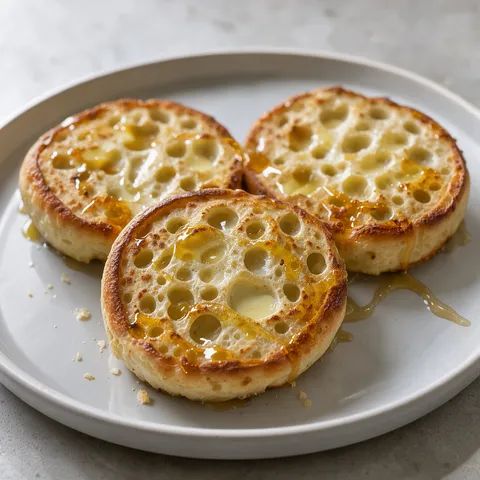
Crumpets
An English bread & pastry. Takes 2 hr, 12 pieces (4 servings). Difficulty: challenging.
At a glance
- Total time
- 2 hr
- Serves
- 12 pieces (4 servings)
- Difficulty
- Challenging
- Cuisine
- English cuisine
- Dish type
- Bread & pastry
- Allergens
- Gluten, Milk, Eggs
Ingredients
Batter
- 175 g strong white bread flour
- 175 g plain flour
- 7 g fast-action dried yeast
- 1 tsp caster sugar
- 350 ml lukewarm milk (about 37°C)
- 1 tsp salt
Raising mix
- 1/2 tsp bicarbonate of soda
- 150 ml lukewarm water
For cooking
- 20 g butter (melted, for the rings)
- 1 tbsp sunflower oil
To serve
- 60 g salted butter
- 4 tbsp flower honey
Equipment
- Mixing bowls
- Wooden spoon / spatula
- Cling film
- Cake ring / food ring
- Pastry brush
- Cast-iron frying pan
- Silicone spatula
- Probe thermometer
- Hand mixer (optional)
Method
- Prepare the yeast and flour (0-5 min): In a large bowl, mix both flours, the yeast and the sugar. Add the salt at the other side of the bowl: salt that touches the yeast directly slows it down. Bring the milk to 37°C, using a thermometer. It should feel just warm on the inside of your wrist, as hotter milk kills the yeast
- Beat the batter (5-10 min): Add the milk to the flour and beat vigorously with a wooden spoon or the dough hooks of a hand mixer for 4-5 min. The batter should be like a thick pancake batter, glossy and elastic, falling from the spoon in a thick ribbon. Beating develops the gluten, so the bubbles tunnel up to the surface during cooking without collapsing
- Rise (10-70 min): Cover the bowl with cling film and leave in a warm place at 26-28°C for 1 hr. The batter should have doubled in size, its surface full of spongy bubbles, and sink slightly when you tap the bowl
- Add the bicarbonate (70-80 min): Dissolve the bicarbonate of soda in the lukewarm water, pour into the batter and mix thoroughly with a wooden spoon for 1 min. The batter should become a pourable, runny cream. Cover and rest for 10 min. The bicarbonate reacts with the acid produced by the yeast and releases a second gas that opens up the crumpets' famous holes
- Prepare the rings and pan (75-80 min, alongside): Brush the inside of 4 metal rings, 9 cm across, with melted butter using a pastry brush. Heat a cast-iron pan over medium-low heat for 5 min and wipe it with a thin layer of sunflower oil on kitchen paper. A drop of water in the pan shouldn't evaporate at once but sizzle slowly. If the pan is too hot, the bottom burns and the top stays raw
- Pour (from 80 min): Set the rings in the pan and pour about 70 ml batter into each: it should come about 1 cm up the sides. The batter weighs about 850 g in total and makes 12 crumpets in 70 g portions. Small bubbles should appear on the surface within 1-2 min
- Cook the base (7-8 min per batch): Cook over low-medium heat without touching. The bubbles should burst and stay open as holes, and the top should look matt and dry. If wet batter remains on top, wait another 1 min
- Flip (1-2 min per batch): Lift the rings with a spatula and the tip of a knife. If the edge sticks, run the knife once around the inside of the ring. Flip the crumpets and cook the holey side for just 1 min until light golden. Transfer to a wire rack and grease the rings again. Cooking 12 crumpets four at a time in 3 batches takes about 30 min (80-110 min)
- Rest and toast (110-118 min): Rest the crumpets on the rack for 5 min while their crumb sets. Just before serving, toast each side for 1-2 min in a dry cast-iron pan so the holey side crisps up
- Plate (118-120 min): Arrange three crumpets slightly overlapping on a flat plate and, while they are hot, spread the holey sides generously with salted butter so it melts into the holes. Drizzle over a dessertspoon of honey
Chef's note
The crumpet is England's griddle bread for breakfast and teatime. It isn't kneaded like bread dough: a runny batter is cooked on one side only, inside a ring. Crumpets are also eaten toasted the next day, and plenty of people argue they're best that way. If the batter seeps out under the ring, it is too runny: add 1-2 tbsp flour. Homemade jam works as well as honey.
Frequently asked questions
- How do crumpets get their holes?
- The bicarbonate added to the batter later reacts with the acid produced by the yeast and gives off a second round of gas. As the crumpets cook, this gas tunnels to the surface and makes the famous holes.
- How hot should the pan be for cooking crumpets?
- A drop of water should not vanish at once but sizzle slowly. If the pan is too hot, the base burns while the top stays raw.
- How are crumpets served?
- Toast each side for 1-2 minutes in a dry cast-iron pan just before serving. Spread plenty of salted butter over the holey side while hot and drizzle with honey.
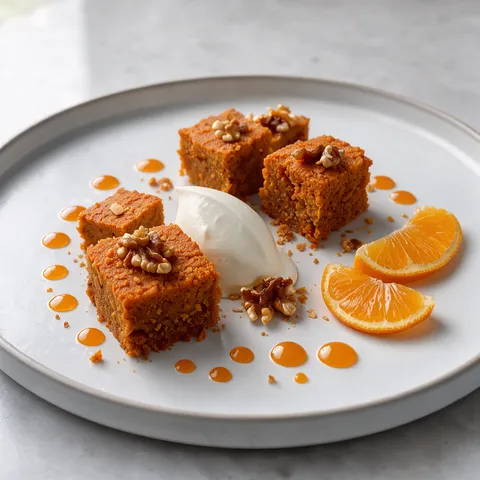 Deconstructed Carrot Cake1 hr 30 min · Dessert
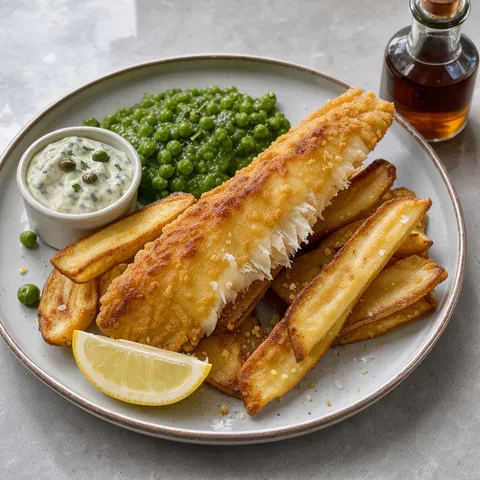 Fish and Chips1 hr 10 min · Main course
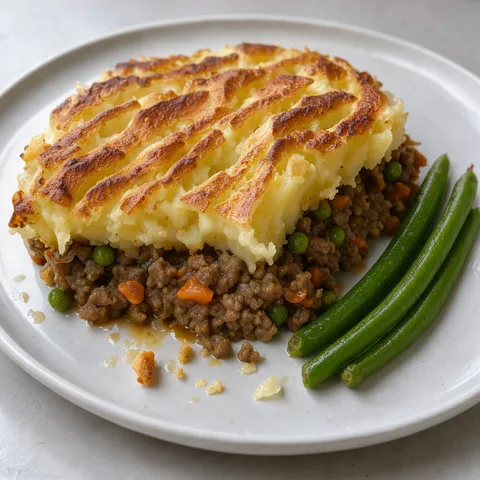 Shepherd's Pie1 hr 55 min · Main course
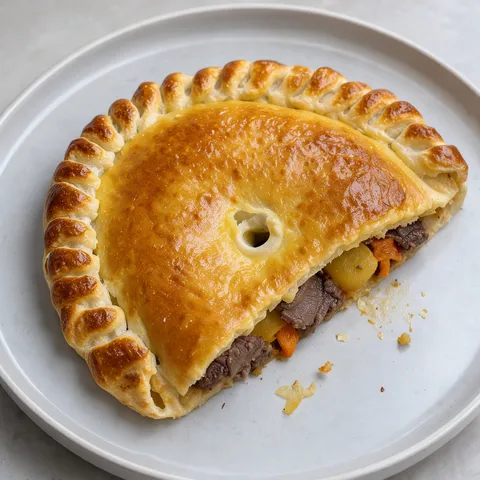 Cornish Pasty2 hr · Bread & pastry
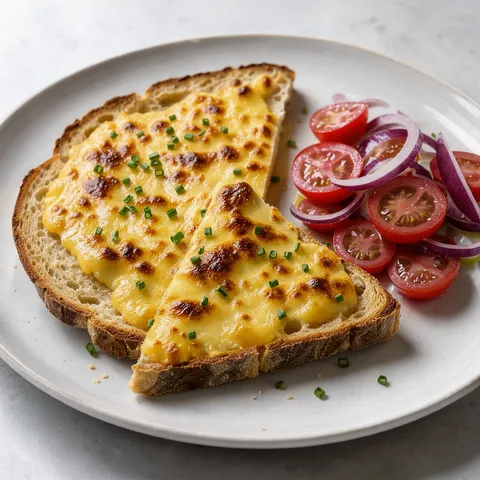 Welsh Rarebit35 min · Starter
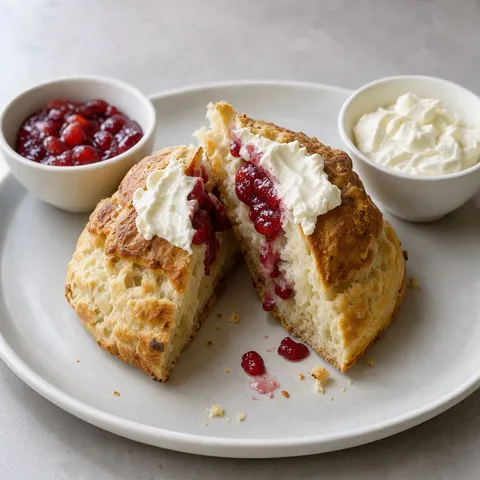 Scones with Clotted Cream and Strawberry Jam50 min · Patisserie