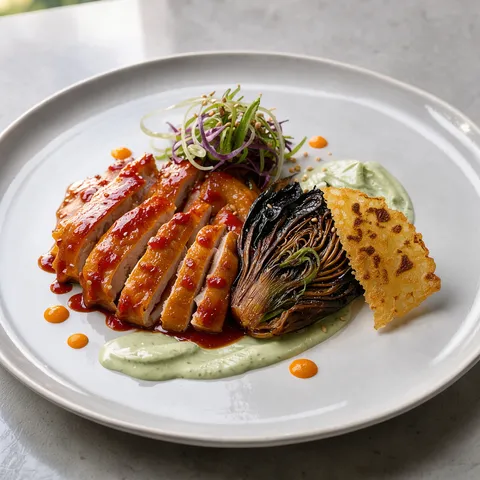
Dakgalbi 2.0
A Korean main course. Takes 1 hr 25 min, Serves 4. Difficulty: challenging.
At a glance
- Total time
- 1 hr 25 min
- Serves
- Serves 4
- Difficulty
- Challenging
- Cuisine
- Korean cuisine
- Dish type
- Main course
- Allergens
- Gluten, Milk, Sesame, Soya, Celery, Mustard
Ingredients
Chicken
- 4 skin-on boneless chicken thighs (about 750 g in total)
- 8 g salt
Gochujang caramel glaze
- 60 g sugar
- 2 tbsp water
- 2 tbsp gochujang
- 1 tbsp soy sauce
- 1 tbsp rice vinegar
- 1 garlic clove (grated)
- 1 tsp ginger (grated)
- 1/4 tsp curry powder
- 1 tsp sesame oil
Charred cabbage
- 1/4 hispi cabbage (4 wedges, held together at the core)
- 1 tbsp neutral oil
- a pinch of salt
Perilla cabbage cream
- 300 g white cabbage (finely shredded)
- 30 g butter
- 1 shallot
- 200 ml Chicken Stock (Basics)
- 60 ml double cream (35%)
- 8 perilla leaves (or a handful of basil)
Sweet potato purée
- 400 g sweet potatoes
- 30 g butter
- 1/2 tsp salt
- 1 tsp rice vinegar
Nurungji (crisp rice)
- 65 g uncooked short-grain rice
- 100 ml water
- 1 tbsp sesame oil
- a pinch of salt
Finishing salad
- 2 spring onions (hair-thin, in iced water)
- 4 perilla leaves (finely shredded)
- 1 tsp toasted sesame seeds
- 1/2 tsp gochugaru
- 1 tsp sesame oil
Equipment
- Oven
- Saucepan
- Cast-iron frying pan
- Blender
- Fine sieve / chinois
- Potato masher
- Piping bag
- Pastry brush
- Probe thermometer
- Silicone spatula
- Chef's knife
- Chopping board
- Mixing bowls
- Frying pan
- Baking tray
Method
- Bake the sweet potatoes: First, preheat the oven to 200°C. Wash the sweet potatoes, wrap in foil and bake at 200°C for 45-50 min, until a knife slides in with no resistance at all. Baking caramelises the sugars in the sweet potato and gives a far more intense purée than boiling
- Salt and dry the chicken: Pat the skin of the thighs dry with kitchen paper and sprinkle the salt evenly over the flesh side. Keep in the fridge on a wire rack, skin uncovered, for 30 min. Dry skin turns glass-crisp in the pan: wet skin poaches
- Make the nurungji: Bring the washed rice to the boil with 100 ml water, cook covered over low heat for 12 min, then spread on a tray and cool for 5 min. Press the cooked rice flat into a non-stick frying pan, 3 mm thick, and compact it with a wet spoon. Cook over low-medium heat for 15-20 min without touching, until the underside is deep golden and the rice lifts away as a disc. Turn, brush the top with sesame oil and cook for another 3-4 min. Cool on a wire rack: once cool, it snaps like glass. The fried rice at the end of the classic becomes the crisp element of the plate here
- Cook the glaze: Melt the sugar and water in a small saucepan without stirring and take off the heat when pale amber (about 165°C). Carefully whisk in the gochujang, soy sauce and vinegar: it will foam. Stir in the garlic, ginger and curry powder, return to the heat and boil for 1 min. Add the sesame oil. It should be like thick honey, for brushing. The caramel rounds off the heat of the gochujang and gives the chicken a glossy lacquer
- Cook the cabbage cream: Soften the shallot in the butter for 3 min, add the cabbage and cook for 6-8 min, until soft but not coloured. Add the chicken stock and boil for 5 min. Add the cream and perilla leaves, blend immediately for 1 min until smooth and pass through a fine sieve. The perilla goes in last so its colour and aroma do not fade. It should be a silky cream that runs off a spoon
- Make the purée: Peel the sweet potatoes and mash until smooth with the butter, salt and vinegar using a potato masher, then press through a fine sieve. The vinegar balances the sweetness. Spoon into a piping bag and keep warm
- Cook the chicken skin-side down: Heat a cast-iron pan over medium heat, put the thighs skin-side down in the lightly oiled pan and weigh them down with a heavy saucepan. Cook for 10-12 min, until the skin is deep golden and crisp: the skin renders its fat and fries in it. Turn, brush the flesh side with glaze and cook for another 3-4 min. The internal temperature should reach 74°C. Rest for 3 min
- Char the cabbage: Heat a separate cast-iron pan over very high heat until smoking, oil the cabbage wedges and cook cut-side down for 3-4 min without moving, until the surface is blackened. Turn, cook for 1 min more and season with salt. The pan-caramelised cabbage of the classic splits here into a smoky, charred surface and a soft interior
- Finishing salad: Drain the spring onions from the iced water and pat dry. Toss lightly with the perilla strips, sesame seeds, gochugaru and sesame oil
- Slice the chicken and glaze again: Cut each thigh into 4-5 slices 2 cm thick, with the cut faces up. The skin side stays unglazed so it keeps its crunch. Brush another thin layer of glaze over the cut faces
- Plate: Spoon two spoonfuls of perilla cabbage cream onto one side of a warm plate and sweep a wide arc with the back of the spoon. Put a charred cabbage wedge in the middle of the cream and pipe three large and two small dots of sweet potato purée beside it. Fan the chicken slices next to the charred cabbage, cut faces forward. Stand a hand-sized shard of nurungji upright against the chicken. Put the finishing salad in a small mound on top of the chicken slices and drop a few dots of glaze onto the plate. Serve at once
Chef's note
The elements of classic dakgalbi are kept: chicken thigh scented with gochujang and curry, caramelised cabbage, sweet potato, perilla and the fried rice at the end. Each becomes a separate texture: crisp glazed skin, cabbage both charred and turned into a cream, silky sweet potato and glass-like nurungji. Gochujang, gochugaru and soy sauce are traditionally bought ready-made.
Frequently asked questions
- Why won't the chicken skin crisp up in the pan?
- Dry skin crisps and wet skin steams. Salt the thighs and leave them uncovered in the fridge to dry out, then press them down in the pan with a heavy pot.
- How thick should the gochujang caramel glaze be?
- It should be the consistency of thick honey, so it can be brushed on. The caramel rounds off the heat of the gochujang and gives the chicken a glossy lacquer.
- Why is the sweet potato baked rather than boiled?
- Baking caramelises the sugars in the sweet potato and gives a far more intense mash than boiling. The vinegar added to the mash balances the sweetness.
 Chuncheon-Style Spicy Chicken and Cabbage1 hr 5 min · Main course
 Bibimbap1 hr 15 min · Main course
 Kimchi3 hr · Side dish
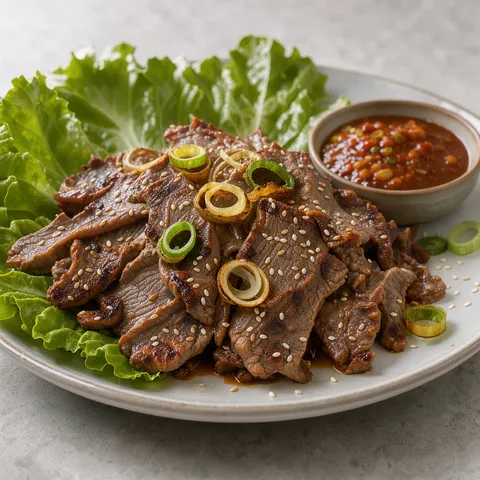 Bulgogi30 min · Main course
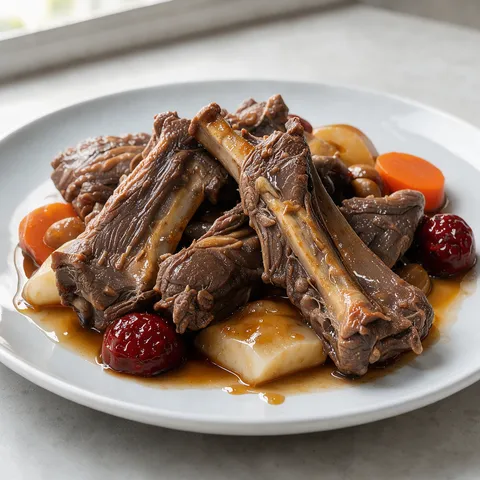 Korean Braised Short Ribs1 hr 30 min · Main course
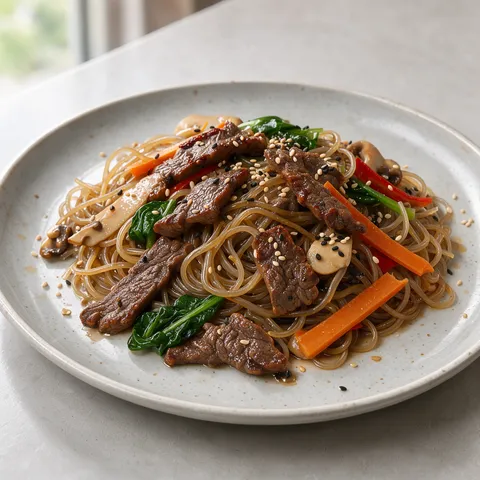 Korean Glass Noodles with Vegetables45 min · Main course
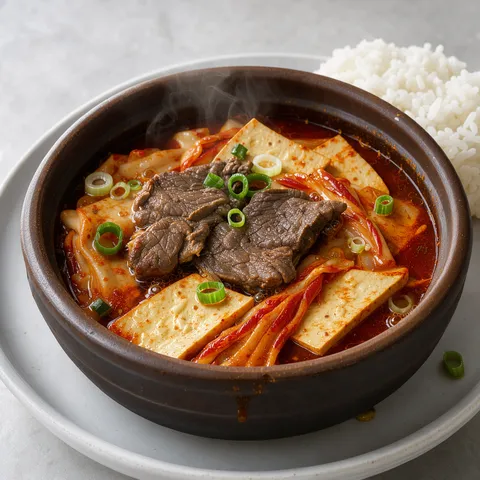 Kimchi Stew40 min · Soup