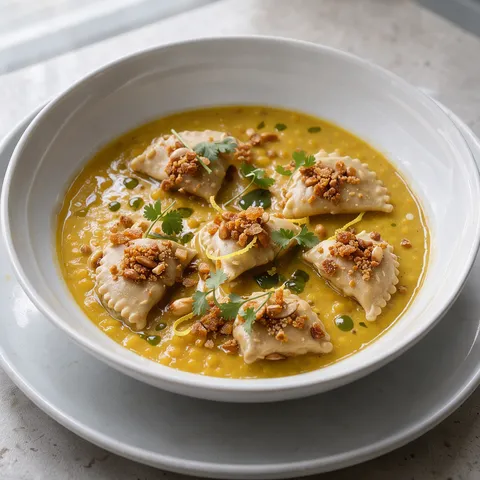
Dal Dhokli 2.0
An Indian main course. Takes 1 hr 8 min, Serves 4. Difficulty: challenging.
At a glance
- Total time
- 1 hr 8 min
- Serves
- Serves 4
- Difficulty
- Challenging
- Cuisine
- Indian cuisine
- Dish type
- Main course
- Allergens
- Gluten, Milk, Peanuts, Sesame, Soya, Mustard, Sulphites
Ingredients
Dal cream
- 150 g toor dal
- 700 ml water
- 1/2 tsp turmeric
- 1 tsp salt
- 1 tbsp jaggery
- 1 tbsp lemon juice
- 1 tbsp ghee
- 1 tbsp tamarind paste
Ravioli dough
- 120 g wholemeal flour
- 1 tbsp gram flour
- 1 tbsp oil
- 1/2 tsp turmeric
- 1/2 tsp ajwain
- 1/2 tsp salt
- 60 ml lukewarm water
Filling
- 2 small potatoes (boiled)
- 3 tbsp peas
- 1 tsp cumin
- 1 tsp grated ginger
- 1 green chilli (finely chopped)
- 1/2 tsp garam masala
- 1 tbsp lemon juice
- salt
- 1 tbsp ghee
Crumb
- 40 g raw peanuts
- 1 tbsp jaggery
- 1/2 tsp chilli powder
- 1 tsp sesame seeds
- 1 tbsp ghee
Asafoetida oil
- 60 ml neutral oil
- 1/4 tsp asafoetida
- 1/2 tsp mustard seeds
- 8 curry leaves
To finish
- 1 tbsp ghee (for tossing the boiled ravioli)
- fine lemon zest
- coriander shoots
- flaky salt
Equipment
- Pressure cooker
- Rolling pin / oklava
- Stick blender
- Colander
- Frying pan
- Saucepan
Method
- Cook the dal: Wash the toor dal and cook in a pressure cooker with the water, turmeric and salt for 15 min once the cooker reaches pressure. The pressure softens the dal enough to mash. Without a pressure cooker the dal takes about 50 min (~23 min)
- Knead the dough while the dal cooks: Mix the wholemeal flour, gram flour, oil, turmeric, ajwain and salt, add the lukewarm water a little at a time and knead a stiff, even dough. Rest in a covered container for 15 min. The ravioli dough should be stiffer than dhokli dough, as the filling leaks if it is soft (~22 min)
- Boil the potatoes while the dal cooks: Boil the potatoes whole in salted water for 15 min, until a knife goes in easily. This is done while the dough rests. Drain, peel and mash while hot, and use when cool for the filling (~15 min)
- Prepare the filling: Mash the boiled potato, crackle the cumin in the ghee, add the ginger, chilli and peas and stir for 2 min. Mix with the potato and add the garam masala, lemon and salt. The filling should be firm and dry, as a wet filling makes the ravioli open (~8 min)
- Make the crumb: Finely chop the peanuts or crush them roughly in a blender. Fry in the ghee for 2 min, add the jaggery, chilli powder and sesame and caramelise for 1 min. It becomes a crisp crumb once cool. If the jaggery burns it turns bitter, so keep the heat low (~5 min)
- Shape the ravioli: Roll out the dough with a pasta machine or rolling pin to 1.5 mm thick. Cut with a 5 cm round cutter or the rim of a glass. Put 1 tsp of filling in the centre of each round, brush the edge with water, fold into a half-moon and press the edges with a fork. Press out the air, as if air is left it bursts as it cooks (~15 min)
- Turn the dal into a cream: Blend the cooked dal with a stick blender for 1 min until smooth. Add the jaggery, lemon, tamarind and ghee and heat in a pan over low heat for 3 min. The consistency should be a flowing cream that coats the back of a spoon, and if thick add hot water. If you pass it through a sieve it turns silky (~5 min)
- Boil the ravioli: Boil salted water in a large pan and boil the ravioli for 3-4 min, until they rise to the surface and the dough is translucent. Lift out with a slotted spoon and toss with the ghee. As the dough is wholemeal, a bite remains in the texture (~5 min)
- Make the asafoetida oil: Heat the oil in a small pan, and once the mustard seeds crackle add the asafoetida and curry leaves. Take off the heat after 15 sec. The oil can be used without straining. Asafoetida dissolves in the oil, its raw taste goes and its smell turns sweet (~3 min)
- Plate: Pour two ladlefuls of hot dal cream into the centre of a warm deep plate. Arrange 5-6 ravioli on top, not touching each other. Scatter the peanut crumb over the ravioli (~3 min)
- Finish: Drizzle 6-8 drops of the asafoetida oil over the surface of the dal. Add fine lemon zest, coriander shoots and flaky salt. Serve hot (~1 min)
Chef's note
In the classic dal dhokli, strips of wheat dough cook in the dal, and here the same dough is rolled thin and turned into potato ravioli, while the dal becomes a smooth cream. The jaggery-sour balance is kept.
Frequently asked questions
- Why should the ravioli dough be stiff?
- The ravioli dough is made firmer than dhokli dough, because if it is soft the filling leaks. The filling should also be tight and dry, as a wet filling makes the ravioli burst open.
- How do I stop the ravioli bursting as they cook?
- Press out the air as you seal them, because trapped air makes them burst while cooking. Brush the edges with water and press with a fork.
- What does the hing oil do?
- The hing dissolves in the oil, its raw taste goes and its smell turns mellow. Drizzle the oil over the surface of the dal drop by drop.
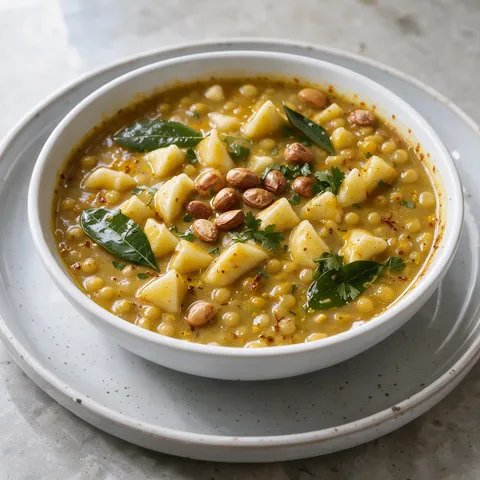 Dal Dhokli1 hr 1 min · Main course
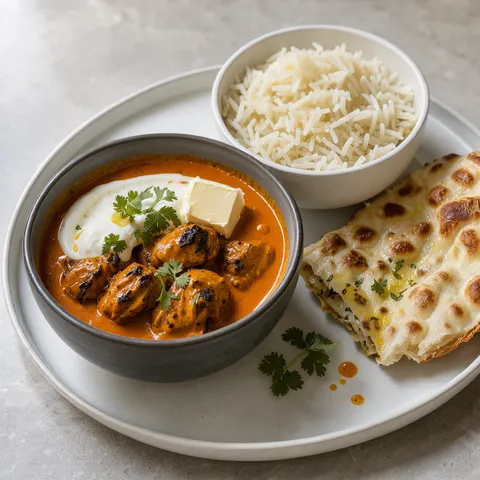 Indian Butter Chicken50 min · Main course
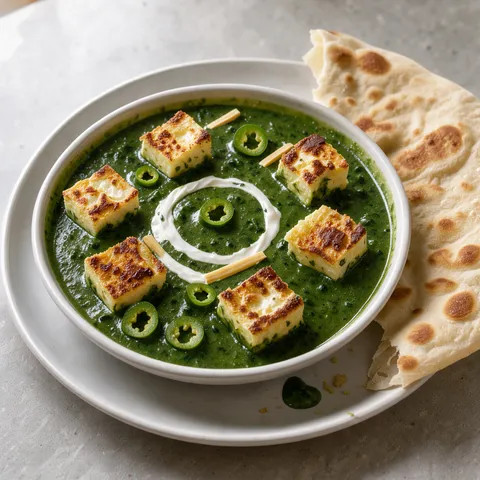 Spinach with Homemade Paneer45 min · Main course
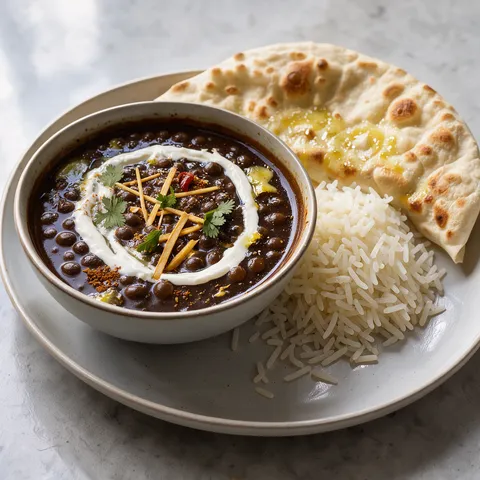 Black Lentil and Kidney Bean Stew1 hr 30 min · Main course
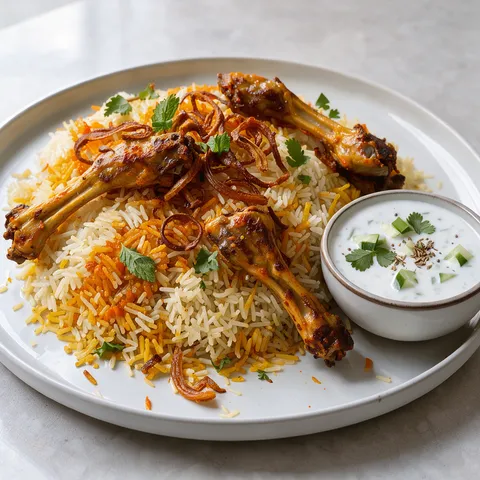 Chicken Dum Biryani1 hr 30 min · Main course
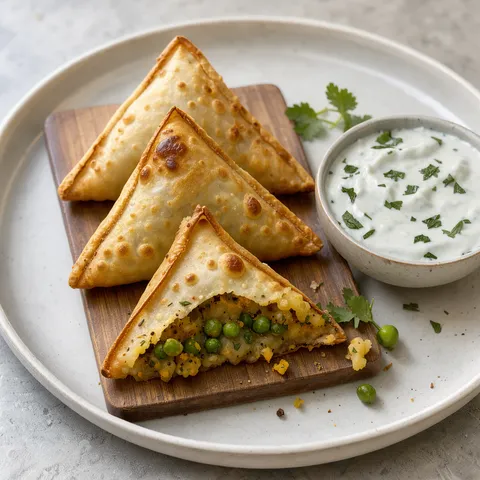 Indian Potato Pastries1 hr 30 min · Bread & pastry
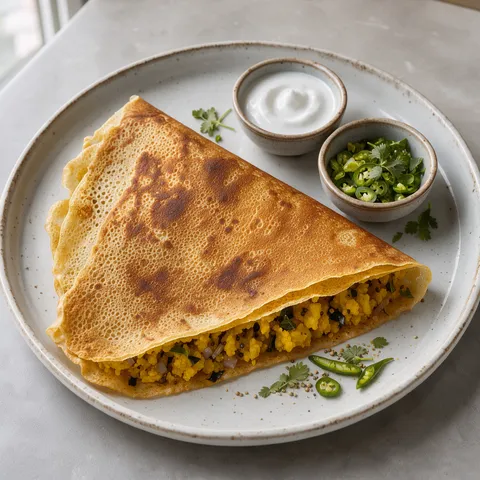 Fermented Rice Crêpes with Spiced Potato50 min · Bread & pastry