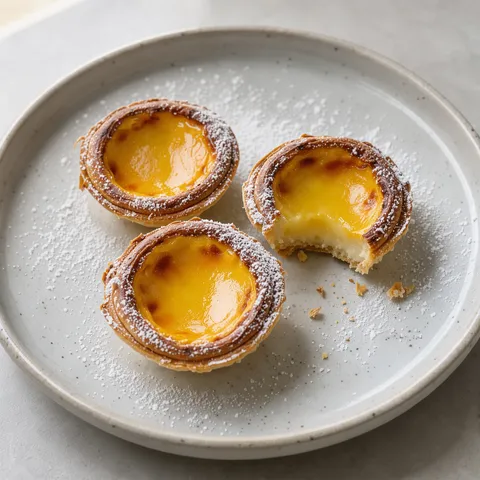
Hong Kong Egg Tarts Dan Tat
A Chinese dessert. Takes 1 hr 35 min, 12 pieces (4 servings). Difficulty: medium.
At a glance
- Total time
- 1 hr 35 min
- Serves
- 12 pieces (4 servings)
- Difficulty
- Medium
- Cuisine
- Chinese cuisine
- Dish type
- Dessert
- Diet
- Vegetarian
- Allergens
- Gluten, Milk, Eggs
Ingredients
Dough
- 200 g plain flour
- 50 g icing sugar
- 100 g cold butter (cubed)
- 1 egg yolk
- 2-3 tbsp cold water
- a pinch of salt
Custard
- 3 eggs
- 80 g sugar
- 200 ml hot water
- 60 ml milk
- 1 tsp vanilla extract
To serve
- 1 tbsp icing sugar
Equipment
- Mixing bowls
- Rolling pin / oklava
- Fine sieve / chinois
- Balloon whisk
- Oven
- Baking tray
- Tart tin
Method
- Rub in the butter: Mix the flour, icing sugar and salt in a bowl. Add the cold butter and rub it in with your fingertips to the consistency of breadcrumbs. If the butter melts and softens, the dough will not firm up, so your hands must be cold (~8 min)
- Bring the dough together: Add the egg yolk and 2 tbsp water and gather the dough together without kneading, adding 1 tbsp more water if it is dry. Shape into a flat disc and wrap in cling film. Overworking develops the gluten and makes the tart tough (~4 min)
- Rest: Rest the dough in the fridge for 30 min. Cold dough does not tear when rolled and does not shrink when baked (~30 min)
- Roll out and line the tin: Roll the dough out on a floured worktop with a rolling pin to 3 mm thick and cut 12 circles with a 9 cm round cutter or a glass. Press them into a greased 12-hole tart tin. Pull the edges neatly up with your fingers and prick the base with a fork to stop it puffing up (~10 min)
- Make the syrup: Dissolve the sugar completely in the hot water and add the milk and vanilla. Let the mixture cool slightly, because hot syrup would cook the eggs and make them lumpy. It should be warm to the touch (~4 min)
- Make the custard: Beat the eggs very gently with a fork or whisk without making them foamy. Slowly add the warm syrup to the eggs, stir and pass through a fine sieve twice. Sieving removes the egg strands and foam and gives a smooth surface (~5 min)
- Fill: Preheat the oven to 200°C. Ladle the custard into the 12 tart shells, leaving a 3 mm gap at the edge. Burst the bubbles on the surface with the tip of a spoon (~4 min)
- Bake: Put the tart tin on a baking tray on the bottom shelf of the oven and bake for 10 min. Then reduce the heat to 170°C and bake for 12-15 min until the centre of the custard wobbles slightly and the edges are set. Overbaked custard gets holes and turns rubbery (~25 min)
- Rest and plate: Rest the tarts in the tin for 5 min, then transfer to a rack. Serve warm or leave at room temperature, dusted lightly with icing sugar. The crust stays crisp as it cools (~5 min)
Chef's note
Hong Kong's famous dan tat is a take on the English custard tart that grew out of the Cantonese tea house tradition. The original recipe uses lard; here it is made with cold butter. There are two types of pastry: crumbly 'short' pastry (used here) and layered pastry. Sieving the custard and finishing at low heat give a smooth surface. Leftover dough can be made into biscuits.
Frequently asked questions
- What is the difference between dan tat and Portuguese pastel de nata?
- Dan tat has a smooth, yellow custard and a short, crumbly or flaky case. Pastel de nata has a caramelised, blistered top and a milk and starch custard.
- Why does the custard get holes or bubbles?
- It happens if the oven is too hot or the eggs are beaten too much. Finishing at a low heat and straining the custard prevents it.
- Can I make the pastry ahead?
- Yes, the dough keeps in the fridge for 2 days or in the freezer for 1 month. Thaw it in the fridge before rolling.
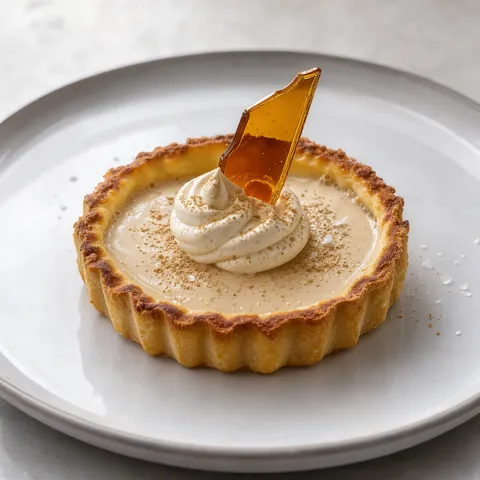 Hong Kong Egg Tarts 2.01 hr 23 min · Dessert
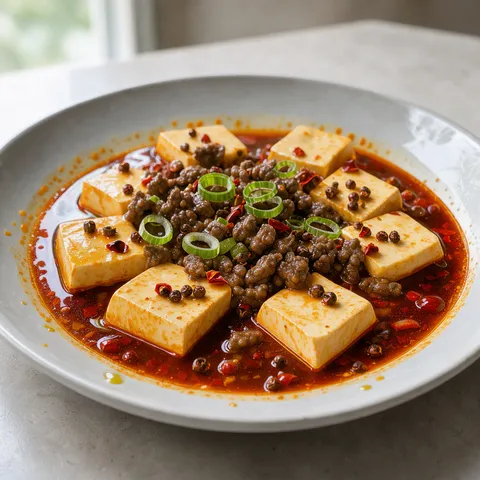 Mapo Tofu35 min · Main course
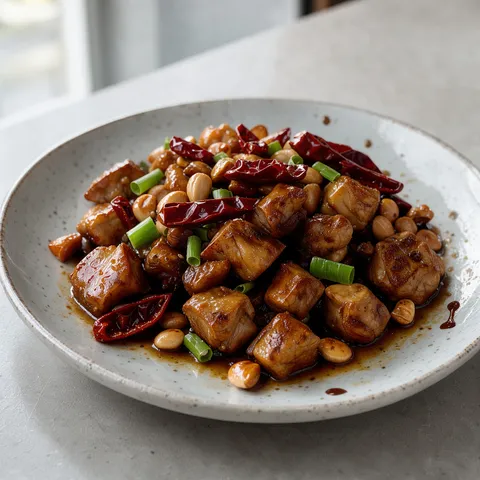 Kung Pao Chicken30 min · Main course
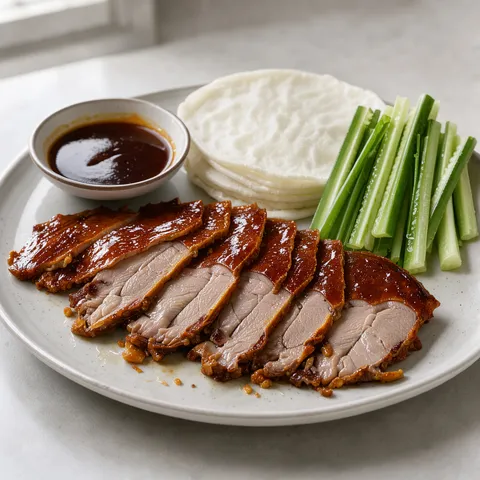 Peking Duck2 hr · Main course
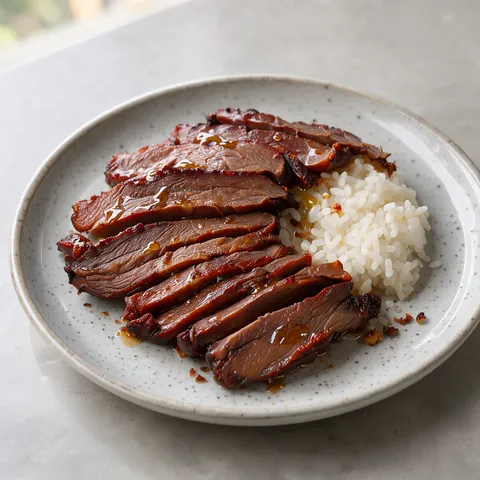 Char Siu1 hr · Main course
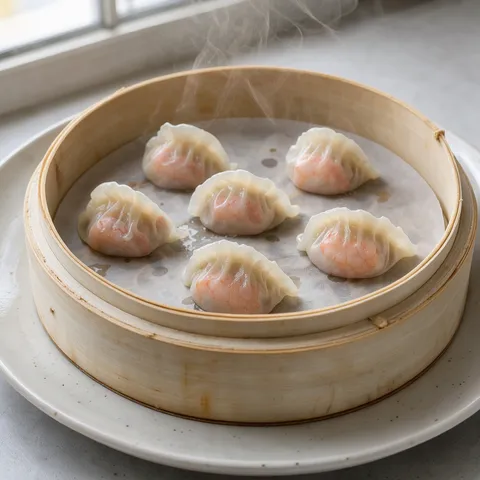 Crystal Prawn Dumplings1 hr 30 min · Starter
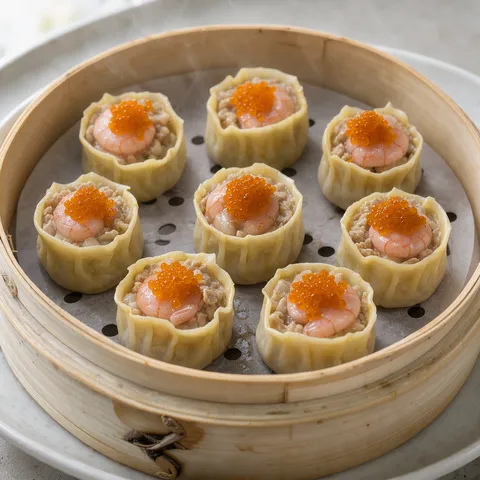 Open-Topped Dumplings50 min · Starter