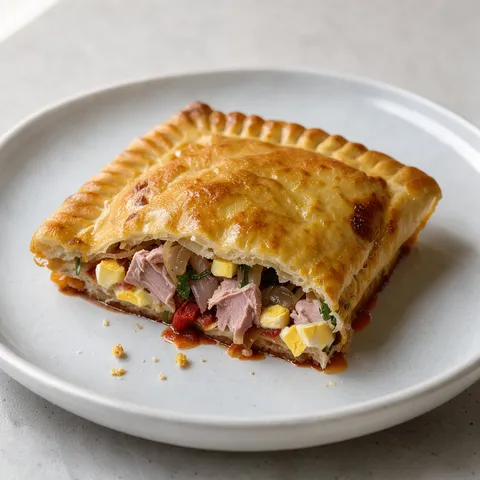
Galician Yeasted Tuna and Pepper Pie Empanada Gallega
A Spanish bread & pastry. Takes 3 hr 20 min, Serves 4. Difficulty: challenging.
At a glance
- Total time
- 3 hr 20 min
- Serves
- Serves 4
- Difficulty
- Challenging
- Cuisine
- Spanish cuisine
- Dish type
- Bread & pastry
- Allergens
- Gluten, Eggs, Fish
Ingredients
Sofrito
- 150 ml extra virgin olive oil
- 3 onions (about 500 g, thinly sliced)
- 2 romano peppers (about 300 g, cut into thin strips)
- 1 pale green Charleston pepper (about 80 g, cut into thin strips)
- 3 garlic cloves (finely chopped)
- 2 ripe tomatoes (about 200 g, grated)
- 1 tsp sweet paprika
- 1 tsp salt
Dough
- 560 g plain flour
- 8 g fast-action dried yeast
- 1 tsp salt
- 245 ml lukewarm water
- 90 ml sofrito oil (from above, drained off)
Filling
- 400 g fresh tuna or Atlantic bonito fillet (skinless, boneless)
- 1/2 tsp salt
- 2 eggs (to be hard-boiled)
For the tray and glaze
- 1 tsp extra virgin olive oil
- 1 egg
Equipment
- Sauté pan
- Colander
- Mixing bowls
- Saucepan
- Chef's knife
- Chopping board
- Box grater
- Baking tray
- Rolling pin / oklava
- Pastry brush
- Oven
- Silicone spatula
- Stand mixer (optional)
Method
- Cook the sofrito: Heat the 150 ml olive oil in a 30 cm wide sauté pan over medium-low heat. Add the onions and cook for 15 min, stirring now and then, until soft and sweet. Add the peppers and garlic and cook for another 10 min. Add the tomatoes and paprika and cook for 5-7 min, until the liquid has evaporated, then season with salt. The sofrito should be thick, sweet and oily, and the vegetables should not brown
- Drain and reserve the oil: Tip the sofrito into a colander set over a bowl and drain for 10 min. Reserve 90 ml of the red oil that drains off for the dough and leave the rest with the sofrito. This oil gives the dough colour and the aroma of sofrito: it is what gives Galician empanada its character
- Knead the dough: Mix the flour, yeast and salt in a large bowl. Add the lukewarm water and the 90 ml sofrito oil, cooled slightly. Knead by hand or with the dough hook of a stand mixer on medium speed for 8-10 min, until smooth, elastic and slightly oily. Cover the bowl and leave in a warm place for 50 min, until doubled in size
- Prepare the filling: While the dough rises, boil the eggs in boiling water for 10 min, transfer to cold water, then peel and chop roughly. Cut the fish into 2 cm cubes and season with salt. Gently mix the fish and eggs into the cooled sofrito. The fish goes in raw and cooks in the sofrito in the oven without drying out
- Divide and roll out the dough: Grease a 30×40 cm tray with the 1 tsp olive oil. Knock back the risen dough and divide it into two pieces, one about 550 g and the other 360 g. Roll out the larger piece on a floured worktop to 38×48 cm, about 3 mm thick, and lay it in the tray so it covers the base and sides and overhangs the top edge of the tray by about 2 cm. A 34×44 cm sheet isn't enough to cover the sides of the tray and leaves no overhang
- Fill and close: Spread the filling evenly over the base, leaving a 2 cm border. Roll out the smaller piece to 30×40 cm and lay it over the top. Fold the overhanging edge of the bottom sheet over the top one and twist it with your fingers into a rope-like braided edge, which stops the filling leaking. Cut a 2 cm hole in the centre as a steam vent. Decorate the top with thin strips made from the dough trimmings and prick the surface in a few places with a fork
- Rest and preheat the oven: Beat the egg for the glaze and brush it over the surface with a pastry brush. Rest the empanada for 15 min, during which the dough puffs slightly. Meanwhile, preheat the oven to 190°C (conventional)
- Bake: Put the tray on the lower-middle shelf of the oven and bake for 35-40 min. The top should be deep golden, and when you lift a corner with a spatula the underside should also be browned and firm. If the underside is pale, move the tray to the bottom shelf for 5 min
- Rest and slice: Rest the empanada in the tray for 15 min: if cut while hot, the filling runs. Cut into 12 squares with a sharp knife. Serve warm or at room temperature
Chef's note
In Galicia, empanada goes along to country fiestas, appears at Sunday tables and is carried on journeys, and it is eaten cold too. The most common filling is tuna or bonito, usually from a tin: here fresh tuna or Atlantic bonito is used instead. Scallop, sardine and chicken fillings are also common in the region. Adding the sofrito oil to the dough is the foundation of the tradition, so don't forget it. The flavour settles further the next day, and it keeps for 2 days in the fridge.
Frequently asked questions
- What if the base of the empanada stays pale?
- Move the tray to the bottom shelf for 5 minutes. When the top is deep golden, lift a corner with a spatula to check that the base is browned and firm as well.
- Why is the empanada not cut while hot?
- If it is cut while hot, the filling runs. So rest it on the tray for 15 minutes and then slice.
- Why is the sofrito oil added to the dough?
- This oil gives the dough colour and the aroma of the sofrito, which is the character of the Galician empanada.
 Cold Córdoba Tomato and Bread Soup25 min · Soup
 Spanish Potato Omelette1 hr 5 min · Main course
 Paella Valenciana1 hr 20 min · Main course
 Sizzling Garlic Prawns20 min · Starter
 Meatballs in Almond Sauce1 hr 10 min · Main course
 Catalan Burnt Cream35 min · Dessert