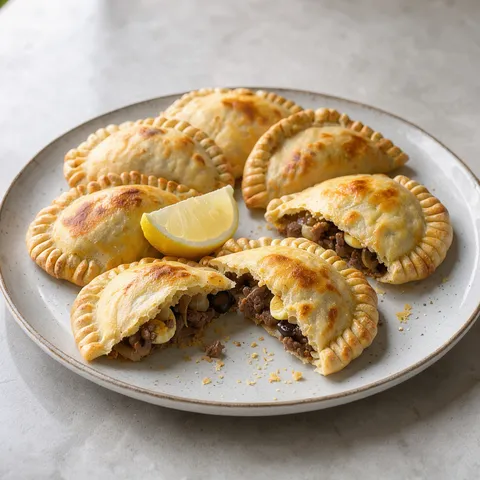
Chilean Beef and Onion Empanadas Empanadas de Pino
A Chilean meze. Takes 1 hr 30 min, Makes 24. Difficulty: medium.
At a glance
- Total time
- 1 hr 30 min
- Serves
- Makes 24
- Difficulty
- Medium
- Cuisine
- Chilean cuisine
- Dish type
- Meze
- Allergens
- Gluten, Milk, Eggs
Ingredients
- Dough (24 circles, about 14 g each): 200 g plain flour
- 50 g butter at room temperature
- 1 egg yolk
- 80 ml warm milk
- 1/2 tsp salt. Pino (24 pieces, about 12 g each): 220 g beef mince
- 200 g onions (3 mm dice)
- 1 tbsp sunflower oil
- 2 garlic cloves
- 1 tsp cumin
- 1 tsp sweet paprika
- 1/2 tsp chilli flakes
- 1/2 tsp dried oregano
- 3/4 tsp salt
- 1 tbsp plain flour
- 1 tbsp water
Filling pieces
- 3 eggs (boiled and each cut into 8 slices)
- 12 pitted black olives (halved)
- 24 raisins
Glaze
- 1 egg yolk
- 1 tbsp milk
Equipment
- Saucepan
- Sauté pan
- Mixing bowls
- Rolling pin / oklava
- Cake ring / food ring
- Baking tray
- Baking paper
- Oven
- Pastry brush
- Precision scales
Method
- Fry the pino: Heat the oil in a sauté pan over medium heat and fry the onion for 8 min, until soft and glassy. In Chilean pino the onion is almost the same quantity as the mince, because the sweetness of the onion carries the moisture and flavour of the filling. Add the mince and cook for 8 min, breaking it up with a spoon, until no liquid remains at the bottom of the pan. Add the garlic, cumin, paprika, chilli flakes, oregano and salt and fry for 1 min, sprinkle over the flour, stir in 1 tbsp water and cook for 1 min more. The flour binds the filling so that it does not soak the pastry. The filling should weigh about 300 g. While the mince cooks, boil the 3 eggs in a small pan for 9 min once the water boils, plunge into cold water, peel and cut each into 8 slices (~18 min)
- Cool the filling and knead the dough: Spread the pino thinly on a wide plate and leave for 20 min until it reaches room temperature. Hot filling softens the dough and tears it. Meanwhile, rub the flour, salt and butter between your fingertips in a bowl until like sand, add the yolk and warm milk and knead for 3 min. You get a smooth dough of about 350 g. Cover with cling film and rest for 20 min, because the relaxed gluten stops the dough shrinking back when rolled (~23 min)
- Roll out and cut: Roll the dough out on a floured worktop to 2 mm thick and cut 24 circles with a 9 cm cutter. About 13 g of dough goes into each circle. Gather the trimmings of about 40 g and re-roll once, as the dough turns tough the third time it is rolled. Keep the circles covered with a damp tea towel, because exposed edges dry out and will not seal (~8 min)
- Fill and seal: Put 12 g of pino in the middle of each circle, then 1 slice of egg, half an olive and 1 raisin. Wet the edge with a finger, fold the circle into a half-moon and press the edge with the back of a fork. Too much filling opens the edge and too little looks empty, so weigh the first three. In Chile the edge is crimped by hand, and pressing with a fork does the same job (~14 min)
- Glaze and arrange: Preheat the oven to 200°C (conventional). Arrange 12 on each of two 30×40 cm trays lined with baking paper: 3 columns × 4 rows, turning each row the opposite way to the one before and fitting them in a staggered (zigzag) pattern with 2 cm between them, because 9 cm half-moons set out in straight rows do not fit on the tray. Whisk the yolk and milk with a fork and brush over for a glossy golden colour. Make a hole in each empanada with the tip of a fork so the steam escapes and the edge does not burst (~4 min)
- Bake: Bake the two trays on the middle and top shelves of the oven at 200°C for 20 min, swapping the trays at 10 min. Test for doneness: the top is deep golden, the bottom crisp and no filling is leaking from the edge. At a low heat the dough stays dry and pale, and at a high heat the top burns before the mince is hot (~20 min)
- Rest and serve: Rest on the tray for 3 min so the steam of the filling escapes and the edge sets. Arrange on a flat ceramic plate with a lemon wedge alongside. They are best eaten in the first 10 min while hot, and the filling should not drop below 74°C (~3 min)
Chef's note
Serve hot. 2 per person, 120 people × 2 = 240 pieces. As the recipe makes 24, the multiplier is 240/24 = 10 (prepare 10.5 times with an allowance for waste: about 2.3 kg beef mince, 2.1 kg onions, 2.1 kg flour, 525 g butter, 32 eggs for boiling, 21 yolks for the dough and glaze, 20 trays: 10 rounds in an oven with 2 shelves). The original Chilean empanada is larger and uses fatty beef, and here it was scaled down to finger-food size. Raw filled empanadas can be frozen on a tray, bagged and kept for 1 month, and baked from frozen at 200°C for 25 min without thawing. Baked ones are refreshed in a 160°C oven for 8 min and kept hot at 70°C for no more than 20 min.
Frequently asked questions
- Why is the pino cooled before it goes onto the dough?
- Hot filling softens the dough and tears it. Spread the pino thinly and leave it for about 20 minutes until it reaches room temperature.
- Why is flour added to the pino?
- The flour binds the filling, so it doesn't make the dough soggy.
- Can leftover empanada dough be rolled out again?
- Leftover dough can be gathered and rolled out once more. By the third rolling the dough turns tough.
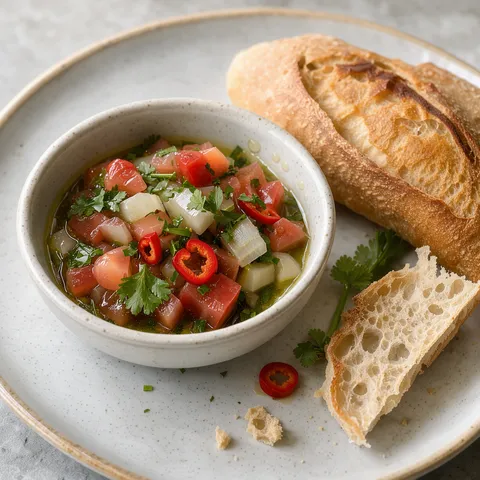 Chilean Tomato and Coriander Salsa20 min · Meze
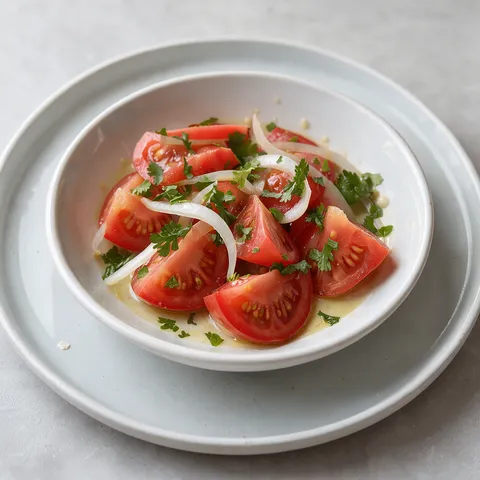 Chilean Tomato and Onion Salad20 min · Salad
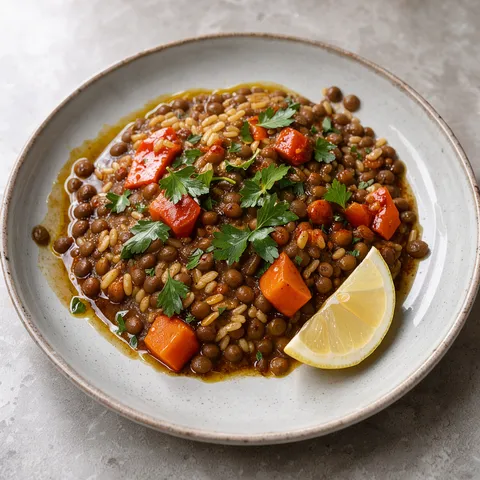 Chilean Lentil and Rice Stew49 min · Main course
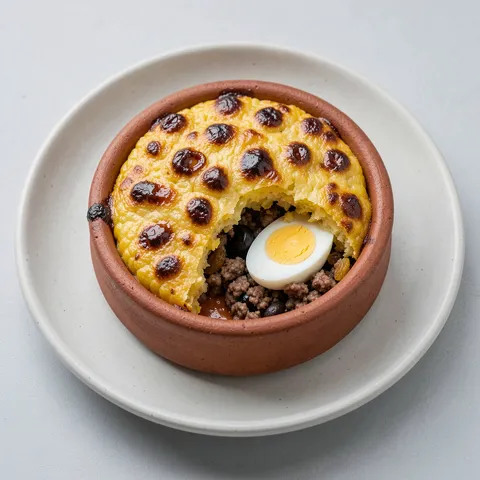 Chilean Beef and Sweetcorn Pie1 hr 40 min · Main course
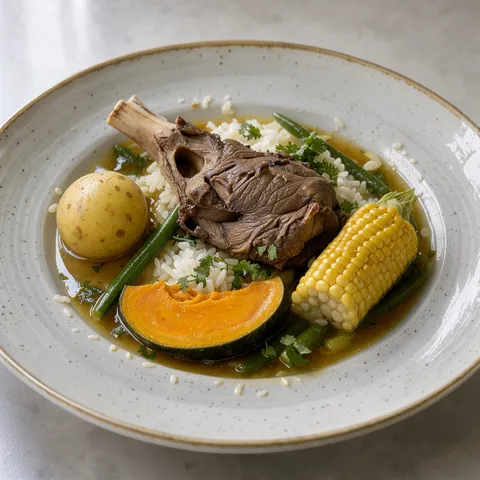 Chilean Beef and Vegetable Soup2 hr · Soup
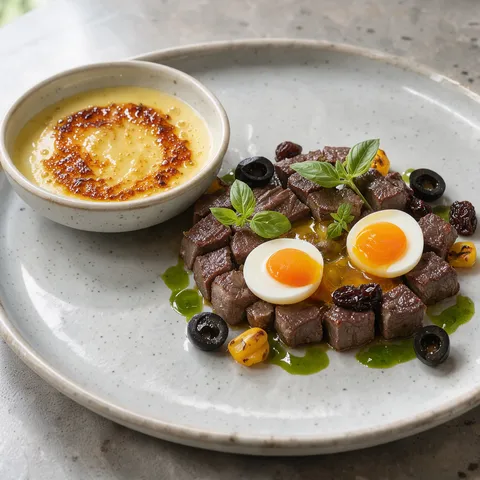 Pastel de Choclo 2.01 hr 25 min · Main course