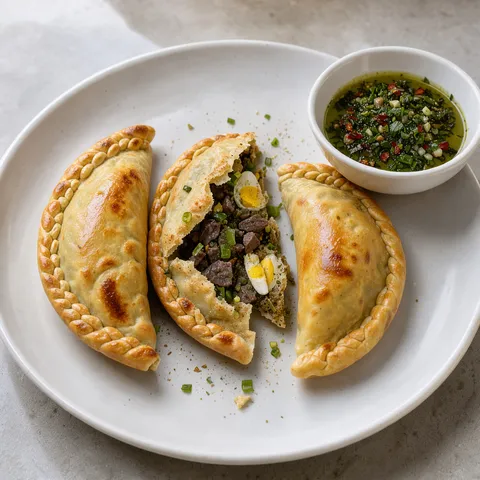
Argentine Knife-Cut Beef Empanadas Empanadas Tucumanas
An Argentinian bread & pastry. Takes 1 hr 50 min · +30 min resting, Serves 4. Difficulty: challenging.
At a glance
- Total time
- 1 hr 50 min · +30 min resting
- Serves
- Serves 4
- Difficulty
- Challenging
- Cuisine
- Argentinian cuisine
- Dish type
- Bread & pastry
- Allergens
- Gluten, Milk, Eggs, Celery
Ingredients
Dough
- 300 g plain flour
- 60 g beef suet (melted) or butter
- 130 ml warm water
- 3/4 tsp salt
Filling
- 500 g beef sirloin or topside (in one piece)
- 2 onions (finely chopped)
- 6 spring onions (whites and greens chopped separately)
- 40 g beef dripping or butter
- 1 tbsp sweet paprika
- 1 tsp cumin (ground)
- 1/2 tsp chilli flakes
- 100 ml Brown Beef Stock (Basics) or water
- 2 boiled eggs (finely chopped)
- 1 tsp salt
- 1/2 tsp black pepper
Topping
- 1 egg (beaten with 1 tbsp milk)
Equipment
- Mixing bowls
- Cling film
- Chef's knife
- Frying pan
- Baking tray
- Oven
- Baking paper
- Rolling pin / oklava
- Pastry brush
Method
- Knead the dough: Put the flour and salt in a bowl and make a well in the centre. Pour in the warm melted suet and rub it into the flour with your fingertips until it resembles sand. Add the warm water a little at a time, bring together, and knead on the work surface for 8 min, until smooth and elastic. Wrap in cling film and rest at room temperature for 30 min. The gluten relaxes and the dough rolls thin without springing back
- Cut the meat by knife: Trim the sinew and membranes from the meat, then use a chef's knife to cut it first into 5 mm strips, then into 5 mm cubes. This is the essence of the Tucumán style: meat put through a mincer is crushed and releases water, whereas knife-cut meat stays juicy and keeps some bite. If the meat is too soft, 20 min in the freezer makes cutting easier
- Cook the onions: Melt the dripping in a wide frying pan over medium heat. Cook the onions and spring onion whites for 10 min, until soft and translucent. Do not let them colour. Empanada filling wants sweet, juicy onions
- Sear the meat: Turn up the heat, add the meat and cook for 3-4 min, stirring, until the red has gone completely and the surface turns grey. Cubes cooked for longer turn tough, and the empanadas will be cooked a second time in the oven
- Season: Turn down the heat, add the sweet paprika, cumin, chilli flakes, salt and black pepper and stir for 30 sec. Add the stock and cook for 5 min, until the liquid has reduced by half and the filling is juicy but not running. Take off the heat and stir in the spring onion greens
- Cool the filling: Spread the filling on a large tray and cool it completely, first 10 min at room temperature, then 15-20 min in the fridge. Hot filling melts the fat in the dough, so the empanadas tear and lose their juices in the oven
- Roll out and cut the dough: Preheat the oven to 220°C and line a tray with baking paper. Divide the dough in two, roll out to 2-3 mm thick with a rolling pin and cut out 13 cm circles. You can gather the offcuts and roll them out once more. This makes 12 circles
- Fill and seal: Put 2 full tbsp of filling and a few pieces of boiled egg in the centre of each circle. Dab water on the edge with a finger, fold the dough in half to make a half-moon and press the edges to seal. Braid the edge into small folds with your thumb and forefinger to make a rope-like edge called a repulgue. This braid both seals the empanada and shows its region
- Bake: Arrange the empanadas on the tray and brush with the egg. Bake on the middle shelf of the oven for 15-18 min, until the tops are deep golden and the edges crisp
- Serve: Rest for 5 min so the hot juices inside settle a little. Serve hot, three empanadas per plate with the repulgue edges showing. The meat juices should run when you bite in, which is why in Tucumán they are eaten leaning forward
Chef's note
The traditional dough and filling are made with beef fat (grasa vacuna or grasa de pella); here beef suet is used, and butter works too. In Tucumán empanadas are traditionally baked in a stone oven or fried in beef fat. In the north-west, matambre (thin flank) is preferred to sirloin.
Frequently asked questions
- Why is the meat for Tucumán empanadas cut by knife rather than minced?
- Meat put through a mincer is crushed and releases water. Meat cut by knife into 5 mm cubes stays juicy and has bite.
- Why is the empanada filling cooled before filling?
- Hot filling melts the fat in the pastry, so the empanadas split in the oven and lose their juices. Cool the filling completely, first at room temperature and then in the fridge.
- Why is the empanada dough rested?
- Wrapped in cling film and rested for 30 minutes, the gluten relaxes. The dough then stretches thin without springing back and rolls easily to 2-3 mm.
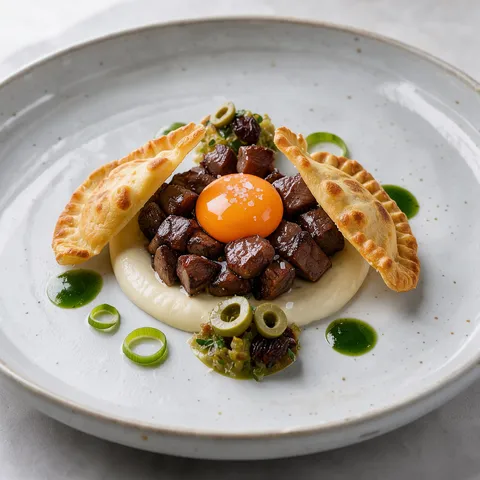 Empanadas Tucumanas 2.01 hr 25 min · Starter
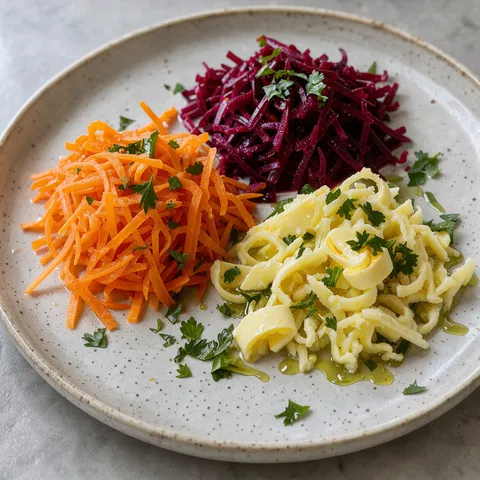 Argentine Three-Colour Grated Salad45 min · Salad
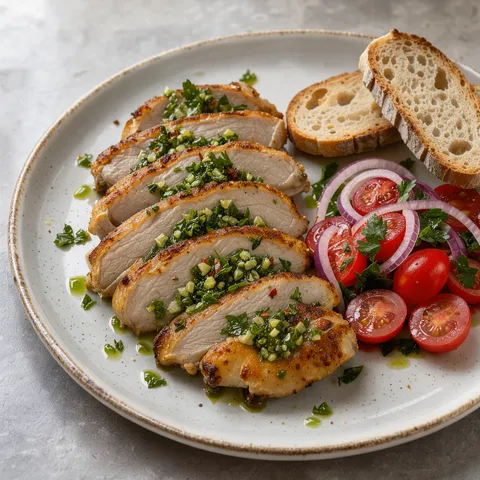 Argentine Pan-Fried Chicken with Chimichurri28 min · Main course
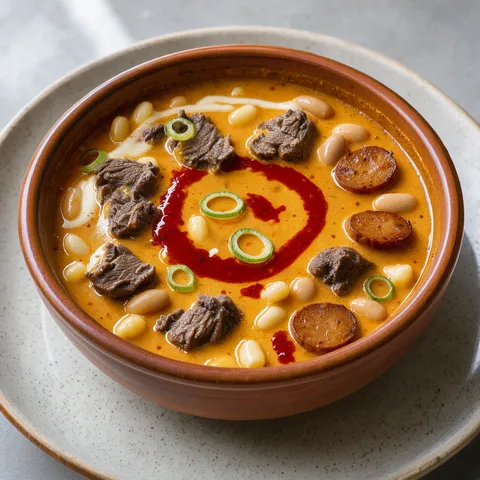 Argentine Corn and Pumpkin Stew2 hr 45 min · Main course
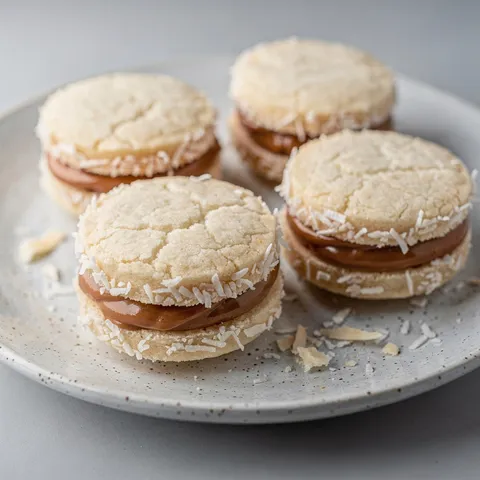 Dulce de Leche Sandwich Biscuits2 hr 15 min · Dessert
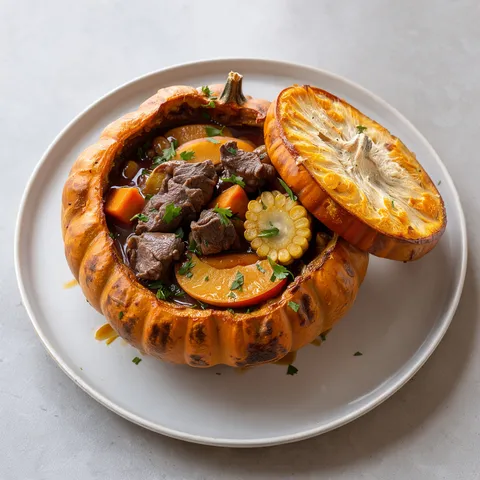 Pumpkin-Baked Beef and Fruit Stew2 hr 15 min · Main course
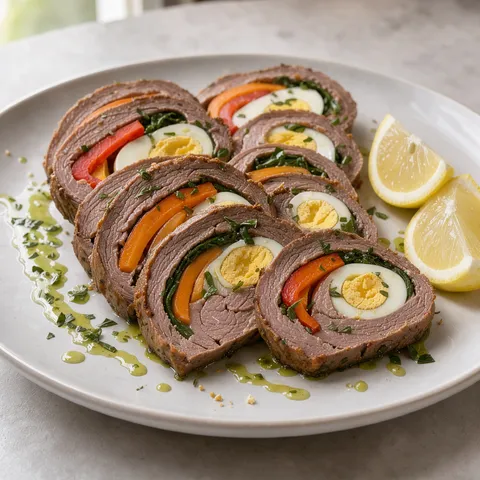 Stuffed Rolled Beef Flank3 hr · Starter