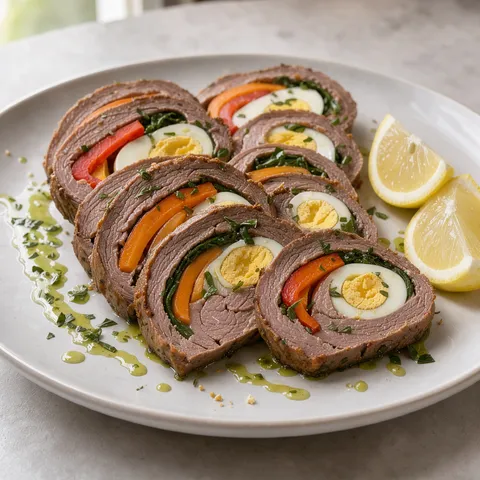
Stuffed Rolled Beef Flank Matambre Arrollado
An Argentinian starter. Takes 3 hr · +3 hr chilling (pressure cooker: ~2 hr 15 min), Serves 4. Difficulty: challenging.
At a glance
- Total time
- 3 hr · +3 hr chilling (pressure cooker: ~2 hr 15 min)
- Serves
- Serves 4
- Difficulty
- Challenging
- Cuisine
- Argentinian cuisine
- Dish type
- Starter
- Diet
- Gluten-free
- Allergens
- Milk, Eggs, Celery, Sulphites
Ingredients
Meat
- 1 beef matambre (thin flank, about 1 kg, a single 30×35 cm piece)
- 1 tsp salt
Rub
- 4 garlic cloves
- 30 g flat-leaf parsley leaves
- 1 tsp dried oregano
- 1/2 tsp chilli flakes
- 1/2 tsp black pepper
- 1 tbsp red wine vinegar
- 1 tbsp olive oil
Filling
- 3 eggs
- 2 carrots (cut lengthways into 1 cm sticks)
- 1 red romano pepper (cut into 1 cm strips)
- 150 g spinach leaves
- 40 g grated hard cheese (optional)
Poaching liquid
- 3 litres water
- 1 onion (halved)
- 1 carrot
- 1 celery stick
- 2 bay leaves
- 8 peppercorns
- 1 tbsp salt
Serving sauce
- 4 tbsp olive oil
- 1 tbsp red wine vinegar
- 2 tbsp chopped parsley
- a pinch of chilli flakes
- salt
- 1 lemon (sliced)
Equipment
- Chef's knife
- Chopping board
- Cling film
- Pestle and mortar
- Saucepan
- Mixing bowls
- Muslin
- Probe thermometer
- Baking tray
- Pressure cooker (optional)
Method
- Prepare the meat: Spread the matambre on a board and trim the tough membranes and excess fat from the surface with a thin knife. Open out the thick parts by cutting horizontally, like opening a book, then pound between two sheets of cling film with a meat mallet until the whole piece is an even 1 cm thick. Even thickness makes the whole roll cook at the same time. Note which way the grain runs, because this matters when rolling. Takes 10 min
- Make the rub: Crush the garlic with the salt in a mortar to a paste, add the finely chopped parsley, then crush and mix for 5 min with the oregano, chilli flakes, black pepper, vinegar and olive oil. Spread the rub over the inside of the meat right up to the edges and leave at room temperature for 15 min, so the salt and vinegar work into the surface
- Boil the eggs: In the meantime, lower the eggs into boiling water, boil for 10 min and plunge straight into iced water. Cold water stops the yolk turning green. Peel them and cut each lengthways into quarters
- Arrange the filling: Lay the spinach leaves in a single layer over the meat, leaving a 3 cm gap at the edges. Arrange the carrot sticks, pepper strips and egg quarters in rows parallel to the grain, towards the long axis of the roll, alternating the colours with 2-3 cm gaps between them, and scatter over the cheese. The rows of filling give a colourful mosaic in each slice. Takes 10 min
- Roll and tie: Roll the meat tightly towards you so that the grain runs along the length of the roll. You then slice across the grain, and the slices stay intact until you bite into them. Wrap the roll tightly in muslin, twist and knot the ends and tie with kitchen string every 3 cm. A roll that is not tied tightly opens while poaching and the filling escapes into the water. Takes 10 min
- Poach: Bring the ingredients for the poaching liquid to the boil in a large pan and lower in the roll. The water must cover the roll completely. Add hot water if necessary. Lower the heat and cook for 1 hr 30 min, so that only a few bubbles break the surface. It is ready when a skewer slides in and out easily and a thermometer reads 85°C in the middle. In a pressure cooker this drops to 45 min once it has reached pressure
- Cool in the liquid: Turn off the heat and leave the roll in its own liquid for 30 min. A roll taken out of the liquid early dries quickly and is fibrous on the outside, while one cooled in its liquid keeps its moisture
- Press and chill: Lift the roll, still in its muslin, onto a tray, put a flat tray on top and weigh down with 2 kg (jars filled with water). Chill in the fridge for at least 3 hr. The press closes the gaps, so in cross-section the filling and meat stick together and slice cleanly
- Make the serving sauce: Whisk the olive oil, vinegar, parsley, chilli flakes and salt in a bowl for 3 min. On the plate the sauce should glisten in droplets
- Slice: Remove the muslin and string and cut the roll into 1 cm slices in a single movement with a sharp knife. If you saw back and forth, the filling slips out of place. Takes 2 min
- Plate: Arrange the slices on a serving dish, cut side up, overlapping by half like fish scales. Drizzle the serving sauce over the slices and put the lemon slices at the side. Serve cold or at room temperature
Chef's note
Matambre is the name given in Argentina to the thin cut of meat between the skin and the ribs, and its name means "hunger killer". The rolled version is a cold starter on feast-day and birthday tables, and in many homes Russian salad is served with it. Ask your butcher for thin flank in one piece; a pierced piece tears when it is rolled. Making the roll a day ahead makes it even easier to slice.
Frequently asked questions
- Why is matambre rolled with the grain?
- The meat is rolled so the fibres run along the length of the roll. When slicing, you then cut across the fibres, and the slices don't fall apart or turn chewy.
- Why is boiled matambre pressed?
- Put a flat tray and 2 kg of weight on top and leave it in the fridge for at least 3 hours. Pressing closes the gaps, and in cross-section the filling and the meat stay stuck together.
- How do I stop the roll from coming undone while boiling?
- Wrap the roll tightly in muslin, knot the ends and tie it with kitchen string every 3 cm. A roll that isn't tied tightly comes undone and the filling escapes into the water.
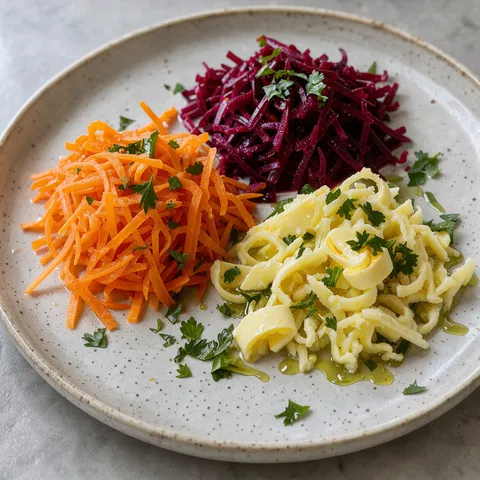 Argentine Three-Colour Grated Salad45 min · Salad
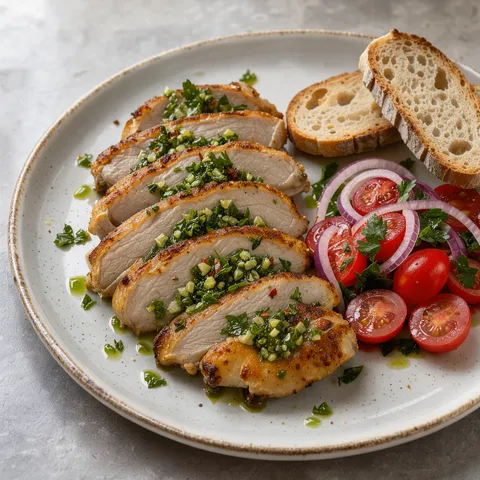 Argentine Pan-Fried Chicken with Chimichurri28 min · Main course
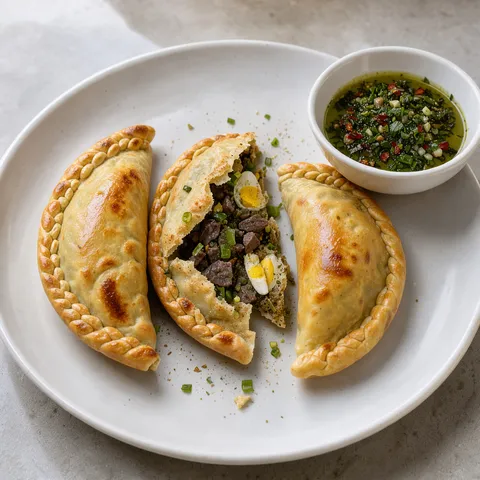 Argentine Knife-Cut Beef Empanadas1 hr 50 min · Bread & pastry
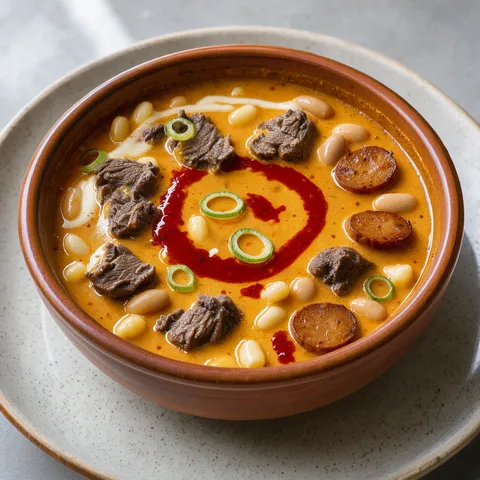 Argentine Corn and Pumpkin Stew2 hr 45 min · Main course
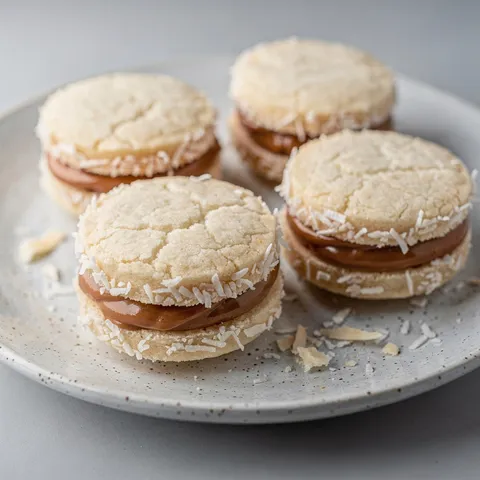 Dulce de Leche Sandwich Biscuits2 hr 15 min · Dessert
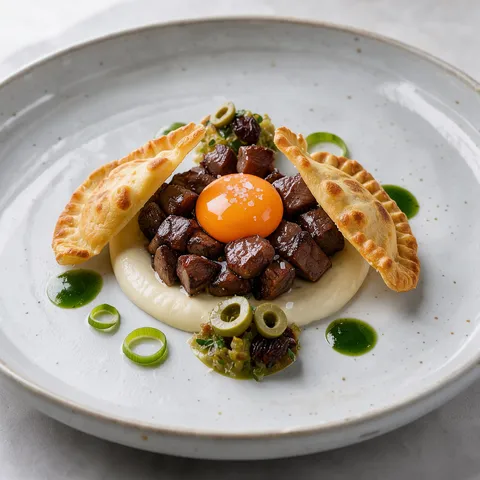 Empanadas Tucumanas 2.01 hr 25 min · Starter