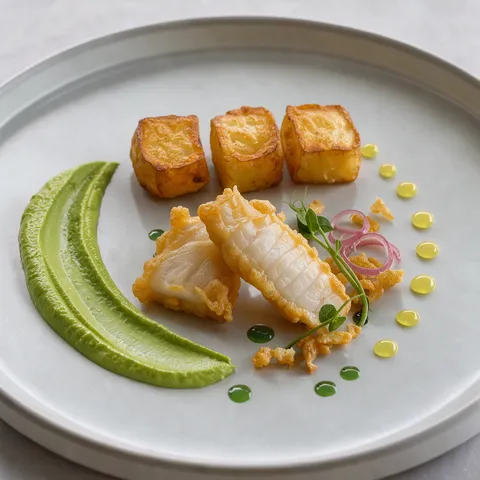
Fish and Chips 2.0
An English main course. Takes 1 hr 25 min, Serves 4. Difficulty: professional.
At a glance
- Total time
- 1 hr 25 min
- Serves
- Serves 4
- Difficulty
- Professional
- Cuisine
- English cuisine
- Dish type
- Main course
- Allergens
- Gluten, Milk, Eggs, Fish, Celery, Mustard, Sulphites
Ingredients
Fish
- 4 skinless cod loin fillets (160 g each, of even thickness)
- 8 g salt
- 4 g sugar
Beer batter
- 80 g plain flour
- 60 g rice flour
- 1 tsp baking powder
- 1/2 tsp salt
- 200 ml very cold lager
- 2 tbsp vodka (ice-cold)
Vinegar chips
- 800 g floury potatoes
- 1 litre water
- 100 ml malt vinegar
- 1 tbsp salt
- 2 litres sunflower oil for frying
- flaky salt
Malt vinegar powder
- 2 tbsp malt vinegar
- 15 g cornflour
Pea cream
- 300 g fresh or frozen peas
- 150 ml Vegetable Stock (Basics)
- 30 g butter
- 6 mint leaves
- salt
Mint oil
- 20 g mint leaves
- 10 g flat-leaf parsley leaves
- 80 ml neutral oil
Lemon gel
- 120 ml fresh lemon juice
- 80 ml water
- 40 g sugar
- 2 g agar
Tartare emulsion
- 120 g Homemade Mayonnaise (Basics)
- 1 tbsp capers
- 2 cornichons
- 1 shallot
- 1 tsp dill
To finish
- 1 shallot (Quick Pickles, Basics, in thin rings)
- fried batter crumbs (scraps)
- pea shoots
Equipment
- Saucepan
- Colander
- Heavy-based saucepan
- Probe thermometer
- Blender
- Fine sieve / chinois
- Muslin
- Squeezy bottle
- Balloon whisk
- Pestle and mortar
- Frying pan
- Mixing bowls
- Chef's knife
Method
- Cure the fish: Mix the salt and sugar and sprinkle evenly over both sides of the fillets. Leave in the fridge for 15 min, then rinse under cold water and pat completely dry with kitchen paper. The short cure firms the outer layer of the fish, stops it breaking into flakes as it fries and seasons it all the way through
- Boil the potatoes in vinegar: Peel the potatoes and cut them into neat 2×2×7 cm blocks. Bring the water, malt vinegar and salt to the boil, add the potatoes and boil for 6-7 min until the edges soften and just begin to break up. The vinegar firms the pectin on the surface of the potatoes so the blocks hold together, and carries the classic salt and vinegar flavour right into the potato. Lift out with a slotted spoon, arrange on a wire rack and leave for 10 min to steam off and dry
- Make the lemon gel: Mix the lemon juice, water, sugar and agar in a small saucepan, bring to the boil and cook for 1 min, whisking. Pour into a flat dish and leave to set in the fridge for 15-20 min. Once set, blend for 1 min to a glossy, squeezable gel and fill a squeeze bottle. The gel does the job of a lemon wedge, spreading the sharpness evenly through every bite
- Make the pea cream: Bring the vegetable stock to the boil, add the peas and cook for 3 min so they stay bright green. Blend the peas with half their liquid, the butter, mint and salt for 2 min until smooth, then press through a fine sieve. Cool straight away in a bowl set over a bowl of iced water so the colour doesn't turn olive green. It should be a thick cream that holds a trail when you draw a spoon through it
- Mint oil and tartare: Blend the mint and parsley with the oil for 2 min until the mixture warms to 70°C, then strain through muslin. You will get a clear, emerald-green oil. Very finely chop the capers, cornichons, shallot and dill, mix with the mayonnaise and transfer to a squeeze bottle
- First fry: Heat the oil to 130°C. Fry the dried potato blocks for 6-7 min without letting them colour, then transfer to a wire rack. The roughened surface gives a glassy crust in the second fry
- Whisk the batter: Mix the flour, rice flour, baking powder and salt. Add the cold beer and vodka and whisk just until combined. Vodka doesn't develop gluten the way water does and evaporates faster than water during frying. Together with the rice flour it gives a coating that is thinner and lighter than the classic and stays crisp for longer. Keep the batter in a bowl set in ice. For the malt vinegar powder, mix the cornflour and vinegar to a paste, spread thinly on a tray lined with baking paper and dry in a 100°C oven for 12-15 min until completely dry and brittle. It can stay in the oven while the fish fries
- Fry the fish and make the scraps: Raise the oil to 180°C. Dust the fillets lightly in flour, dip them in the batter, let the excess drip off and lower them into the oil away from you. Fry for 5-6 min until light golden: the centre of the fish should reach at least 60°C and the flesh should be white, juicy and flake easily. Transfer to a wire rack. Flick a few drops of batter into the same oil with your fingertips and fry for 1 min to make crisp scraps, then lift out with a slotted spoon
- Second fry: Raise the oil to 190°C and fry the potato blocks for 2-3 min until deep golden and glassy-crisp. Grind the dried vinegar pieces to a fine powder with a pestle and mortar and sprinkle over the chips with the flaky salt
- Plate: Put a spoonful of pea cream on the left of a warm plate and draw a thick arc with the back of the spoon in one stroke. Lean three potato blocks side by side in a neat row in the middle of the arc. Cut the fish fillet in half and lean the pieces against each other in front of the chips, cut sides showing. In the space on the right, pipe three dots of tartare emulsion of different sizes, with small dots of lemon gel between them
- Finish: Add a few drops of mint oil to the pea cream. Place the pickled shallot rings on the tartare dots and top the fish with a pinch of scraps and pea shoots. Serve at once: the coating is at its crispest within 5 min
Chef's note
Every part of the classic is here: fish, chips, peas, tartare, lemon and vinegar. What changes is the technique: cured fish, a lighter coating made with vodka and rice flour, chips boiled in vinegar, a sour powder instead of vinegar from the bottle on the table, and a gel instead of a lemon wedge. The batter scraps that chippies hand out for free are a childhood memory for the British, so they are back on the plate.
Frequently asked questions
- Why is vodka used in the batter?
- Vodka develops less gluten than water and evaporates faster than water during frying. Together with the rice flour, the coating turns thinner and lighter and stays crisp for longer.
- Why are the chip blocks boiled in vinegar water?
- The vinegar firms up the pectin on the outside of the potato so the blocks don't fall apart, and it carries the salt and vinegar flavour into the potato. The potatoes are then dried and fried in two stages.
- Why is the fish cured before frying?
- A short 15-minute cure with salt and sugar firms the outer layer of the fish, stops it flaking apart in the fryer and seasons it right through. Rinse it afterwards and dry it completely.
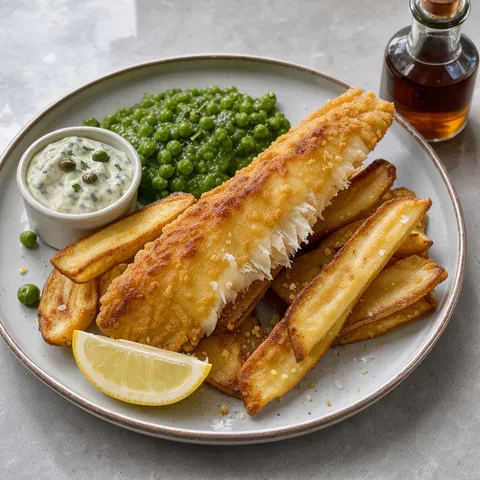 Fish and Chips1 hr 10 min · Main course
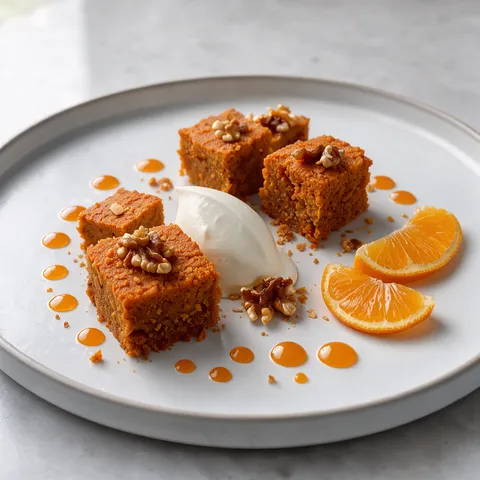 Deconstructed Carrot Cake1 hr 30 min · Dessert
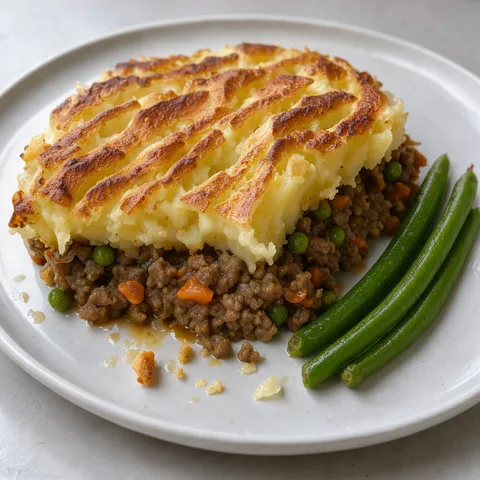 Shepherd's Pie1 hr 55 min · Main course
 Cornish Pasty2 hr · Bread & pastry
 Welsh Rarebit35 min · Starter
 Scones with Clotted Cream and Strawberry Jam50 min · Patisserie
 Sticky Toffee Pudding1 hr 15 min · Dessert