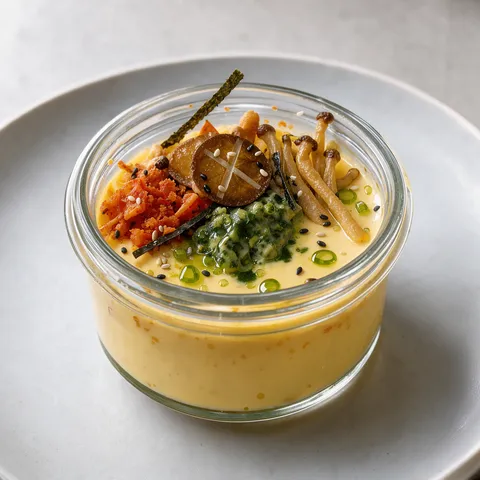
Gyeran-jjim 2.0
A Korean starter. Takes 52 min, Serves 4. Difficulty: challenging.
At a glance
- Total time
- 52 min
- Serves
- Serves 4
- Difficulty
- Challenging
- Cuisine
- Korean cuisine
- Dish type
- Starter
- Allergens
- Gluten, Milk, Eggs, Fish, Sesame, Soya
Ingredients
Egg custard
- 6 large eggs
- 300 ml Dried Anchovy Stock (Basics) (lukewarm)
- 2 tbsp milk
- 1/2 tsp salt
- 1 tsp light soy sauce
Fried mushrooms
- 120 g shiitake (thinly sliced)
- 100 g enoki (roots trimmed)
- 1 tbsp butter
- 1 tsp dark soy sauce
- 1 garlic clove
Crispy kimchi
- 100 g Kimchi (Basics) (squeezed well, finely chopped)
- 1 tbsp neutral oil
- 1/2 tsp sugar
Spring onion oil
- 3 spring onions (thinly sliced into rings)
- 60 ml neutral oil
- 1 tsp sesame oil
- 1/4 tsp salt
Ssamjang butter
- 1 tbsp Ssamjang (Basics)
- 30 g softened butter
Plate
- 1 sheet nori (thin strips)
- 1 tbsp toasted sesame seeds
- 4 small heatproof jars or bowls of 200 ml
Equipment
- Frying pan
- Saucepan
- Balloon whisk
- Fine sieve / chinois
- Mixing bowls
Method
- Fry the crispy kimchi (5 min): Squeeze the kimchi, discard the liquid and chop finely. Heat the oil in a wide pan over medium-high heat, add the kimchi and sugar and fry for 5 min, stirring often, until dry with crisp edges and a dark red colour. Dry kimchi adds firmness without spoiling the moisture of the steamed egg. Transfer to kitchen paper
- Fry the mushrooms (6 min): In the same pan, foam the butter, add the shiitake in a single layer, leave untouched for 3 min, then turn. Add the garlic, enoki and soy and cook for 2 min more. The mushrooms should be brown and crisp at the edges. Keep warm
- Make the spring onion oil (5 min): Heat the oil in a small pan over medium heat for 3 min, add the spring onion rings, wait 1 min for them to sizzle and take off the heat. Add the sesame oil and salt. The aroma opens fully as the oil cools, and the spring onion stays green and aromatic and does not fry
- Mix the ssamjang butter (3 min): Mash the ssamjang and softened butter in a bowl with a fork until smooth. The butter softens the saltiness of the fermented paste and melts over the egg. Keep chilled
- Prepare the egg custard (5 min): Whisk the eggs, anchovy stock, milk, salt and soy in a bowl with a whisk just until combined, without frothing. Pass through a fine sieve and divide between the jars, skimming off any foam with a spoon. The milk makes the texture creamier and silkier
- Set up the steam (4 min): Boil 3 cm of water in a large pan. Put the jars in (covered over the mouth with foil). The foil stops condensation dripping and keeps the surface smooth
- Steam (16 min): Set the heat to low-medium and leave the lid slightly ajar. Cook for 14-16 min, until the middle trembles slightly when shaken but does not ripple. The internal temperature should be at least 74°C, as leaving no raw egg is necessary for safety. Hard boiling gives a rubbery texture
- Place the ssamjang butter (4 min): Take the jars out and remove the foil. Put 1 tsp of ssamjang butter in the middle of each jar and wait 1 min for it to melt in the heat
- Plate (4 min): Put the jar in the middle of the serving plate. Top with the fried mushrooms and chopped crispy kimchi and drip 1 tsp of spring onion oil over. Scatter the nori strips and sesame seeds. Put a spoon beside it and serve at once
Chef's note
The silky egg texture of gyeran-jjim is kept, but anchovy stock and milk make it creamy, and the contrasts of texture are added with ssamjang butter, crispy kimchi, fried mushrooms and spring onion oil. It is not vegetarian because it contains anchovy stock (the classic version is vegetarian). If you cannot find Kimchi (Basics), well-fermented ready-made kimchi, squeezed, can be used. The egg must be fully cooked.
Frequently asked questions
- Why is the crispy kimchi fried until dry?
- Dry kimchi adds crunch without spoiling the moisture of the steamed egg. Squeeze it, chop it finely and fry until the edges are crisp and dark red.
- What does the milk do in the egg custard?
- The milk makes the texture creamier and silkier. Whisk the mixture only until combined, without making it frothy.
- How do I know the egg is fully cooked?
- When you shake the dish, the centre may wobble slightly but should not ripple, and the internal temperature should be at least 74°C. Boiling hard makes it rubbery.
 Korean Steamed Egg30 min · Side dish
 Bibimbap1 hr 15 min · Main course
 Kimchi3 hr · Side dish
 Bulgogi30 min · Main course
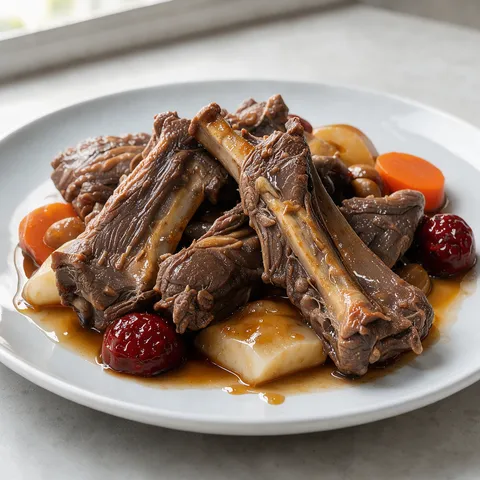 Korean Braised Short Ribs1 hr 30 min · Main course
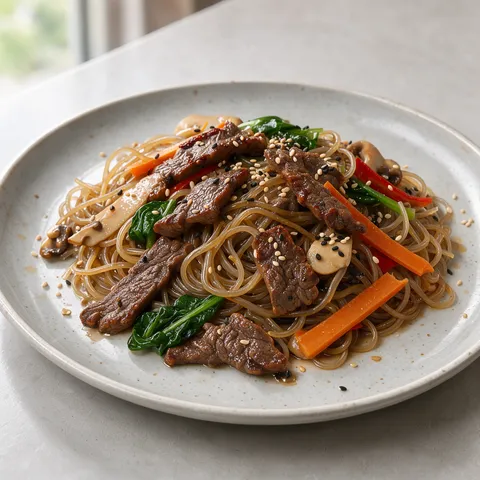 Korean Glass Noodles with Vegetables45 min · Main course
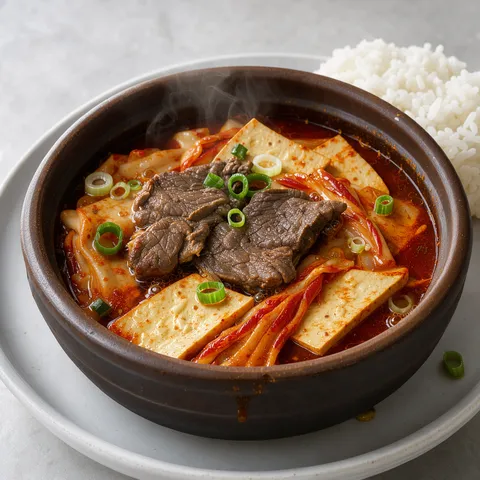 Kimchi Stew40 min · Soup