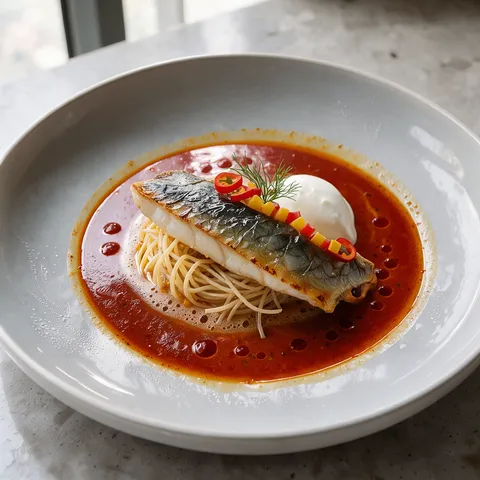
Halászlé 2.0
A Hungarian main course. Takes 1 hr 25 min, Serves 4. Difficulty: professional.
At a glance
- Total time
- 1 hr 25 min
- Serves
- Serves 4
- Difficulty
- Professional
- Cuisine
- Hungarian cuisine
- Dish type
- Main course
- Allergens
- Gluten, Milk, Eggs, Fish, Celery, Sulphites
Ingredients
Fish
- 4 skin-on zander or sea bass fillets (about 140 g each, pin-boned)
- 6 g salt
- 1 tbsp neutral oil
- 15 g butter
Paprika base
- 1 litre Fish Fumet (Basics)
- 2 medium onions (about 300 g, thinly sliced)
- 1 romano pepper (seeded, roughly chopped)
- 2 ripe tomatoes (roughly chopped)
- 20 g butter
- 2 tbsp sweet Hungarian paprika
- 1/2 tsp hot Hungarian paprika
- 1/2 tsp salt
- 1 tsp lemon juice
Paprika oil
- 80 ml sunflower oil
- 1 tbsp sweet Hungarian paprika
- 1/4 tsp hot Hungarian paprika
Matchstick noodles (gyufatészta)
- 100 g plain flour
- 1 egg
- a pinch of salt
- 1 tsp salt for boiling
Pepper and tomato brunoise
- 1 yellow romano or yellow Hungarian pepper (about 100 g)
- 1 tomato (about 120 g)
- 1 tsp cider vinegar
- a pinch of salt
Soured cream
- 80 g Crème Fraîche (Basics)
- 1 tsp lemon juice
- a pinch of salt
To finish
- 1 fresh red chilli (cut into thin rings)
- 8-10 dill fronds
- flaky salt
Equipment
- Plating tweezers
- Chef's knife
- Chopping board
- Heavy-based saucepan
- Cling film
- Saucepan
- Probe thermometer
- Muslin
- Fine sieve / chinois
- Mixing bowls
- Vegetable peeler
- Rolling pin / oklava
- Blender
- Oven
- Colander
- Cast-iron frying pan
- Silicone spatula
- Stick blender
- Balloon whisk
Method
- Prepare the fish (0-5 min): Check the fillets for bones one last time with tweezers. Scrape the skin with the back of a chef's knife to remove the moisture and pat dry with kitchen paper. Make 3-4 shallow cuts in the skin so it does not shrink and curl the fish as it cooks. Sprinkle salt on the flesh side and put the fillets in the fridge, skin side up, on an uncovered plate. Dry skin turns glassy and crisp in the pan
- Start the base (5-35 min): Soften the onion in the butter in a heavy-based saucepan for 5 min without letting it colour. Add the romano pepper and tomatoes and stir for 2 min. Take the pan off the heat and stir in the sweet and hot paprika so it does not burn. Pour in the fumet, return to the heat and simmer gently with the lid ajar for 25 min. The onion should melt completely. In a classic halászlé the base thickens as the fish heads and onion cook for a long time and are passed through a sieve. Here the fumet and melted onion give the same body in half an hour
- Noodle dough (5-12 min, alongside): Knead the flour, egg and salt for 5 min into a stiff dough. If the dough looks dry, add 1 tsp water. Wrap in cling film and rest for 20 min. The gluten relaxes and the dough rolls out very thinly
- Paprika oil (12-25 min): Heat the sunflower oil in a small saucepan to 60°C on a thermometer and take it off the heat. Add the sweet and hot paprika, stir and leave to infuse for 10 min. Strain through a fine sieve lined with muslin to leave a clear, ruby-coloured oil. If the oil is any hotter, the paprika darkens and turns bitter
- Brunoise and soured cream (25-35 min): Core the yellow pepper and cut it into 3 mm dice. Peel the tomato with a peeler, remove the seeds and cut the flesh into 3 mm dice. Mix the two with the vinegar and salt. Whisk the crème fraîche with the lemon juice and salt in a bowl and put it in the fridge
- Roll out and cut the noodles (32-45 min): Roll the dough out on a floured work surface with a rolling pin to 1 mm thick. Leave to dry for 5 min, then cut into 6 cm wide strips and cut the strips with a sharp knife into matchstick-thin noodles, 1-2 mm wide. Toss lightly with flour so they do not stick together. These thin noodles, which go into the soup in Baja-style halászlé, will make a nest on the plate
- Blend the base until smooth (35-45 min): Blend the cooked base for 1 min until completely smooth and press it through a fine sieve. You should have about 800 ml of velvety, bright red base. Keep it over low heat in a clean pan and adjust the salt and lemon
- Warm the plates and set up the station (45-60 min): Warm the deep plates in the oven set to 60°C. Bring salted water to the boil for the noodles, slice the chilli into thin rings, pick the dill fronds and keep the soured cream and brunoise ready by the plates. Once the fish comes out of the pan, the plate is assembled in 10 min
- Boil the noodles (60-63 min): Boil the noodles in salted boiling water for 2 min, drain in a colander, toss with 1 tsp of the paprika oil and keep warm, covered
- Cook the fish (63-73 min): Heat a cast-iron pan over medium-high heat and add the neutral oil. Lay the fillets in skin side down and press them lightly with a spatula for the first 30 sec so the skin sits flat on the pan. Cook without touching for 4-5 min, until two thirds of the flesh is opaque and the skin is crisp and golden. Turn, add the butter and spoon the foaming butter over the fish for 30-60 sec. Take it off when the internal temperature reaches 55-58°C on a thermometer and place skin side up on kitchen paper. At this temperature the zander stays juicy and flakes apart
- Froth the base (73-75 min): Take the base off the heat and blitz with a stick blender for 20 sec to form a light froth on the surface. On the plate, the froth holds the drops of paprika oil
- Plate (75-85 min): Twirl a quarter of the noodles with a fork into a small nest in the centre of a warm deep plate. Lay the fillet skin side up across the nest. Shape a dessertspoonful of soured cream into a quenelle with two spoons and place it beside the fish. Arrange the brunoise dice in a strip along the edge of the fish, add 3-4 chilli rings and the dill fronds and sprinkle flaky salt over the skin. Bring the base to the table in a hot jug, pour about 180 ml around the fish without touching the skin and add 8-10 drops of paprika oil to the surface
Chef's note
The paprika fish base of halászlé, the chilli and the thin noodles of the Baja style are kept, but crisp-skinned zander takes the place of the carp that breaks up in the soup. Zander is fogas, the famous fish of Lake Balaton. The base is built quickly with fumet and melted onion instead of long boiling. If zander is unavailable, use sea bass. If you use carp, score the skin at 3 mm intervals. Soured cream does not go into a classic halászlé. It is added here to soften the heat of the base.
Frequently asked questions
- How is the paprika oil made in Halaszle 2.0?
- Heat sunflower oil to 60°C, take it off the heat, add the sweet and hot paprika and infuse for 10 minutes. Once strained you are left with a clear, ruby-coloured oil. In hotter oil the paprika darkens and turns bitter.
- How do you get crisp fish skin in the pan?
- Dry the skin, make 3-4 shallow scores and lay the fillets skin-side down in the pan. Press gently with a spatula for the first 30 seconds. Dry skin turns glassy and crisp in the pan.
- Why is the noodle dough rested?
- Rest the dough for 20 minutes. The gluten relaxes and the dough can be rolled out paper-thin, to 1 mm.
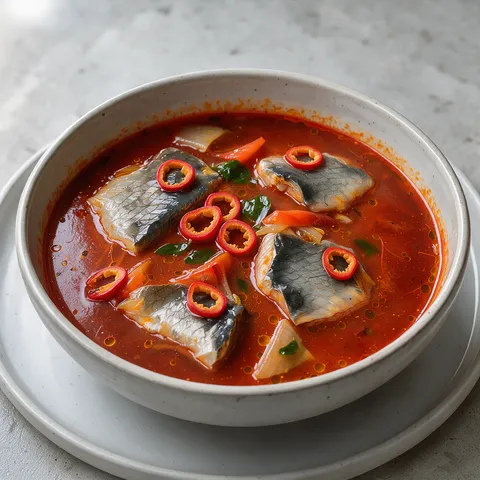 Hungarian Fisherman's Soup with Paprika1 hr 40 min · Soup
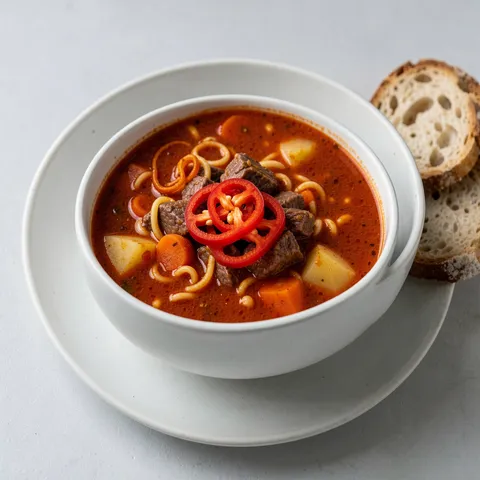 Hungarian Goulash Soup2 hr 5 min · Soup
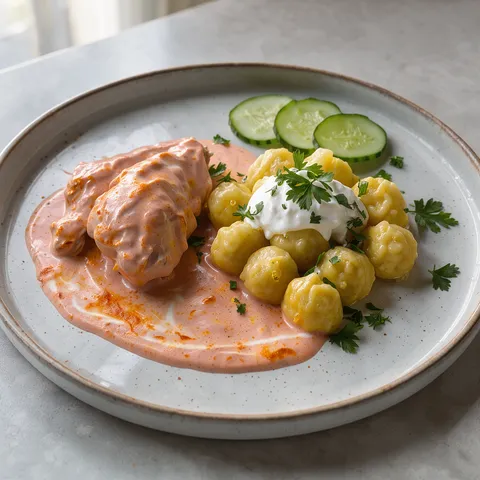 Csirkepaprikás with Nokedli1 hr 25 min · Main course
 Hungarian Fried Flatbread1 hr 15 min · Bread & pastry
 Hungarian Layered Sponge Trifle1 hr 30 min · Dessert
 Csirkepaprikás 2.01 hr 25 min · Main course
 Hungarian Pepper and Tomato Sauté with Eggs50 min · Starter