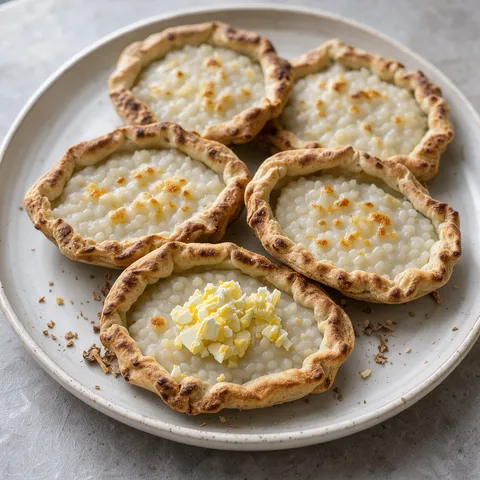
Karelian Rye Pasties with Rice Karjalanpiirakka
A Finnish bread & pastry. Takes 2 hr 10 min, Serves 4. Difficulty: challenging.
At a glance
- Total time
- 2 hr 10 min
- Serves
- Serves 4
- Difficulty
- Challenging
- Cuisine
- Finnish cuisine
- Dish type
- Bread & pastry
- Diet
- Vegetarian
- Allergens
- Gluten, Milk, Eggs
Ingredients
Rice porridge
- 200 g short-grain rice (pudding rice)
- 400 ml water
- 1 litre milk
- 30 g butter
- 1.5 tsp salt
Dough
- 200 g rye flour (plus 30 g for rolling)
- 50 g plain flour
- 180 ml water
- 1 tsp salt
For brushing
- 50 g butter
- 100 ml milk
Egg butter (munavoi)
- 4 eggs
- 100 g soft butter
- 1/4 tsp salt
Equipment
- Heavy-based saucepan
- Wooden spoon / spatula
- Mixing bowls
- Dough scraper
- Rolling pin / oklava
- Oven
- Baking tray
- Baking paper
- Saucepan
- Pastry brush
- Chef's knife
- Chopping board
Method
- Cook the porridge: Bring the rice and water to the boil in a heavy-based saucepan, then cook over low heat for 10 min until the water is absorbed. Add the milk and cook over low heat for 40-45 min, stirring often with a wooden spoon so it doesn't stick. The porridge should be very thick, so that a spoon stands up in it. Stir in the butter and salt, transfer to a bowl and let cool slightly for 15 min
- Knead the dough: While the porridge cooks, mix the rye flour, plain flour and salt, add the water and knead for 3 min until the dough is firm and slightly sticky. Rye dough doesn't stretch like wheat dough, so there's no need for long kneading. Shape into a log, divide into 20 equal pieces (about 21 g each) with a dough scraper and cover with a damp cloth
- Roll out the dough: Shape each piece into a ball, flatten it in your palm and roll out on a floured surface with a rolling pin to an almost translucent round 15 cm across and 1-2 mm thick. Stack the rounds with flour sprinkled between them and cover with a cloth: dried-out rye dough cracks when crimped
- Preheat the oven: Set the oven to 275°C (conventional) or its highest setting and preheat for at least 20 min. The pasties must bake quickly in a very hot oven: at a lower heat the crust turns hard
- Fill and crimp: Put 2 tbsp (about 60 g) lukewarm porridge in the centre of each round and spread it into an oval, leaving a 1.5 cm border. Fold the edges in from both sides over the porridge and pinch with your thumb and index finger to make pleats at 5-6 mm intervals. The porridge should stay exposed in the middle and the ends should be pointed
- Bake: Arrange the pasties ten to a tray on two trays lined with baking paper. Bake one tray at a time on the upper-middle shelf of the oven for 12-15 min. The crust edges should be speckled brown and the porridge should have golden patches here and there
- Brush: While they bake, heat the butter and milk in a small saucepan. Brush the pasties generously with this mixture using a pastry brush as soon as they come out of the oven. The hard rye crust softens as it absorbs the milk
- Rest: Cover the brushed pasties with baking paper and a clean tea towel and rest for 10 min: the crust softens completely
- Make the munavoi: While the pasties bake, boil the eggs in boiling water for 10 min, transfer to cold water and peel. Chop finely with a knife and mash together with the soft butter and salt using a fork
- Serve: Serve the pasties warm, spreading 1 tbsp munavoi over each
Chef's note
Karjalanpiirakka spread from Karelia across the whole of Finland and is now counted among the country's iconic foods. It is registered in the EU as a Traditional Speciality Guaranteed. There are also versions filled with mashed potato or barley porridge. Pudding rice works best: long-grain rice won't bind into a porridge. The rye flour shouldn't be coarsely ground: fine rye flour rolls out thinly. The pasties can be frozen and served after reheating in the oven at 200°C for 8 min.
Frequently asked questions
- Why are the pasties baked in a very hot oven?
- They need to bake quickly in a very hot oven. At a lower heat the dough turns hard.
- Why are the baked pasties brushed with milk and butter?
- The hard rye crust absorbs the milk and softens. Brush generously as soon as they come out of the oven, then rest them covered for 10 minutes.
- Why does rye dough crack?
- Dough that dries out cracks when folded. Dust the rolled circles with flour, stack them and cover with a cloth.
 Finnish Creamy Salmon and Potato Soup with Dill1 hr 10 min · Soup
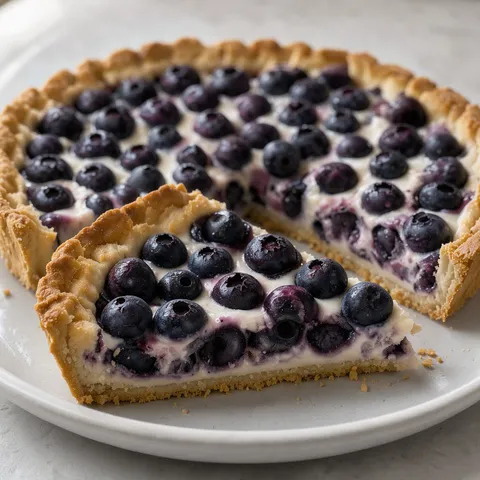 Finnish Blueberry Pie with Soured Cream1 hr 25 min · Patisserie
 Lohikeitto 2.01 hr 30 min · Main course
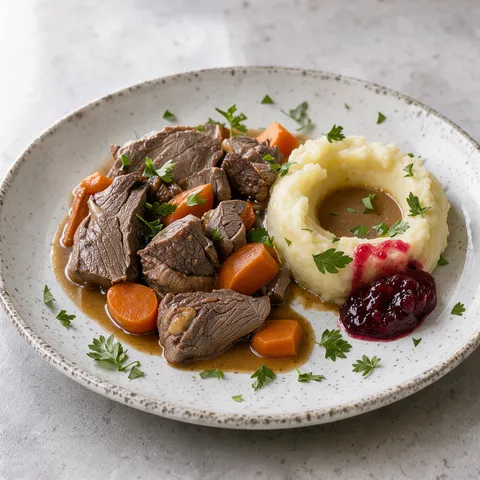 Karelian Braised Beef and Lamb3 hr 40 min · Main course
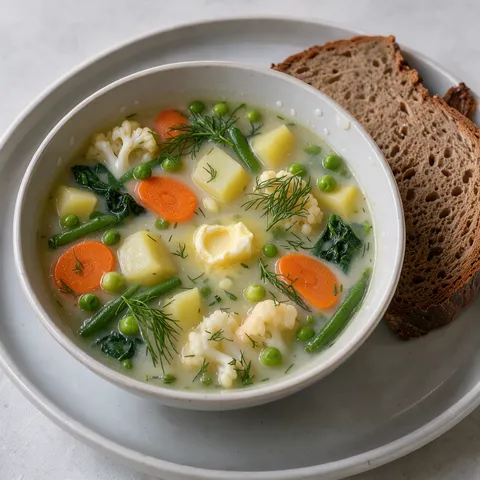 Finnish Summer Vegetable Soup with Dill45 min · Soup
 Finnish Baked Macaroni with Mince1 hr 20 min · Main course