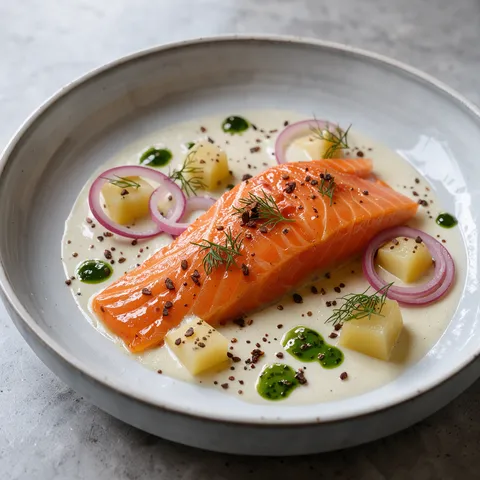
Lohikeitto 2.0
A Finnish main course. Takes 1 hr 30 min, Serves 4. Difficulty: challenging.
At a glance
- Total time
- 1 hr 30 min
- Serves
- Serves 4
- Difficulty
- Challenging
- Cuisine
- Finnish cuisine
- Dish type
- Main course
- Allergens
- Gluten, Milk, Fish, Celery, Sulphites
Ingredients
Fish stock
- 1 salmon head and frame (about 400 g, from the fishmonger)
- 1 litre water
- 1/2 onion
- 1 bay leaf
- 6 allspice berries
Salmon
- 4 pieces of salmon fillet (about 140 g each, skinless, an even thickness of about 2.5 cm)
- 1 tsp salt
Butter bath
- 300 g cold butter (diced)
- 60 ml water
Potato and leek cream
- 1 leek (about 200 g)
- 250 g waxy potatoes
- 15 g butter
- 500 ml fish stock (from above)
- 150 ml whipping cream (35% fat)
- 1/2 tsp salt
Potato cubes
- 200 g waxy potatoes
- 300 ml fish stock (from above)
Dill oil
- 1 bunch dill (about 40 g, with 12 tips set aside to garnish)
- 100 ml sunflower oil
Rye crumb
- 40 g rye flour
- 20 g rolled oats
- 20 g butter
- a pinch of salt
Quick pickle
- 1/2 red onion
- 50 ml cider vinegar
- 50 ml water
- 1 tbsp sugar
- 1/4 tsp salt
Equipment
- Saucepan
- Fine sieve / chinois
- Plating tweezers
- Mandoline
- Mixing bowls
- Blender
- Muslin
- Squeezy bottle
- Frying pan
- Sauté pan
- Balloon whisk
- Probe thermometer
- Chef's knife
- Chopping board
- Palette knife
Method
- Make the fish stock: Remove the gills from the salmon head and rinse the head and bones in cold water. Put in a saucepan with 1 litre water, the half onion, bay leaf and allspice. Bring to the boil, skim, then simmer over low heat for 20 min. Strain through a fine sieve: you should have about 800 ml, 500 ml for the cream and 300 ml for the potato cubes. The whole flavour of the classic lohikeitto relies on this stock, and here too it is the backbone of the plate
- Season the salmon: While the stock simmers, pull out any remaining pin bones from the fillets with tweezers. Salt each piece on both sides and leave in the fridge for 15 min, then blot off the liquid on the surface with kitchen paper. The short dry-salting firms the flesh and reduces the white protein seeping out during cooking
- Make the pickle: Slice the onion into 1 mm rings on a mandoline. Stir the vinegar, water, sugar and salt in a small bowl until the sugar dissolves, then add the onion. Leave for at least 20 min: the onion turns pink and loses its sharpness. It balances the creamy plate with a sharp acidity
- Make the dill oil: Set aside 12 fine dill tips for garnish. Blend the remaining dill, thick stalks included, with the sunflower oil at the highest speed for 2 min: the oil should warm slightly and turn deep green. Leave to drip through muslin into a bowl for 15 min. Don't press, or it turns cloudy. Transfer to a squeeze bottle
- Toast the rye crumb: In a dry frying pan, melt the butter over medium heat, add the rye flour, oats and salt and toast for 5-6 min, stirring constantly, until deep brown, crisp and smelling of toast. Spread on kitchen paper and let cool. It takes the place of the rye bread served with the soup on the Finnish table
- Cook the potato and leek cream: Wash the leek and slice into thin rings, then peel the 250 g potatoes and cut into 1 cm cubes. Sweat the leek in 15 g butter in a saucepan over medium-low heat for 5 min without colouring. Add the potato and 500 ml fish stock and cook with the lid ajar for 15 min until the potato falls apart. Add the cream and salt and boil for 2 min. Blend for 1 min and strain through a fine sieve back into the pan. It should be a silky cream that lightly coats the back of a spoon. Keep warm, covered, over the lowest heat
- Cook the potato cubes: Peel the 200 g potatoes and cut into neat 1 cm cubes. Bring 300 ml fish stock to the boil in a small saucepan, add the cubes and cook for 6-7 min until a knife goes in easily but the corners stay sharp. Turn off the heat and leave the cubes to keep warm in the stock. This way the potato pieces of the classic soup remain a separate texture on the plate
- Make the butter bath: Bring the 60 ml water to the boil in a narrow 20 cm sauté pan, then reduce to the lowest heat. Add the cold butter cubes one or two at a time, whisking constantly, and don't add more until each batch has melted and emulsified. You get a pale yellow, creamy, unsplit butter sauce. Keep the temperature between 55-60°C with a thermometer: above 65°C the emulsion breaks and the fat separates
- Cook the salmon gently: Lay the fillets in the butter bath in 2 batches, two at a time: four fillets won't fit in a 20 cm pan. The butter is about 1.3 cm deep and covers nearly the lower half of the fillet. Cook each batch for 8-9 min, constantly spooning butter over the top and keeping the temperature at 55-60°C. Lift the first batch onto a warm plate with a fish slice, bring the bath back to 55-60°C and cook the second batch. The internal temperature in the centre of the fillet should be 45-48°C: the flesh stays orange and glossy, ready to flake but not dried out at all. This is the measured version of the salmon cooked in the classic soup without boiling. Lift out carefully with a fish slice and drain on kitchen paper for 30 sec
- Plate: Pour 4-5 tbsp potato and leek cream into the centre of each warmed deep plate. Scatter a handful of drained potato cubes into the cream. Set the salmon in the centre on top of the cream and sprinkle with a pinch of flaky salt. Dot 8-10 drops of dill oil onto the surface of the cream, and top the salmon with 4-5 pickled onion rings and 3 dill tips. Scatter a pinch of rye crumb beside the salmon. Serve immediately
Chef's note
Every ingredient of lohikeitto has been taken apart and rebuilt here: the fish stock and cream became a silky potato and leek cream, the salmon a fillet gently cooked in a butter bath, and the dill a vivid oil. The rye bread served with the soup came onto the plate as toasted rye crumb. A thermometer is essential for the butter bath: if the temperature runs away, take the pan off the heat and wait. Trout fillet also works instead of salmon, and the cooking time drops to 6-8 min. The cream, dill oil and crumb can be made a few hours ahead. Salmon cooked at a low temperature stays glossy in the centre: if serving pregnant women, young children, older people or anyone with a weakened immune system, cook the fillet until the centre reaches 63°C. To do this, raise the bath to 75-80°C and cook for 12-14 min. As the butter sauce is not served, it doesn't matter if it splits. Use farmed salmon.
Frequently asked questions
- Why is the salmon cooked at 55-60°C in the butter bath?
- Above 65°C the emulsion splits and the fat separates. At this temperature the salmon stays orange and glossy and doesn't dry out. The internal temperature in the centre of the fillet should be 45-48°C.
- How is the fish stock made for lohikeitto?
- Rinse the salmon head and bones in cold water. Bring to the boil with the onion, bay and allspice, skim, then simmer gently for 20 minutes. Strain through a fine sieve to get about 800 ml.
- How do I stop the butter sauce splitting?
- Add the cold butter cubes one or two at a time and don't add the next until each batch has melted and emulsified. Whisk constantly to keep the temperature between 55-60°C.
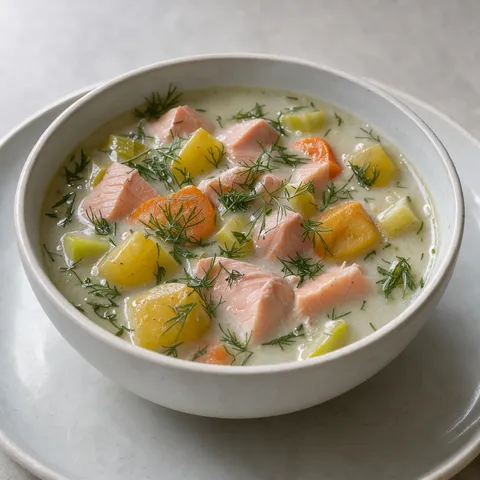 Finnish Creamy Salmon and Potato Soup with Dill1 hr 10 min · Soup
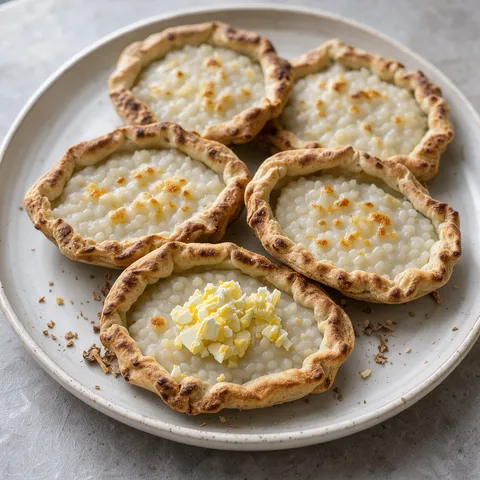 Karelian Rye Pasties with Rice2 hr 10 min · Bread & pastry
 Finnish Blueberry Pie with Soured Cream1 hr 25 min · Patisserie
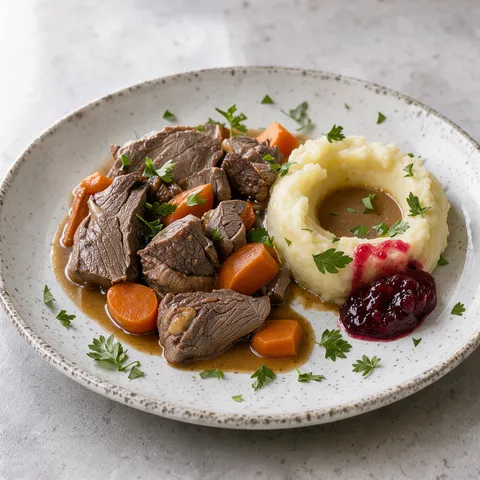 Karelian Braised Beef and Lamb3 hr 40 min · Main course
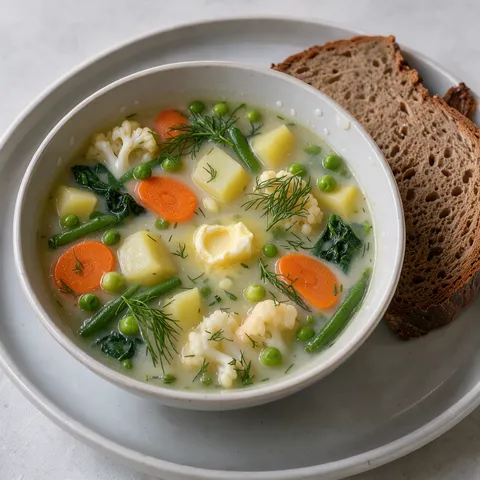 Finnish Summer Vegetable Soup with Dill45 min · Soup
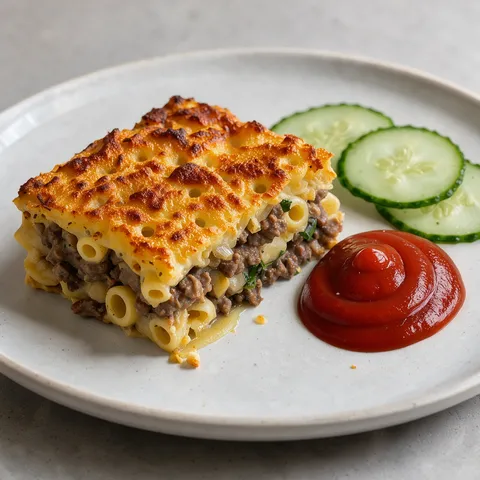 Finnish Baked Macaroni with Mince1 hr 20 min · Main course
 Finnish Cardamom and Cinnamon Ear Buns1 hr 10 min · Bread & pastry