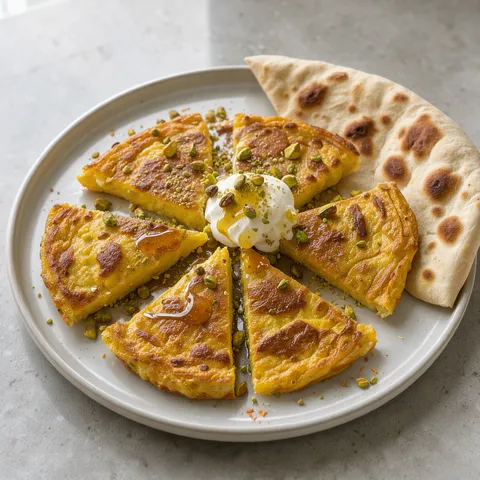
Persian Sweet Saffron Omelette Khagineh
An Iranian breakfast. Takes 13 min, Serves 4. Difficulty: medium.
At a glance
- Total time
- 13 min
- Serves
- Serves 4
- Difficulty
- Medium
- Cuisine
- Iranian cuisine
- Dish type
- Breakfast
- Allergens
- Gluten, Milk, Eggs
Ingredients
Omelette
- 8 eggs
- 3 tbsp caster sugar
- 1/2 tsp ground cardamom
- a pinch of saffron (threads)
- 2 tbsp hot water
- 1 tbsp rosewater
- a pinch of fine salt
- 2 tbsp butter
To serve
- 100 g clotted cream or strained yoghurt
- 2 tbsp honey
- 2 tbsp raw pistachios (roughly chopped)
- 4 slices warm bread (lavash or a thin flatbread)
Equipment
- Balloon whisk
- Mixing bowls
- Frying pan
- Silicone spatula
- Pestle and mortar
Method
- Steep the saffron: Grind the saffron threads to a fine powder in a mortar for 30 sec, mix with 2 tbsp hot water (about 80°C) and leave to steep for 5 min. Hot water brings out the colour and aroma of saffron, while boiling water drives off its aroma. Do the next two steps in these 5 min
- Whisk the egg mixture: Whisk the 8 eggs, 3 tbsp sugar, cardamom, rosewater and salt in a large bowl for 2 min, until the sugar dissolves and the mixture is one colour and lightly frothy. Add the saffron water and mix for 30 sec. If the sugar does not dissolve, the surface of the omelette gets brown spots
- Heat the pan: Heat a 26 cm non-stick pan over medium-low heat for 1 min, add 2 tbsp butter and when it melts and foams lightly, reduce the heat to low. Sugared egg burns quickly, so the butter should not turn brown
- Cook the omelette: Pour the egg mixture into the pan, cover and cook over low heat for 5 min. The edges should set and the surface almost firm, with the centre still slightly moist. Loosen the edges from the pan with a spatula, cover the pan with a large plate, flip, slide the omelette back into the pan and cook for 1 min more. If you do not want to flip it, add 1 min to the covered cooking, and the top sets with steam
- Prepare the pistachios and clotted cream: While the omelette cooks, roughly chop 2 tbsp pistachios with a knife. Put the clotted cream in a small bowl and soften it with a fork. Warm the bread in a dry pan or the oven for 1 min, as warm bread is essential for eating with the omelette
- Cut and plate: Lift the omelette from the pan onto a board and cut into 4 triangles with a knife. Put a slice of omelette on each plate with a spoonful of clotted cream and a piece of bread beside it. The edges of the slices should be golden and the inside moist and soft
- Finish and serve: Drizzle honey over the clotted cream, sprinkle the pistachios over the omelette and eat at once while hot. When it cools the egg firms and the aroma of cardamom is lost
Chef's note
Khagineh (xagine) is a sweet omelette eaten for breakfast in Iran, in which the eggs are cooked with sugar, cardamom, rosewater and saffron. The amount of sugar traditionally varies between 2 and 4 tbsp, and here 3 tbsp keeps it lightly sweet. Cooking the omelette over low heat prevents the sugar burning and the egg turning rubbery. The dish is vegetarian and contains egg and dairy. If you have no rosewater, it can be made with saffron alone.
Frequently asked questions
- Why not use boiling water to steep the saffron?
- Hot water at around 80°C releases the saffron's colour and aroma. Boiling water drives off its fragrance.
- Why does the Khagineh omelette get brown spots on top?
- The surface gets blotchy if the sugar has not fully dissolved. Whisk the egg mixture until the sugar dissolves and it is one even colour and slightly frothy.
- Can I cook the omelette without flipping it?
- Yes. Add 1 minute of covered cooking and the top sets in the steam.
 Iranian Spinach and Egg Skillet27 min · Main course
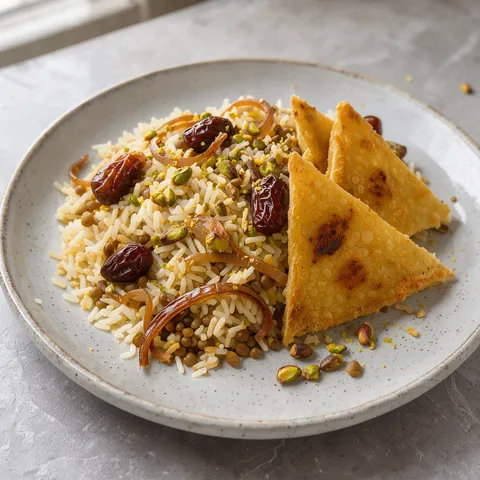 Iranian Lentil and Date Rice1 hr 43 min · Main course
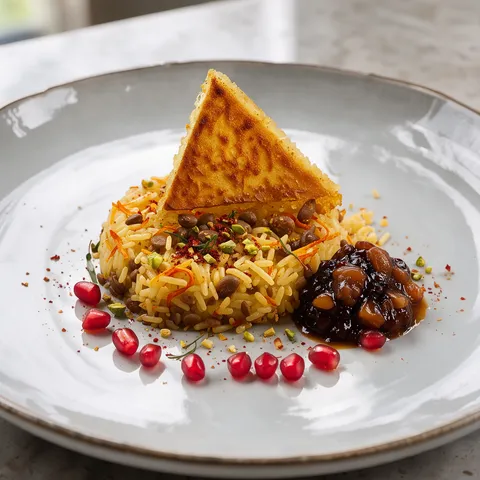 Adas Polo 2.01 hr 17 min · Main course
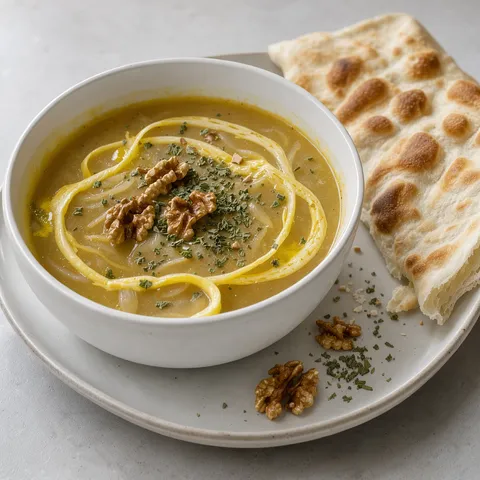 Iranian Onion and Fenugreek Soup27 min · Soup
 Gilan Chickpea and Beef Patties1 hr 32 min · Meze
 Iranian Potato Squares 5×5 cm1 hr 21 min · Meze