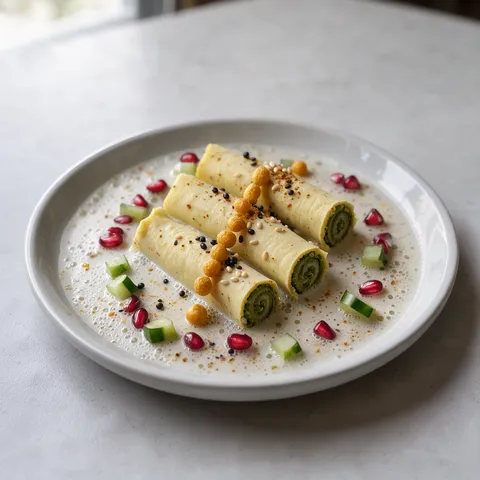
Khandvi 2.0
An Indian meze. Takes 1 hr 10 min, 12 rolls (4 servings). Difficulty: challenging.
At a glance
- Total time
- 1 hr 10 min
- Serves
- 12 rolls (4 servings)
- Difficulty
- Challenging
- Cuisine
- Indian cuisine
- Dish type
- Meze
- Allergens
- Gluten, Milk, Eggs, Tree nuts, Sesame, Mustard, Sulphites
Ingredients
Khandvi sheets
- 70 g gram flour (chickpea flour)
- 140 g plain yoghurt
- 280 ml water
- 1/2 tsp ground turmeric
- 3/4 tsp salt
- 1 green chilli and 1 cm piece of fresh ginger (pounded in a mortar)
For the surfaces
- 1 tsp sunflower oil
Green chutney filling
- 80 g freshly grated coconut
- 30 g fresh coriander (leaves and thin stalks)
- 10 g mint leaves
- 1 green chilli
- 1 tbsp lemon juice
- 1/2 tsp sugar
- 1/4 tsp salt
- 2-3 tbsp water
Spiced chaas (yoghurt drink)
- 250 g plain yoghurt
- 250 ml cold water
- 1/2 tsp cumin seeds
- 1 cm piece of fresh ginger
- 5 mint leaves
- 1/4 tsp salt
Crispy boondi
- 40 g gram flour
- 1/4 tsp ground turmeric
- a pinch of salt
- about 50 ml water
- 300 ml sunflower oil
Tadka
- 2 tbsp sunflower oil
- 1 tsp black mustard seeds
- 1 tbsp white sesame seeds
- 10 curry leaves (optional)
To finish
- 1/2 small cucumber (2 mm dice)
- 3 tbsp pomegranate seeds
- a few fresh coriander leaves
Equipment
- Baking tray
- Frying pan
- Pestle and mortar
- Blender
- Fine sieve / chinois
- Mixing bowls
- Balloon whisk
- Heavy-based saucepan
- Palette knife
- Probe thermometer
- Colander
- Paring knife
- Box grater (optional)
Method
- Plan the workflow and oil the surfaces: The order is: chaas, chutney, khandvi sheets, boondi, tadka, rolling and plating, 70 min in total. Lightly oil the undersides of 2 baking trays (30×40 cm) with 1 tsp oil. The khandvi batter must be spread the moment it is cooked, so the prep is done in advance
- Make the chaas: Toast the cumin in a dry frying pan for 1 min, until it darkens and smells fragrant, and grind it to a powder in a mortar. Blend the yoghurt, cold water, ground cumin, ginger, mint and salt in a blender for 30 sec. Strain through a fine sieve into a jug and put it in the fridge. It should be cold, frothy and lightly spiced, and it is poured into the bowl at the moment of serving
- Blend the green chutney: Rinse the blender and blend the coconut, coriander, mint, green chilli, lemon juice, sugar and salt with 2 tbsp water for 30-40 sec, adding another spoonful of water if needed. It should be a thick, spreadable paste, as a watery chutney slides out of the roll and soaks the sheet. Transfer to a bowl
- Cook the khandvi batter: In a bowl, whisk the yoghurt and water until smooth like buttermilk, then add the gram flour, turmeric, salt and chilli-ginger paste and whisk until lump-free. Strain through a fine sieve into a 24 cm heavy-based saucepan. Whisk constantly over medium-low heat for 8-10 min, sweeping the base. When the batter has become a glossy, heavy cream, spread a spoonful on a tray: if it rolls up smoothly after 1 min, it is ready
- Spread and cool: Immediately divide the batter in half, pour it onto the trays and spread with a palette knife in quick, long strokes into an even layer about 1.5 mm thick. Leave to cool at room temperature for 10 min. Spreading it thinner than classic khandvi makes the filled rolls look elegant and layered
- Fry the boondi: While the sheets cool, whisk the gram flour, turmeric and salt with the water to a runny batter with the consistency of a pancake batter. Heat the 300 ml oil (about 1.5 cm deep) in a small 16 cm saucepan to 175°C on a thermometer. Hold a slotted spoon 10 cm above the oil, pour a spoonful of batter onto it and push it through the holes into the oil with the back of a spoon. Fry the pearl-sized drops for 1-1.5 min, until the sizzling dies down and they are crisp but not dark, then lift onto kitchen paper with a second slotted spoon. The batter makes two batches
- Make the tadka crumb: Heat the 2 tbsp oil in a small frying pan over medium-high heat and let the mustard seeds pop for 20-30 sec, then add the sesame seeds and curry leaves and stir for 20 sec, until the sesame is light golden. Take off the heat, add the boondi to the pan and stir. The tadka poured over classic khandvi becomes a crisp crumb here
- Cut, fill and roll: With a paring knife, trim 1 cm from the edges of each sheet, then cut 6 rectangles of 13×12 cm from each tray, 12 sheets in total, and discard the edge offcuts. Spread 1 tsp chutney thinly and evenly over each rectangle with a palette knife, leaving 1 cm clear at one end. Roll up tightly starting from a 12 cm side, finishing with the clear edge underneath. You will have rolls 13 cm long and about 2 cm across. Trim the ends straight with a sharp knife
- Plate: Place 3 rolls side by side, slightly apart, in the centre of a cold, shallow bowl. Scatter the cucumber dice and pomegranate seeds around the rolls, lay a strip of tadka crumb over the rolls and arrange the coriander leaves on top
- Pour the chaas and serve: At the table, pour the cold chaas from the jug down the side of the bowl until it comes halfway up the rolls, about 100 ml per bowl. Serve immediately: the boondi is crisp for the first few minutes and softens as it soaks up the chaas
Chef's note
The thin gram flour sheet, mustard seed tadka, coconut and coriander of classic khandvi are kept intact here. The innovation lies in the structure and temperature: the rolls are filled with the green chutney of the Gujarati table, the tadka becomes a crumb with crisp boondi, and the spiced chaas drunk at the end of a Gujarati meal is poured into the bowl like a cold soup. If you have no curry leaves, leave them out. Grate fresh coconut on a grater.
Frequently asked questions
- How do you know when khandvi batter is ready?
- The batter should be a glossy, heavy cream. If a spoonful spread on the tray rolls up smoothly after 1 minute, it is ready.
- Why should the green chutney be thick?
- A runny chutney slides off the roll and soaks the plate. So make it a thick, spreadable paste.
- Why does the boondi soften after serving?
- Boondi is crisp in the first minutes and softens as it soaks up the chaas. So the chaas is poured at the table and served straight away.
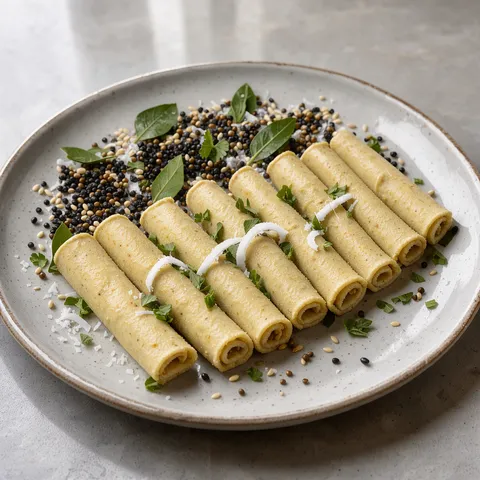 Gujarati Gram Flour and Yoghurt Rolls45 min · Meze
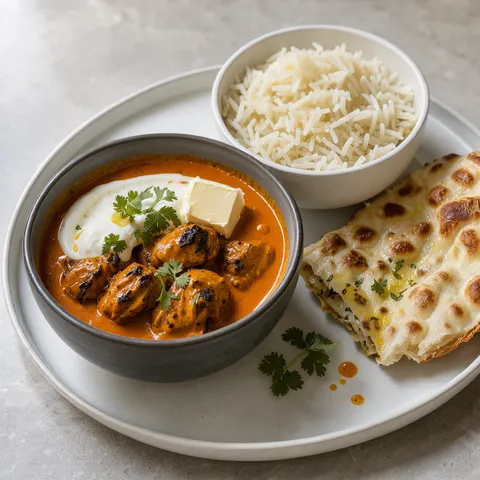 Indian Butter Chicken50 min · Main course
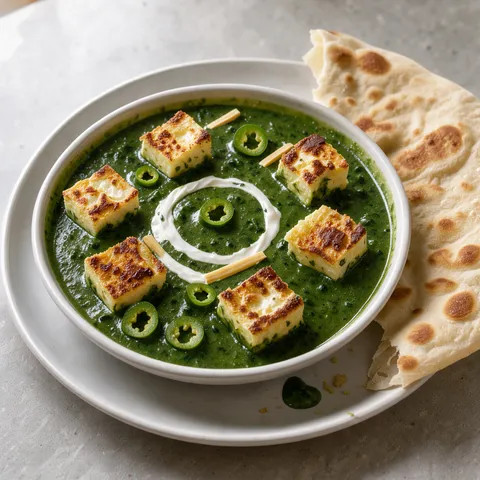 Spinach with Homemade Paneer45 min · Main course
 Black Lentil and Kidney Bean Stew1 hr 30 min · Main course
 Chicken Dum Biryani1 hr 30 min · Main course
 Indian Potato Pastries1 hr 30 min · Bread & pastry
 Fermented Rice Crêpes with Spiced Potato50 min · Bread & pastry